







Undersea Communication Network Vulnerable to Sabotage and Deliberate Damage
New research by Elisabeth Braw highlights the increasing risks to subsea cables, which carry most of the world's internet traffic.
The world's undersea communication network is facing a growing threat from sabotage and deliberate damage, according to new research that highlights the vulnerability of these critical infrastructure links.
Most of the world's internet traffic still travels through subsea cables, which crisscross the ocean floors alongside oil and gas pipelines and submarine power cables. The increasing risks to this invisible infrastructure beneath the waves are the focus of a new book by Elisabeth Braw, a senior fellow at the Atlantic Council.
Braw's research suggests that while human error during fishing and shipping activities is still the main cause of undersea cable damage, accounting for around 60 percent of incidents. This can occur when weighted nets or anchors drag across the seabed, causing damage to cables and pipelines.
In addition to human error, natural hazards such as storms and undersea landslides also contribute to cable damage. According to Braw's estimates, between 150 and 200 cables are damaged each year, with most being repaired quickly.
However, international tension and open conflict have led to increased scrutiny of cable-cutting incidents. Governments are now investigating and prosecuting crews for allegedly causing deliberate damage to subsea cables. One notable example is the "Christmas Day massacre in 2024, when a Russian-linked oil tanker dragged its anchor across the seabed for 56 miles, cutting or damaging four data cables.
The incident was particularly significant because it affected a submarine power cable connecting the Baltic and Nordic power grids. This type of infrastructure is critical to maintaining reliable electricity supplies in the region.
Another recent example cited by Braw is the Yi Peng 3, a Chinese cargo ship that damaged two data cables in the Baltic region just one month before the Christmas Day massacre. The crew was not prosecuted by European authorities.
The Finnish government has attempted to prosecute three senior officers of the Eagle S, the Russian-linked oil tanker involved in the Christmas Day massacre". This case highlights the growing concern about the intentional damage of undersea cables and pipelines.
The breakdown in international cooperation to protect undersea infrastructure has raised concerns about the security and stability of global communication networks.
In recent years, several incidents have highlighted the vulnerability of these critical systems. For instance, a Chinese-owned ship was convicted of severing an undersea telecommunications cable off Taiwan's coast in 2025, prompting the island democracy to amend its laws to increase penalties for intentional damage.
The Strait of Hormuz has also become a contentious area, with Iran attempting to impose fees on operators of undersea cables that traverse this strategic waterway. This move has been met with resistance from other countries, which argue that it undermines international agreements and sets a precedent for other nations to follow suit.
A joint operation between the UK, Norway, and the US recently confronted Russian submarines in Arctic waters near Norway's Svalbard archipelago. The aim of this mission was to detect and deter any potential threat to undersea cables, which are increasingly being used by Russia as a means to exert influence over global communication networks.
Experts warn that the erosion of international cooperation on protecting undersea infrastructure is a worrying trend. According to analysts, the current system, which relies on countries adhering to voluntary guidelines and agreements, may no longer be effective in preventing intentional damage.
One key factor contributing to this breakdown is the growing recognition of the strategic importance of subsea cables and pipelines. These critical systems are now seen as essential components of modern economies, with billions of dollars worth of data and financial transactions passing through them every day.
The loss of just one minute's worth of communication would have significant operational losses and financial implications for major hubs like New York City and its surrounding areas. This has made subsea cables a prized target for nations seeking to disrupt global supply chains or gain leverage over their adversaries.
In the absence of a unified international framework, countries may resort to unilateral actions to protect their interests, further exacerbating tensions and instability in the region.
The increasing importance of subsea cables has made them a prime target for malicious actors. Unlike during the Cold War era, when telephone cables were scarce and international communication was limited, modern societies rely heavily on these underwater networks to function.
In contrast to the past, today's world is characterized by declining commitment to upholding international agreements. The United Nations Convention on the Law of the Sea, adopted in 1982, aimed to establish rules for the use of the world's oceans. However, key countries are now showing less willingness to adhere to these principles.
The shift towards non-military means of weakening adversaries has created a new landscape where subsea cables have become an attractive target. Russia has been at the forefront of this strategy, using underhanded tactics to disrupt its opponents' communications infrastructure.
Recent reports suggest that NATO countries thwarted a Russian attempt to sabotage undersea cables in the spring. While details about this incident remain scarce, it highlights the growing concern surrounding subsea cable security.
The dependence on subsea cables is not just limited to domestic territories but extends across international waters where countries have no jurisdiction. As these cables crisscross the globe, connecting nations and facilitating global communication, their vulnerability has become a pressing issue.
The fact that subsea cables traverse the world's oceans underscores the need for cooperation among nations to protect this critical infrastructure. The oceans are considered a global commons, requiring international responsibility and stewardship to prevent damage and ensure continued functionality.
As tensions rise and countries prioritize their interests, the risk of unilateral actions against subsea cables grows, further destabilizing an already volatile region. This escalating threat requires urgent attention from governments, industries, and international organizations to develop effective countermeasures.
Merchant vessels have been causing concern in recent years by dragging their anchors across the seafloor, damaging subsea cables in various regions around the world. This has happened multiple times in the Baltic Sea, off the coast of Norway, and in Taiwanese waters, resulting in significant anxiety for affected countries and substantial repair costs for operators.
The incidents have raised questions about the competence of seafarers, as dragging an anchor is not a common occurrence that should go unnoticed. Typically, crew members are aware of their vessel's position on the seabed and the location of cables beneath them. However, in these cases, anchors were left to drag for extended periods, causing significant damage.
The cause behind these incidents remains unknown, and it may never be determined as seafarers are unlikely to disclose what happened. The incidents themselves were deemed suspicious due to their frequency and severity.
The situation has taken a more ominous turn with the emergence of reports suggesting that Russia and other countries might develop tools to intentionally damage subsea cables using submarines or unmanned vessels equipped with gadgets or drones.
Russia's research vessels have been spotted loitering around subsea cables, sparking concerns about their intentions. The presence of these vessels raises questions about what they are measuring or researching in the area where the cables are located.
China has also been observed sending research vessels to other countries' waters without informing them of their activities or the nature of their research. This lack of transparency has led to suspicions about China's true motives for conducting research in these areas.
The increase in geopolitical tensions and the rapid expansion of submarine fleets, both in the West and among major powers like Russia and China, have created a volatile environment that heightens concerns about subsea cable security.
As global reliance on subsea cables continues to grow, the need for effective countermeasures to prevent intentional damage has become increasingly pressing. This escalating threat requires urgent attention from governments, industries, and international organizations to develop strategies for protecting these critical infrastructure assets.
The escalating tensions in the Persian Gulf have significant implications for global communication networks. The region is home to a critical infrastructure asset: subsea cables that connect countries across the world, including a third of India's westbound internet traffic.
These cables are not just vital for the countries directly connected by them but also for nearby nations relying on their connectivity. Their importance cannot be overstated, especially in an era where digital communication has become increasingly indispensable.
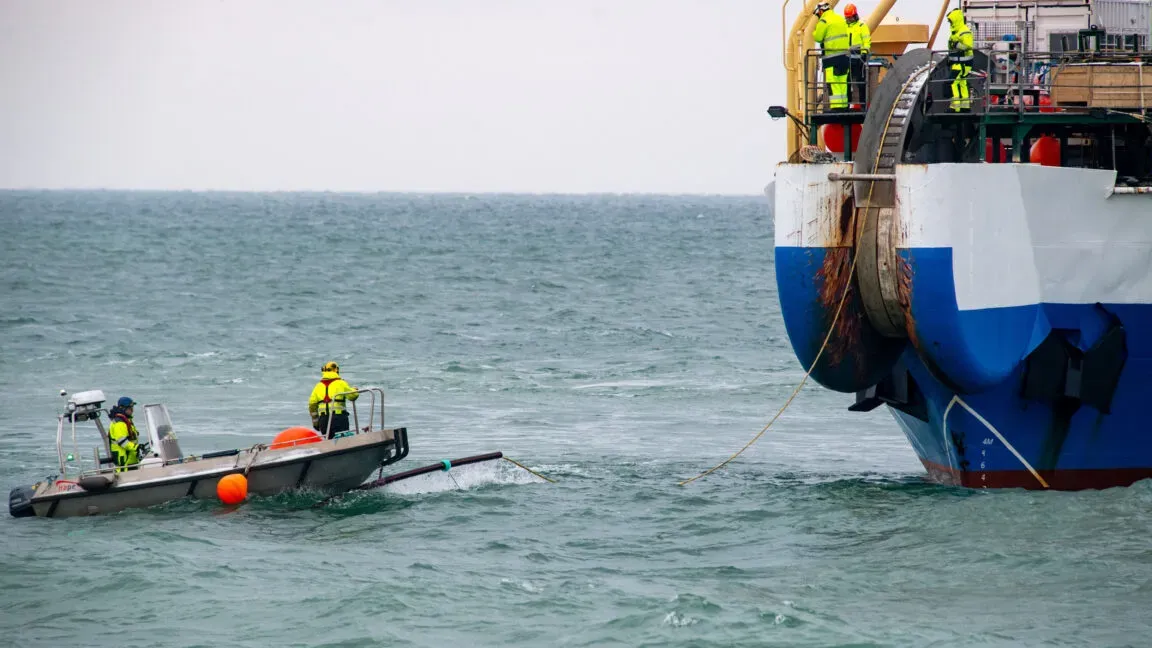
The situation in the Strait of Hormuz has led to a reevaluation of subsea cable projects in the region. Prior to the conflict, three new cable projects were set to launch or were already underway. However, with the outbreak of war, installation work had to be suspended due to the risks posed by missile strikes and drones.
The challenges faced by cable installation crews are considerable, especially when compared to the hazards associated with ship navigation in the region. Installation ships are stationary targets, making them vulnerable to attack.
As global tensions continue to rise, the issue of subsea cables has become increasingly pressing. The question remains: how will cable installation and repair crews be able to carry out their work safely amidst ongoing conflicts?
The threat posed by Iran's decision to impose tolls on shipping in the Strait of Hormuz is another significant concern. This move violates the United Nations Convention on the Law of the Sea, which governs international maritime law.
Iran's stance on this issue has been consistent with its previous actions, despite being a signatory but not ratifier of UNCLOS. Its decision to disregard international conventions raises concerns about the stability of global communication networks.
The impact of these developments on global connectivity cannot be overstated. The reliability and security of subsea cables are critical for maintaining the flow of information across borders.
As tensions in the region continue to escalate, it is essential that governments, industries, and international organizations develop strategies to protect these critical infrastructure assets from emerging threats.
Tensions between countries have created an environment where international obligations are being called into question.
In March, Iran cited the US and Israel's actions as a reason for reneging on its commitment to the United Nations Convention on the Law of the Sea (UNCLOS). The country argued that if these nations were not adhering to the UN Charter, why should it be bound by UNCLOS?
Iran subsequently announced plans to impose tolls on subsea cables passing through the Strait of Hormuz. This move is a clear violation of UNCLOS, as signatory countries are prohibited from charging fees for laying or maintaining submarine cables.
Facts based on reporting originally published by Ars Technica.
You may republish this story, in full or in part, if you credit Noti Group and link to it (licence CC BY 4.0). Photos are not included.