





Sudan's manufacturing sector struggles to recover from civil war
The country's industrial sector is still reeling from the effects of a devastating conflict that has left thousands of businesses in ruins.
Sudan's manufacturing sector is struggling to recover from the devastating impact of the country's civil war, which has left thousands of businesses in ruins.
Mansour Gaily's factory in Khartoum was once a thriving enterprise that produced sweets for local consumers and provided employment for workers, but production ground to a halt when fighting erupted between the Sudanese Armed Forces (SAF) and the Rapid Support Forces (RSF) in April 2023.
Over three years later, Gaily is still trying to bring his business back to life, with the factory currently operating at just 40 percent of its previous capacity. This is a common problem facing many manufacturers across Sudan, where the war has caused widespread destruction and disruption to industry.
The losses suffered by factories like Gaily's are staggering, with estimated damages running into millions of dollars. For example, Gaily estimates that his factory lost around $1m in equipment and infrastructure during the conflict.
Khartoum was once a major industrial centre for Sudan, but its location at the heart of the conflict zone has left it severely damaged, with many factories either destroyed or operating at reduced capacity due to lack of resources and investment.
The scale of destruction inflicted on Sudan's industrial sector during the conflict is staggering, with many factories facing significant challenges in restarting operations.
Abdulelah Mohamed, owner of a factory for plastic products and recycling in Khartoum, paints a bleak picture of the situation. He claims that the systematic destruction and looting of factories has left his business on the brink of collapse.
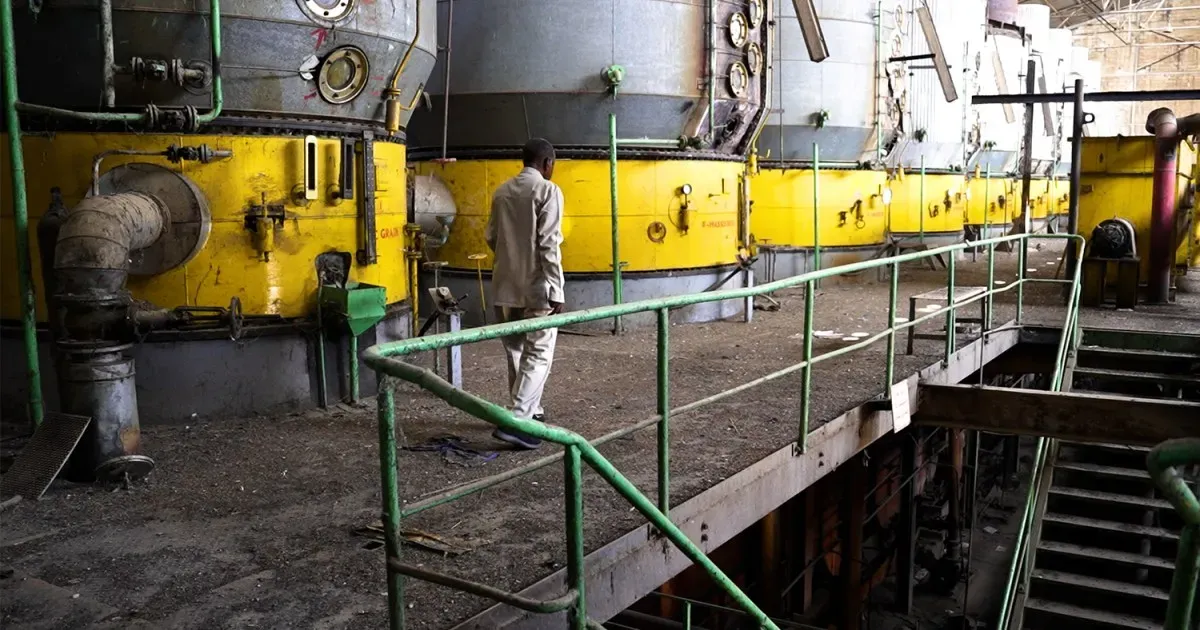
Mohamed's words are echoed by Sara Elfatih Khalil, chief executive of Al Teital Advance Industries, whose factory in Khartoum produced sesame oil before the war. The company had a workforce of 300 employees, but its warehouses were looted during the fighting and its buildings were damaged.
The impact of the conflict extends beyond physical damage to factories. Raw materials, finished goods, and equipment have been destroyed or stolen, while electricity shortages, damaged transport networks, and rising import costs have made it difficult for businesses to reopen.
Khalil believes that industry will play a crucial role in Sudan's economic recovery, but only if certain conditions are met. These include security and political stability, clear economic policies, legal protection for investment and property rights, reliable financing, and infrastructure.
The situation is dire, with less than 10 percent of factories currently operational, and those that remain open struggling to stay afloat due to high costs and intermittent production.
Sudan's manufacturing industry continues to grapple with the aftermath of its devastating conflict.
Restoring production at factories requires a delicate balance of resources, including essential ingredients and supplies such as sesame seeds and sugar. Disruptions in any of these areas can cause operations to come to a standstill, further exacerbating the challenges faced by manufacturers.
Many factories are operating at significantly reduced capacity due to severe damage sustained during the conflict. Limited capital has hindered efforts to replace lost equipment and machinery, forcing some businesses to continue with reduced productivity.
The difficulties in restarting production have also led to increased costs for manufacturers, who now must import materials that were previously sourced locally. This vulnerability to disruptions in transport and supply chains further threatens the already fragile recovery of Sudan's industrial sector.
As a result, thousands of workers are struggling to find employment, including Mohamed Haj, a former sweets factory worker who lost his job at the beginning of the conflict.
Shopkeepers in Sudan's markets are facing a new challenge: finding locally made goods to sell. Many factories have shut down due to damage or lack of raw materials during the conflict, leaving a gap in the supply chain.
Traders like Abdelgadir Mohamed, who sells sweets and other consumer products at Bahri Central Market, are struggling to source stock. Imported goods have become more prevalent, but this can mean higher costs for shopkeepers and uncertainty about future supplies.
The shortage of locally made products has put pressure on household budgets, especially for consumers already facing a decline in purchasing power. Ahmed Mahmoud, a local consumer, noted that prices are constantly changing, making it difficult to choose between expensive imported goods and high-priced Sudanese-made ones.
Sudan's government is working to revive the manufacturing sector by assessing industrial facilities' condition and offering incentives to factory owners to reopen. The recovery plan also includes restoring essential services in industrial areas, such as electricity, water, roads, sewage, and waste management.
The recovery plan's focus on restoring essential services is crucial for manufacturers seeking to resume operations, but factory owners are emphasizing that reconstruction requires more than just infrastructure repairs.
Factory owners need capital to rebuild and restart their businesses, and representatives of the Sudanese Chamber of Commerce argue that what they require is tangible support from authorities, rather than empty promises.
Economist Mohamed Elnayer believes that the reconstruction process offers a chance to address long-standing structural weaknesses in Sudan's industrial economy. He notes that these issues predated the war and will need to be addressed if the sector is to be rebuilt successfully.
Before the conflict, Khartoum was the hub of industrial activity in Sudan, with most factories concentrated within its borders. This created an uneven distribution of opportunities between the capital city and other parts of the country, but the war brought a new challenge when it made Khartoum a major front line.
The resulting destruction and looting of many factories have led analysts to suggest that rebuilding the industrial sector should not be limited to restoring what existed before the conflict. Instead, they propose spreading economic benefits across Sudan by developing industries in other states, thereby avoiding future paralysis if fighting were to break out again in the capital.
Gaily's confectionery factory is still recovering from wartime damage, but he faces more than just physical repairs.
He hopes to secure essential ingredients for production and rehire his former employees once machinery is repaired, requiring stronger support from authorities in facilitating production and adopting policies that encourage industry growth.
Facts based on reporting originally published by Al Jazeera.
You may republish this story, in full or in part, if you credit Noti Group and link to it (licence CC BY 4.0). Photos are not included.