





AMD Reports Record-Breaking Quarter with $13.4 Billion Revenue
The company's data center business saw a significant increase in revenue, driving overall growth.
AMD has announced a record-breaking quarter, with revenues reaching $13.4 billion, a 45% increase from the same period last year. This significant growth is largely attributed to the company's data center business, which nearly doubled in revenue.
The data center segment of AMD's business saw a remarkable 97% year-over-year increase, generating a record $8.5 billion in revenue. The company attributes this growth to strong demand for its EPYC line of enterprise server CPUs and the launch of the Instinct MI450 series GPUs.
In contrast, AMD's gaming segment experienced a significant downturn, with revenues cratering despite the growing popularity of gaming consoles. This decline is particularly notable given the importance of the gaming market to AMD's overall business.
AMD's CFO, Jean Hu, provided some insight into the company's future prospects, stating that they expect revenue to reach approximately $17 billion in the fourth quarter, representing a 66% year-over-year increase driven primarily by the acceleration of their data center segment.
AMD's data center business has seen significant growth, with operating margins expanding from 25 percent to 34 percent in the latest quarter. This expansion is reflected in the company's operating income, which surged by a substantial 168 percent to $2.88 billion.
The embedded segment revenue, encompassing SoCs, FPGAs, and boards designed for other hardware applications, reached $1.1 billion, marking a notable 29 percent increase over the same period last year. AMD attributes this growth to gains in various end markets, including aerospace and defense, automotive, communications, and industrial sectors.
The gaming segment of AMD's business, however, has taken a hit, with revenue declining by 40 percent to $773 million compared to the same quarter last year. This decline is largely due to lower sales of semi-custom processors, as well as reduced graphics revenue.
It's worth noting that Ryzen processors, commonly used in gaming PCs, are not included in the company's gaming segment but rather fall under its client business. According to AMD Chair and CEO Lisa Su, the 40 percent year-over-year decline in gaming revenue is primarily attributed to lower semi-custom sales, which are expected at this stage of the console cycle.
AMD has also been showcasing upcoming hardware developments, including the Threadripper Halo Station. This high-performance system combines a Threadripper 9995WX CPU with up to four Instinct MI350P GPUs and is capable of running trillion-parameter LLMs locally.
The AMD Threadripper Halo Station is scheduled for release in 2027, although pricing details have yet to be announced.
AMD's Ryzen AI Halo platform is set to expand its reach to Windows-based systems in the near future, with the company announcing that such systems will be available soon.
The effort, known as Project Zenith, aims to provide a developer-focused experience on the current PRO 400 Series platform. This platform is built around the Ryzen AI Max+ PRO 495 processor, which boasts impressive capabilities, including support for up to 192GB of unified system memory and the ability to allocate up to 160GB of that memory for graphics processing.
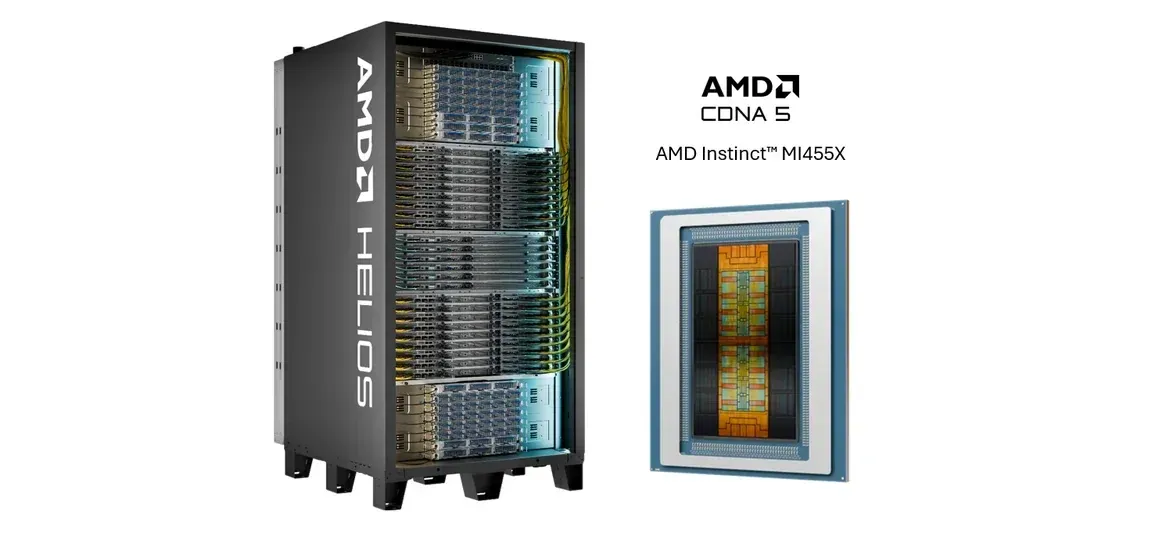
The MI455X, a key component in AMD's data center offerings, began shipping in volume during this quarter. Several leading customers, including Anthropic, Meta, Microsoft, OpenAI, and Oracle, have quickly brought their first Helios racks online, leveraging the capabilities of the MI455X processor.
Facts based on reporting originally published by Ars Technica.
You may republish this story, in full or in part, if you credit Noti Group and link to it (licence CC BY 4.0). Photos are not included.