







Financial Data Shows Anthropic Achieves Operating Profit and High Net Revenue Retention
Anthropic's new reporting system provides customers with detailed understanding of their AI investments.
Anthropic, a frontier lab focused on artificial intelligence, has made significant strides in its business operations, according to financial data shared with investors this week. The company has achieved an operating profit in the second quarter and boasts impressive net revenue retention, with a staggering 900% increase in spending from existing customers.
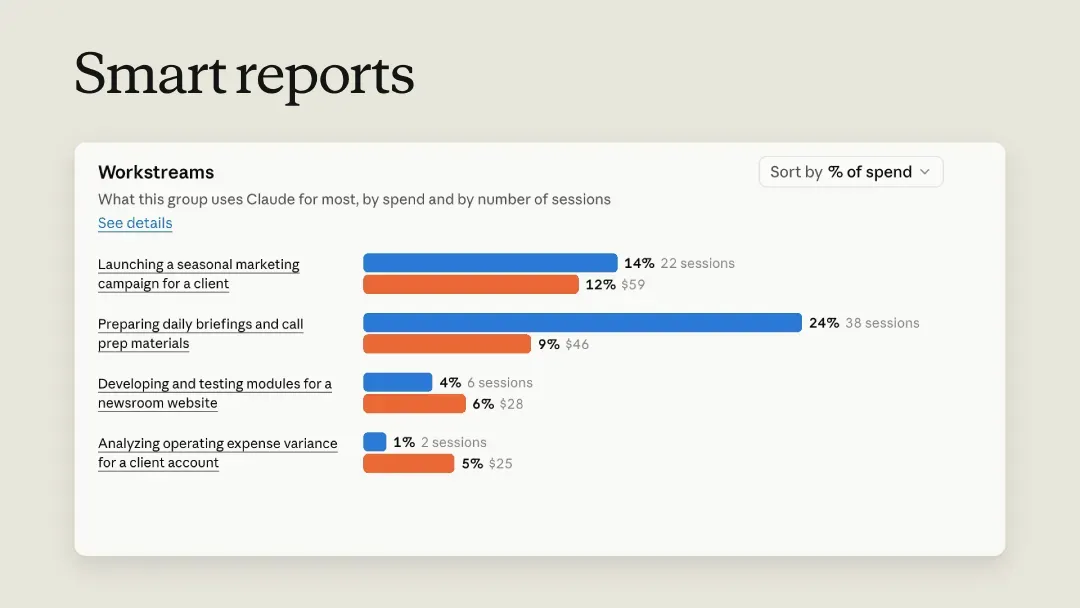
This success can be attributed in part to Anthropic's efforts to retain enterprise users and provide them with tools to optimize their AI investments. To that end, the company has introduced a new suite of reporting tools designed to give customers a detailed understanding of the value they derive from their token spend.
The new reporting system uses internal analytics and employee surveys to offer managers a comprehensive view of team performance over specific date ranges. This includes metrics on productivity, costs, and workflow breakdowns, providing valuable insights for improvement.
Anthropic emphasizes that it will not use customer data for model training by default, ensuring the confidentiality and security of user information. The reports also offer actionable recommendations to enhance results.
The new reporting tools are designed to address a pressing concern among large customers: demonstrating return on investment from AI deployments. As companies like Anthropic continue to innovate in this space, they face the challenge of justifying the significant costs associated with AI adoption.
A recent report from Jellyfish highlights the growing adoption of agentic coding tools among its 276,000 customers. These tools, built on Anthropic models, have become the most widely used in the survey, accounting for nearly a third of all proposed code changes submitted for review.
The data shows that spending on these tools has increased tenfold since the beginning of the year, with their cost now equivalent to about 2% of total engineering costs. This significant growth is a concern for companies looking to manage their AI expenses effectively.
Nicholas Arcolano, chief scientist at Jellyfish, notes that even if 2% may seem like a small percentage, the tenfold increase in spending on these tools has caught many by surprise. He emphasizes that companies can no longer afford to simply spend money on AI without optimizing its use.
Anthropic's new reports aim to address this challenge by providing insights into the adoption and usage of agentic coding tools among enterprise customers. The data suggests that Anthropic leads in this space, but what drives the success of these tools remains unclear.
The release of OpenAI's Astra model this summer was seen as a potential threat to Anthropic's dominance, but so far it hasn't slowed down its adoption numbers. According to Nikolas Albarran, AI product lead at Jellyfish, even with the introduction of new models like Astra and Codex, Anthropic's existing customer base remains loyal.
Albarran attributes this loyalty to the fact that Anthropic's tools "just worked" well from the start, allowing companies to standardize workflows around them. This incumbent advantage has made it difficult for competitors to gain traction.
As a result, despite the intense competition in the market, Anthropic continues to maintain its position as the leading provider of agentic coding tools among enterprise customers.
Anthropic's agentic coding tools have become a crucial part of many enterprise customers' AI strategies.
As these companies continue to invest heavily in AI research and development, they're finding it increasingly difficult to switch from one provider to another.
This is partly due to the significant upfront costs associated with switching, which can be substantial considering the time and resources required to adapt new tools and workflows.
The major AI labs, including Anthropic, are also investing heavily in forward-deployed engineering (FDE) organizations, teams that embed AI consultants directly within customer organizations to help them get up and running.
The trend of AI adoption in companies is facing a harsh reality, as many are struggling to justify the financial returns on their investments. According to an economist from Apollo, most businesses implementing AI technology do not see any significant financial benefits.
Many companies are starting to realize that their AI spending may not be delivering the expected results. In response, some organizations are turning to forward-deployed engineering (FDE) teams, which embed AI consultants directly within customer organizations to help them get up and running with AI solutions. This approach aims to mitigate the challenges associated with AI adoption and ensure a smoother integration process. As companies reassess their AI strategies, it remains to be seen how this shift will impact the industry as a whole.
Facts based on reporting originally published by TechCrunch.
You may republish this story, in full or in part, if you credit Noti Group and link to it (licence CC BY 4.0). Photos are not included.