







Controversy Surrounds European Commission's Handling of EU Loans for Egypt
Leaked documents have ignited a controversy surrounding the European Commission's handling of figures related to Egypt's eligibility for €2.5bn in loans under a landmark pact with President...
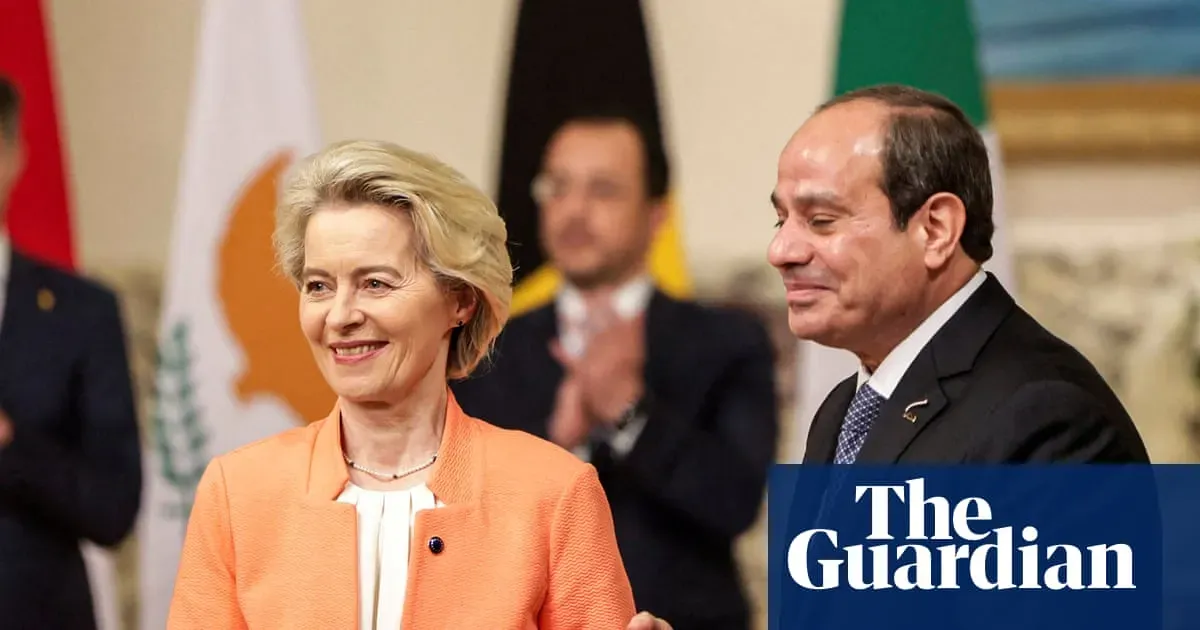
Leaked documents have ignited a controversy surrounding the European Commission's handling of figures related to Egypt's eligibility for €2.5bn in loans under a landmark pact with President Abdel Fatah al-Sisi's government.
The allegations suggest that the Commission manipulated statistics to enable the release of funds, which were part of a larger €7.4bn deal promised by Ursula von der Leyen during her visit to Cairo in 2024. The partnership aimed to bolster Egypt's economy, curb migration to Europe, and stabilize the region following the October attacks and Israel's war on Gaza.
Egyptian authorities have been facing increasing scrutiny over their treatment of journalists, with several recent incidents raising concerns about press freedom. At least six journalists have been jailed and allegedly tortured, while a fact-checking platform had its entire newsroom detained and one of the country's last independent news outlets was shut down in October.
The closure of the outlet was accompanied by the conviction of its editor, Lina Attalah, who is appealing against her sentence. This week, she will appear in court as part of an ongoing effort to clear her name and overturn other charges leveled against her.
Attalah was sentenced to a year in prison for "publishing false news without her knowledge, sparking concerns about the Egyptian government's efforts to silence independent voices.
The controversy surrounding Egypt's eligibility for EU loans has placed a spotlight on €5bn in soft loans provided by Brussels, lending with favorable repayment terms that are typically reserved for countries demonstrating respect for human rights and democracy.
Data from leaked EU documents and deleted Egyptian government files have cast doubt on the European Commission's assertion that Egypt met targets linked to social welfare programs.
These programs were a key condition for releasing €2.5bn in EU assistance, with the commission claiming that Egypt had broadly fulfilled" and then "fulfilled" two separate targets to increase the numbers of poor people on these programs between 2024 and 2026.
However, actual data points suggest a different story: instead of expanding coverage, the Egyptian government removed people from its welfare programs, resulting in a net reduction of 85,734 households.
If the EU's conditions had been met, around 245,000 households, approximately 909,000 individuals, would have benefited from these programs. This estimate is based on World Bank data used by The Guardian to calculate the potential increase in beneficiaries.
Despite this, the commission gave the green light for two separate "soft" loans totaling €2.5bn, with leaked documents showing that it had wanted Egypt to further expand its cash transfer programs.
The European parliament's leading spokesperson on EU-Egypt relations, Dutch MEP Tineke Strik, has responded to these findings by introducing a question to the commission demanding clarification.
The European Commission's handling of Egypt's social welfare programmes has come under scrutiny as it appears that the organisation may have misrepresented figures in order to release funds.
A closer examination of the data reveals a complex situation: while some households were added to the beneficiary list, others were removed due to a recertification process. The net result was a decline of 62,281 households, which contradicts the commission's claim that the target had been met.
The Takaful and Karama cash transfer programmes are designed to provide support to vulnerable individuals and families. However, the data suggests that these programmes may not be as effective as initially thought, given the significant drop in beneficiary numbers.
In order to secure further funding from the EU, Egypt was required to expand its social welfare programme by adding 60,000 households to the list of beneficiaries. A second leaked report reveals that this target was met when 442,118 families were added to the list.
A spokesperson for the European parliament's leading group on EU-Egypt relations has responded to these findings by calling for clarification from the commission on its handling of the situation.
The EU's €1.5bn payment to Egypt in July 2026 followed a period of declining participation in the country's poverty reduction programs. Figures from Egypt's ministry of social solidarity show that between January and June 2026, the number of beneficiaries under these programs decreased by 23,453.
Screenshots and archived webpages obtained by The Guardian confirm that this data was previously available on the Egyptian ministry website but has since been removed. The EU had required Egypt to add 160,000 households to its poverty reduction rolls between 2024 and 2026, yet during this period there was a net decline of 85,734 households.
Critics argue that the commission's handling of the situation is emblematic of a broader issue - the EU's inability to leverage its funds effectively in support of genuine economic stabilization in Egypt. A more stable economy with a less precarious population would be a strategic interest for Europe, according to experts.
The data presented by The Guardian has raised important questions about the commission's decision-making process and transparency regarding the fulfillment of commitments made under European funding agreements. MEP Sandra Gómez López from Spain's socialist party recently visited Cairo to assess human rights in Egypt and is now calling for a clear explanation from the commission on its handling of this situation.
The commission must demonstrate that European funding is genuinely contributing to improving social protection for the Egyptian population, according to López. This requires transparent explanations and evidence-based outcomes, rather than simply fulfilling technical requirements.
The EU's willingness to support Egypt's economic development is being questioned by critics who argue that the bloc is compromising its standards on human rights.
This concern stems from the fact that the EU has not set clear benchmarks for Egypt to meet in terms of socioeconomic targets, which are considered crucial to holding the country accountable for its actions.
Strik expressed skepticism about the EU's ability to enforce its conditions, pointing out that the commission seems to be ignoring these clear socioeconomic conditions. As a result, she doubts that the EU will adhere to the less defined goals for democracy and human rights.
Without clear benchmarks, critics argue that the EU has essentially given Egypt a free pass on human rights issues. This is evident in the way the country's authoritarian regime has been able to maintain its grip on power despite promises of democratic reforms.
The European Commission's response to these concerns has only added to the confusion, with officials insisting that there is no contradiction between their public statements and internal documents that suggest Egypt must expand its cash transfer programs.
EU officials claim they assess Egypt's compliance with conditionality thoroughly, taking into account information from various sources including Egyptian authorities.
The assessment process has sparked controversy, with some questioning whether it is thorough enough to justify releasing funds to Egypt.
Facts based on reporting originally published by The Guardian World.
You may republish this story, in full or in part, if you credit Noti Group and link to it (licence CC BY 4.0). Photos are not included.