


Tesla Unveils Next-Generation Roadster Capabilities in Texas
The next-generation Tesla Roadster showcased its capabilities at a recent event, including driving upside down and flying before accelerating to 60mph in under a second.
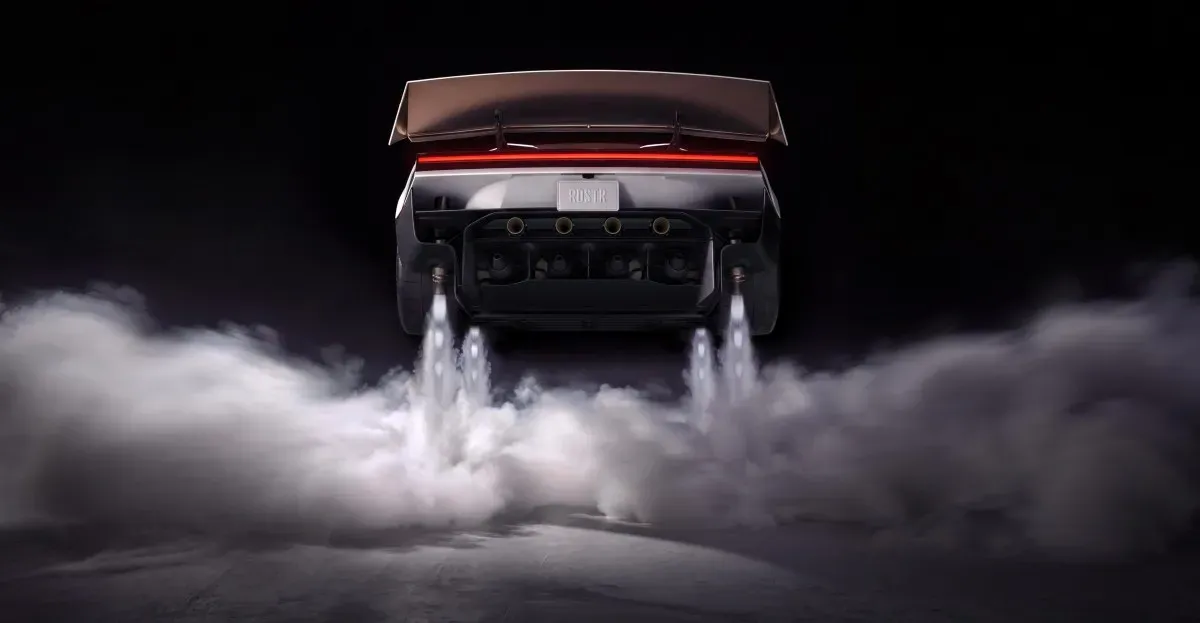
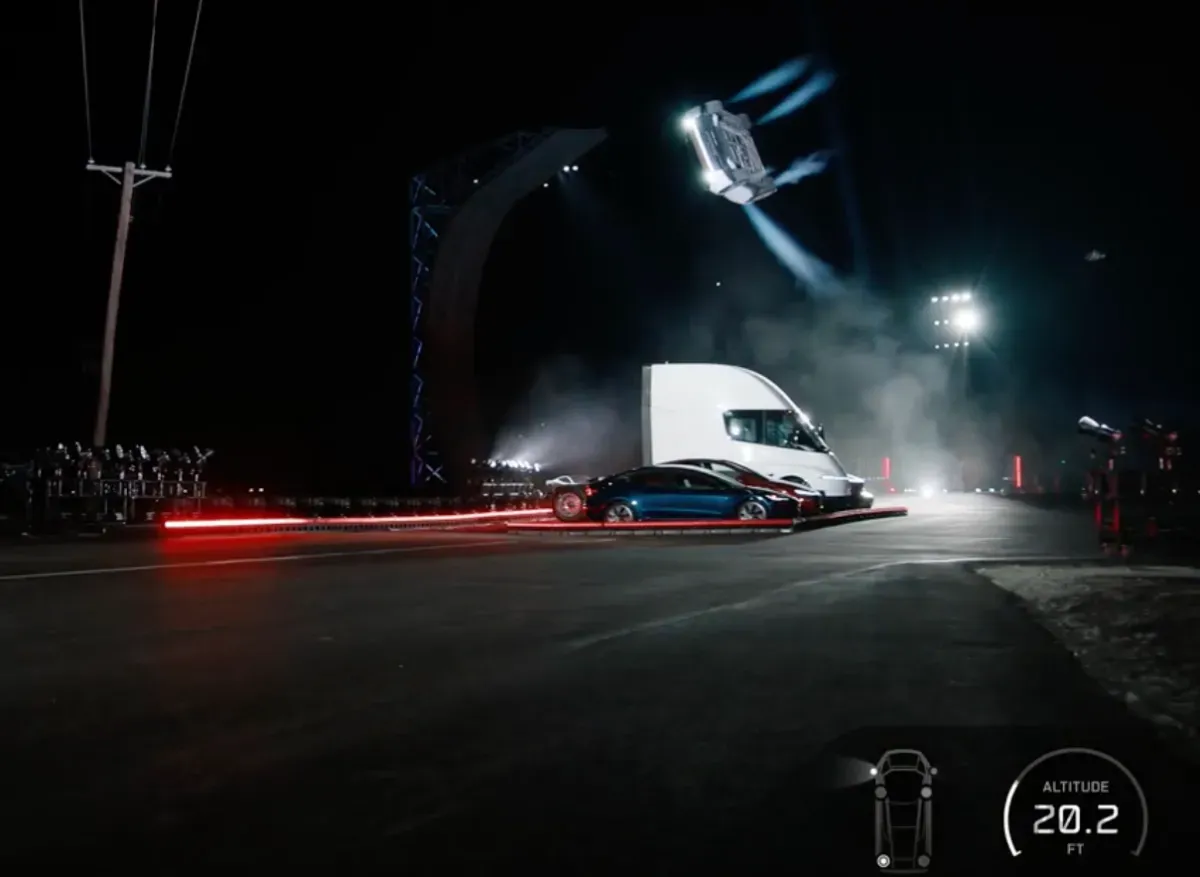
Tesla's next-generation Roadster made a splash at an event in Waco, Texas, where the electric supercar showcased its extraordinary capabilities. The car's impressive performance included driving upside down and briefly flying before accelerating to 60mph in under a second.
The demonstration was part of a short presentation that lasted less than 30 minutes, with the focus firmly on showcasing the car's remarkable features rather than discussing its practical details. As such, there were no announcements made regarding the Roadster's price or release date, leaving many questions unanswered for now.
To achieve this impressive display, the Roadster used its downforce to stay attached to a multi-story ramp as it drove up. Once at the top of the ramp, the car utilized its cold-gas thrusters to flip around and gently descend back to earth.
As part of its advanced propulsion system, the Tesla Roadster is equipped with a fan-based suction system supplied by SpaceX. This system generates up to two Gs of suction force, which enables the car to lift off and perform aerial stunts.
The vehicle's flight capabilities were showcased as it soared over other Tesla models, including the Model 3, Model Y, Cybertruck, Semi, and Cybercab. In a particularly impressive maneuver, the Roadster performed what Tesla VP for Engineering Lars Moravy described as a "kick flip, leaving onlookers likely in awe.
The car's ability to fly is made possible by its rocket-like propulsion system, which features attitude-control thrusters at the rear and main thrusters positioned elsewhere. This configuration allows the vehicle to achieve remarkable agility and maneuverability, including the ability to perform rolls and execute complex gymnastics.
The Roadster's advanced propulsion system relies on ultra-high pressure air tanks that can be recharged onboard without the need for specialized chemical propellants. The stored compressed air is then used to generate the thrust needed to lift the car off the ground and perform its impressive aerial stunts.
The Tesla Roadster's design and features have been tailored to meet its unique requirements as an electric sports car capable of flight. Its two-seater configuration boasts seats molded directly into the chassis, providing a snug fit for both occupants.
The car's steering and driving controls employ advanced steer-by-wire technology, which includes a yoke, brakes, and throttle. This innovative system allows for precise control over the vehicle's movements. At the rear of the car, thrusters and fans are strategically positioned around the diffuser area to optimize performance.
A retractable rear wing has also been integrated into the design, providing additional downforce when needed. The aerodynamic features work in conjunction with the car's advanced propulsion system to achieve exceptional speed and agility.
Tesla's engineers have optimized the Roadster's acceleration by applying increased force while minimizing its mass, enabling it to reach 0-60mph in under a second.
The production version of the Tesla Roadster is expected to surpass the impressive performance demonstrated during the recent test drive. According to Elon Musk, the electric car's acceleration will be further optimized to achieve even faster times.
Musk hinted that the vehicle would need to accelerate at a significant fraction of the speed of sound to reach its top speed. However, he acknowledged the extreme forces involved in such high-speed maneuvers and the importance of protecting occupants from excessive acceleration.
Tesla has updated its website with details on the performance tiers for the next-generation Roadster, which will feature three distinct configurations: Performance, Thrust, and Rocket.
The Tesla Roadster's development has been marked by numerous delays and shifting priorities within the company. Initially announced as a one more thing" surprise during the 2017 Tesla Semi event, the prototype was touted for its impressive performance capabilities.
As time passed, however, deliveries of the next-generation Roadster were repeatedly pushed back, with Musk initially promising they would start in 2020. In the meantime, early adopters had already placed deposits, some paying as much as $250,000 for a limited Founders Series model.
These deposits effectively functioned as interest-free loans to help fund Tesla's scaling ambitions. However, it soon became clear that the Roadster was not a priority project within the company, with production deadlines slipping as Tesla focused on more mainstream vehicles like the Model Y and the Cybertruck.
The Tesla Roadster's experimental nature has led some to question whether it can even be considered a car. Analysts have suggested that the decision to re-release the vehicle may be a strategic move by Elon Musk to set the stage for a potential merger between Tesla and SpaceX.
In hindsight, Tesla's failure to bring the Roadster to market allowed other automakers to gain ground in the hyper-powered electric vehicle segment. Companies like Rimac and Porsche have made significant strides with their own high-performance EVs, while Chinese manufacturers such as BYD are producing track-ready supercars at a lower cost.
As the industry continues to evolve, the Tesla Roadster's unique features, including its ability to fly, may no longer be enough to set it apart.
Facts based on reporting originally published by The Verge.
You may republish this story, in full or in part, if you credit Noti Group and link to it (licence CC BY 4.0). Photos are not included.