







UK Man Survives Knife Blade Piercing Right Eye and Brain
A young man arrived at a UK hospital with a shocking injury - a 15mm-wide knife blade had pierced his right eye and brain, yet he was conscious and talking when he checked in.
A young man arrived at a UK hospital with a shocking injury - a 15mm-wide knife blade had pierced his right eye and brain, yet he was conscious and talking when he checked in.
The doctors described him as agitated, indicating that the severity of his condition was not immediately apparent despite the visible trauma. His vital signs were stable enough for him to move all four limbs, but his speech was confused and disoriented.
A medical evaluation using the Glasgow Coma Scale revealed a score of 12 out of 15, classifying his brain injury as moderate. This is just one point above what would be considered mild, suggesting that while serious, it may not have been as severe as initially expected.
Despite his apparent resilience, hospital staff were concerned about the man's ability to care for himself in his confused state and took swift action to sedate him and intubate.
Medical imaging was used to assess the extent of the internal damage caused by the blade, which had penetrated through the eye socket and into the brain before coming to rest at the top of the skull.
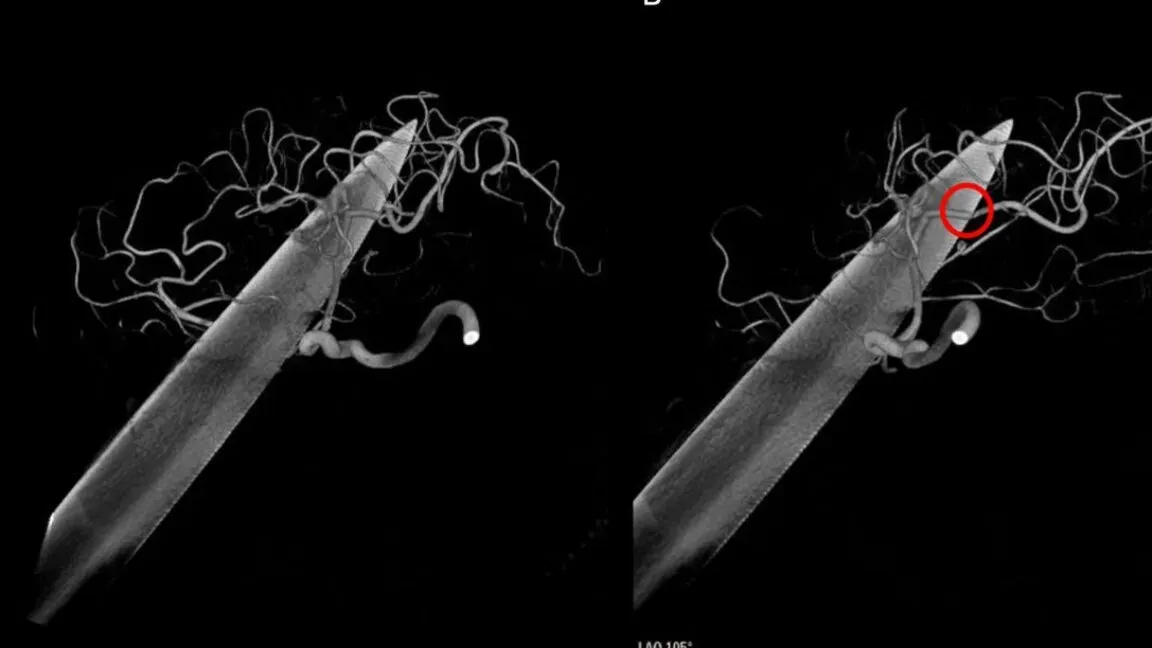
The extent of the internal damage caused by the blade became clear as medical imaging assessments were conducted. The right eye socket and eyeball had been completely penetrated, while the left frontal and temporal lobes of the brain had also been traversed. Notably, the blade passed in front of the corpus callosum without causing any apparent damage to this vital nerve fiber bundle that connects the two sides of the brain.
The medical team also found that the blade had missed a crucial blood vessel when it was close to the left internal carotid artery but didn't seem to have damaged it. However, they did observe that a branch of the middle cerebral artery appeared to be indented by the knife, indicating some level of impact on this major blood vessel.
Following consultation with various medical specialties, the man's doctors decided to proceed with emergency neurosurgery. They chose a conservative approach, removing part of his skull to allow direct access to the brain while avoiding invasive excavation methods. Instead, they used a "pull-and-see" method to carefully slide the blade out without causing further damage.
Once the blade was removed, the medical team saw no signs of significant hemorrhaging and was able to clean and drain the wound before patching up his skull. Unfortunately, the right eye had suffered extensive damage and was subsequently removed due to its condition.
The man's recovery was remarkable as he moved to intensive care and began to show rapid improvement. A day after surgery, doctors were able to remove his breathing tube, a significant milestone in his road to recovery. He did experience some minor weakness on the right side of his body but this resolved itself two days later.
Scans of his brain showed that while there was still some bleeding and swelling present, overall healing was taking place at a steady rate. There was also air present in his brain tissue from where the knife had been, but no infections developed and he suffered no seizures throughout his recovery.
The man's remarkable recovery from a knife wound that traversed his eye and brain has left medical professionals stunned. Despite the unusual path of the injury, he showed no signs of neurological damage, maintaining full language function and motor coordination.
The doctors treating him are still unclear about how this happened, citing an unknown mechanism of injury. They do note, however, that the patient had a history of depression prior to the incident.
This type of injury is extremely rare, typically occurring as a result of high-velocity mechanisms such as gunshots or other ballistic injuries. In contrast, low-velocity mechanisms like knife wounds are associated with significant morbidity and mortality due to complications like hemorrhage and seizures.
Medical experts point out that while this recovery is exceptional, it's not entirely unprecedented. They cite reports of patients who have made astonishing recoveries from what seemed to be devastating brain injuries.
The unexpected recovery of a man who suffered a severe brain injury from a knife wound has left medical professionals stunned. The case highlights that the severity of a head injury may not be the primary factor in determining its outcome, but rather the precise path it takes through critical brain structures.
This is supported by comparisons to other cases where severe injuries have surprisingly resulted in minimal long-term damage, such as Phineas Gage's infamous accident and a reported nail-gun incident. The doctors who treated the patient emphasize that the trajectory of the wound relative to key blood vessels, brain areas, and underlying tissues plays a crucial role in determining the extent of neurological impairment.
Facts based on reporting originally published by Ars Technica.
You may republish this story, in full or in part, if you credit Noti Group and link to it (licence CC BY 4.0). Photos are not included.