



Turkish President Meets Eastern Libya Commander Haftar in Ankara
Turkey has shifted its approach to Libya since 2020 when it helped repel a military offensive led by Haftar's self-styled Libyan National Army.
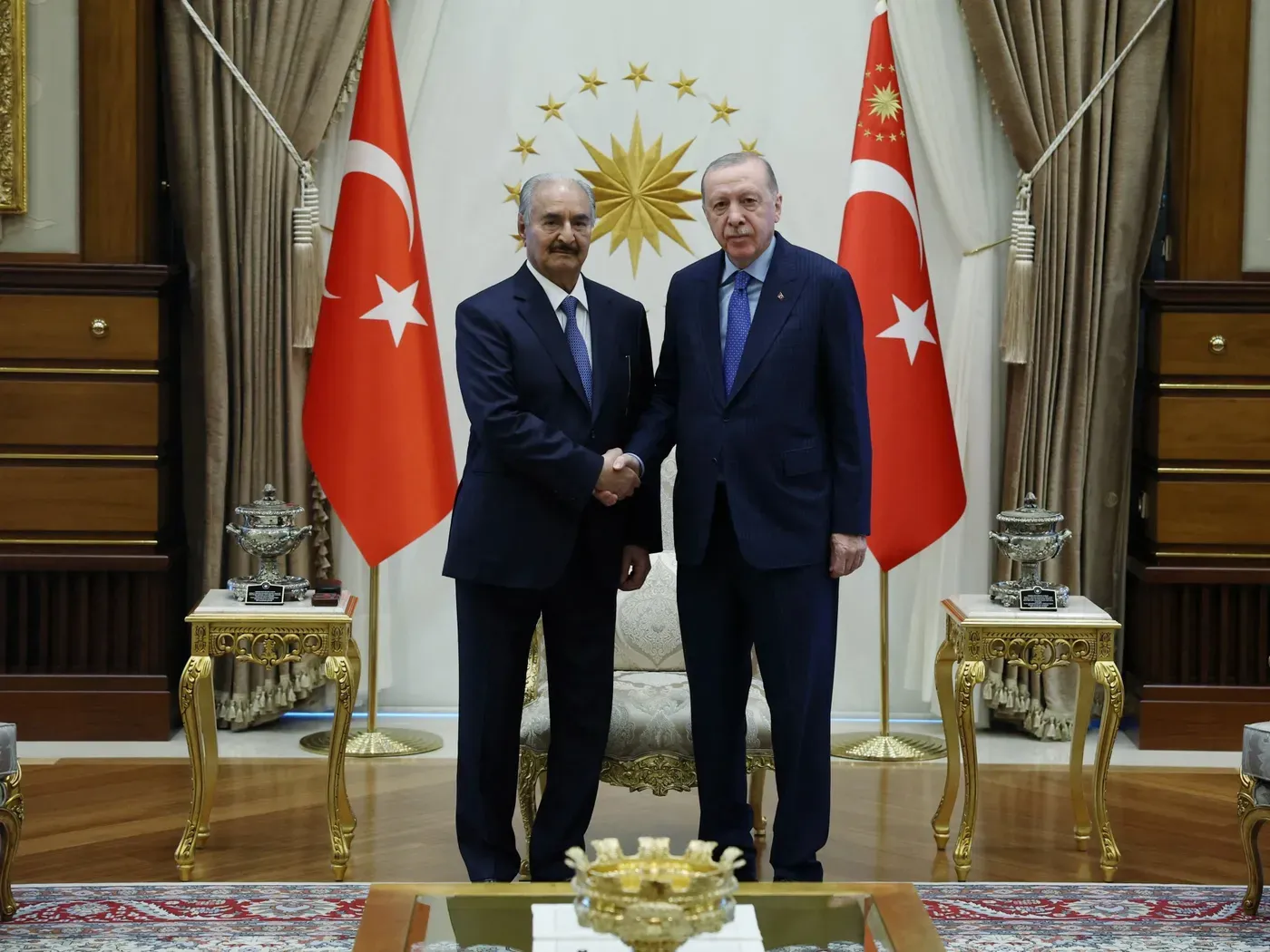
Turkish President Recep Tayyip Erdogan hosted a high-profile meeting in Ankara on Wednesday with Khalifa Haftar, the eastern Libyan military commander who has been a key player in the country's ongoing conflict.
The visit marks a significant shift in Turkey's approach to Libya, which has evolved since 2020 when it helped repel a military offensive led by Haftar's self-styled Libyan National Army. This move was part of Turkey's efforts to support the internationally recognized Government of National Accord, based in Tripoli.
Despite its earlier backing for the GNA, Turkey has now turned towards a more pragmatic approach aimed at bringing rival administrations together and securing its maritime interests in the Mediterranean Sea. The meetings with Haftar are seen as a key step in this direction.
The Turkish president is expected to visit Libya soon, his first trip there in 15 years, as Ankara seeks to reconcile the country's two main factions. This move comes after Haftar's forces were forced to retreat from western Libya following Turkey's military intervention in support of the Tripoli-based government in 2019-2020.
Turkish officials are likely keen to know what drove Haftar's decision to visit Ankara, particularly given his past stance on Libya's rival administrations.
Turkiye's diplomatic efforts to reunify Libya have gained momentum in recent years, particularly since 2025 when the US launched a reconciliation initiative between the country's rival governments. The move was complemented by a UN-backed agreement signed this August, which outlines a roadmap for a unified government and elections within two years.
The agreement has been welcomed by several countries, including Turkiye, which has strengthened its ties with the eastern region through military cooperation and infrastructure development. In July, Ankara reached agreements with Haftar's LNA on military training and infrastructure, marking a significant step in their partnership.
Libya analyst Jalel Harchaoui believes that Turkiye's military strength and influence have earned it respect across the country. According to him, no Libyan leader can afford to ignore Ankara's interests, given its growing presence in the region.
The maritime boundary agreement signed by Ankara with Tripoli-based government in 2019 has become a contentious issue for several countries in the Eastern Mediterranean. Greece and Israel have expressed opposition to the deal, while Egypt has criticized it for violating its own maritime rights. However, Turkiye has defended the agreement as lawful.
Turkiye's efforts to bring Libya's rival military leaderships together have included high-level meetings between Turkish officials and their Libyan counterparts. In May, Turkish Defence Minister Yasar Guler met with Abdulsalam al-Zoubi, the deputy defence minister in Tripoli, while Turkish intelligence chief Ibrahim Kalin later met Saddam Haftar, a senior LNA commander, in Benghazi.
Turkish officials have been engaging in intense diplomatic efforts to reunify Libya, a nation torn apart by conflict. Key discussions on military unification have taken place in Ankara, where experts have debated the merits of establishing a joint command centre in Sirte.
The central city's strategic location makes it an attractive hub for military operations, but disagreements over who would hold authority over a unified force remain unresolved. This stalemate is likely to hinder progress towards reunification.
On the economic front, Turkey has welcomed Libya's adoption of its first unified national budget in more than a decade. Alongside nine other countries, Ankara has endorsed this significant step towards stabilizing Libya's economy.
Behind-the-scenes diplomacy has been intense as Turkey coordinates with other nations involved in the reconciliation process. High-level talks have taken place in Cairo and Tripoli, with Turkish Foreign Minister Hakan Fidan meeting key players on both sides of the conflict.
Despite Turkey's diplomatic efforts, no clear power-sharing arrangement has been publicly endorsed by Ankara. US mediators have proposed a contentious plan to make Saddam Haftar chairman of Libya's Presidency Council, but it remains unclear whether this will be accepted by all parties involved.
The Turkish government's efforts to bring stability to war-torn Libya have led some analysts to suggest that a unified government would provide a more favorable environment for Ankara to pursue its economic and strategic interests in the region.
Turkiye has shifted its stance from backing one side to engaging both parties, with experts attributing this change of heart to a desire to protect its economic and maritime interests. A stable, unified Libya is seen as essential for these pursuits, according to Sansom Milton, a senior research fellow at the Center for Conflict and Humanitarian Studies.
This approach aligns with Turkiye's historical diplomatic strategy when dealing with divided states, says Saban Kardas, a research professor at Qatar University. The goal is to promote national unity in order to make engagement more sustainable.
Despite Ankara's current strong position in Libya, analysts warn that the country remains volatile due to ongoing instability and competing visions for its future leadership. Even with significant assets and advantages accumulated by Turkiye in Libya, the economic crisis gripping the nation poses a major challenge to political stability efforts.
Libya is facing severe economic woes, including a weakening dinar, rising living costs, fuel and cash shortages, and deteriorating public services, which have led to increased protests and strikes over the past year. These issues cast a shadow over attempts to achieve reconciliation and stability in Libya.
The complexities of Libya's conflict are deeply ingrained in its geography and politics. Western Libya, a stronghold of the 2011 uprising that overthrew Muammar Gaddafi, has proven to be a challenging terrain for Khalifa Haftar's forces, who suffered a defeat there in 2020.
Leadership vacuum and conflicting interests hinder reconciliation efforts in western Libya, according to experts. "Division remains profitable for elites and armed groups on each side," said Milton of the Center for Conflict and Humanitarian Studies. This reality casts a significant obstacle to achieving stability in the region.
Facts based on reporting originally published by Al Jazeera.
You may republish this story, in full or in part, if you credit Noti Group and link to it (licence CC BY 4.0). Photos are not included.