





NASA Spacecraft Crashes into Asteroid Dimorphos
The impact was part of a test to assess Earth's planetary defences and determine if it's possible to knock a space rock off course.
A NASA spacecraft deliberately crashed into an asteroid in 2022, causing extensive damage to its surface. The impact was part of a test to assess Earth's planetary defences and determine if it's possible to knock a space rock off course.
The asteroid, called Dimorphos, is about 150 meters wide and orbits around a larger space rock called Didymos. This unique relationship between the two asteroids made Dimorphos an attractive target for the crash test.
A European Space Agency (ESA) spacecraft called Hera is now surveying the aftermath of the collision to gather more information. The images obtained by Hera reveal a stadium-sized crater on Dimorphos' surface, which has left scientists in awe.
Dr Sabina Raducan, a planetary scientist and member of the Hera science team, described the crater as "really, really spectacular". She also expressed her excitement at finally seeing the aftermath of the collision.
The impact was so violent that it created a trail of debris measuring approximately 6,200 miles long. The trail was visible to telescopes on Earth and in space, providing further evidence of the massive damage caused by the crash test.
The collision between the spacecraft Dart and asteroid Dimorphos had a significant impact on the smaller object's orbit.
The duration of Dimorphos' orbit around its parent body, Didymos, was shortened by approximately 33 minutes following the crash test.
This reduction in orbital time is crucial for scientists working on the Hera mission to understand the effectiveness of the spacecraft's maneuvering technique.
By measuring Dimorphos' mass, researchers can determine whether it would be possible to deflect a similar asteroid on a collision course with Earth using the same method.
Precise calculations are essential for predicting the outcome of such an intervention and determining the required resources.
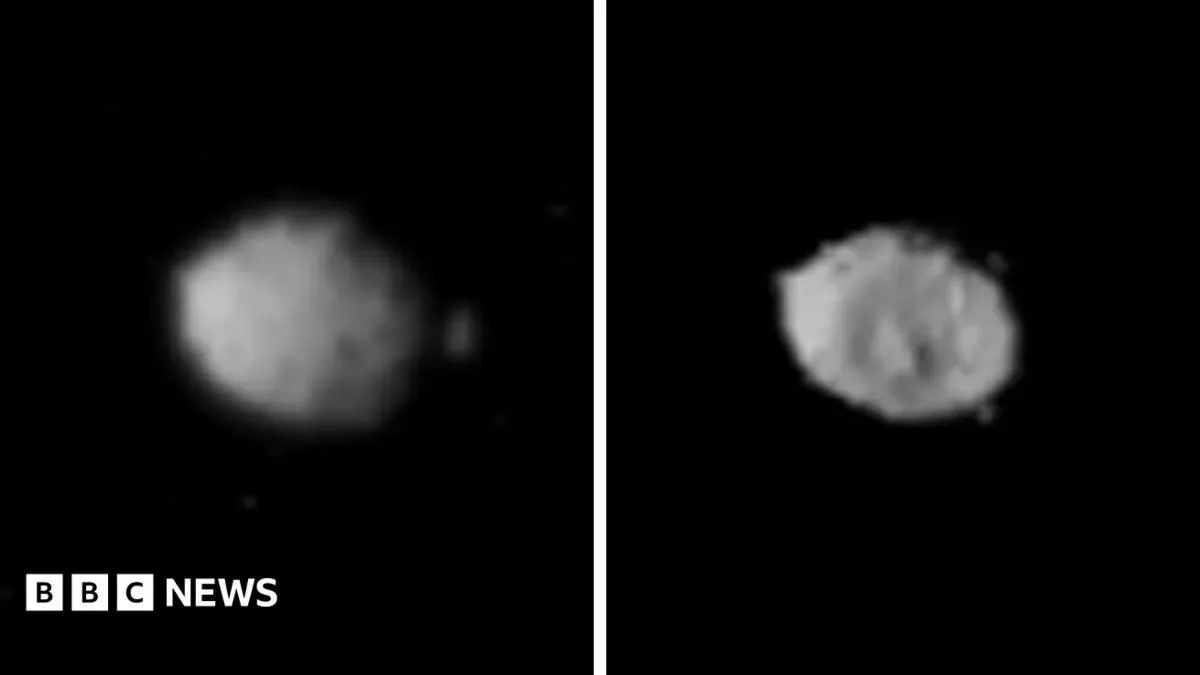
The European Space Agency's Hera mission has captured detailed images of Didymos, the asteroid targeted for a collision test. The surface of Didymos is now visible in high resolution, showing its geological features.
Naomi Murdoch, a member of the Hera team, noted that the gravity on Didymos is an astonishing 40,000 times weaker than Earth's gravitational pull. This remarkable difference has significant implications for the asteroid's composition and structure.
The images reveal vast regions of boulders scattered across Didymos' surface. These boulders range in size from at least three meters to as large as ten meters in diameter, roughly equivalent to cars or buses. The sheer scale of these rocks is impressive, especially considering the minimal gravity they're situated on.
As the Hera mission continues its observations, it will spend the next six months studying Dimorphos and Didymos in greater detail. This will involve capturing higher-resolution images from closer proximity, providing scientists with a wealth of new information about these asteroids.
Operating a spacecraft and its accompanying cube satellites through a boulder field is going to be an extremely demanding task.
The sheer scale of asteroids poses a significant threat to our planet's safety and security, with some measuring over a kilometre in diameter potentially causing global devastation.
Carolyn Ernst at Johns Hopkins Applied Physics Laboratory highlighted the devastating consequences that can result from asteroid impacts, recalling the fate of the dinosaurs and implying a desire to avoid a similar catastrophe for humanity.
According to Ernst, while it is reassuring to know that the largest asteroids have been identified and are not on a collision course with Earth, there remains a sizeable gap in our understanding of medium-sized asteroids, which could potentially cause significant problems if impacted.
These unknown objects pose a particular concern because they fall into a middle ground where their presence is still being mapped and understood.
The launch of the Near-Earth Object (NEO) Surveyor in 2027 will be a crucial step in tracking potentially hazardous asteroids that could pose a threat to Earth.
Asteroids like Apophis, which is approximately 450 meters long and was initially thought to have a high chance of colliding with our planet as early as April 2029, are now being targeted for closer study. According to scientists, the asteroid's orbit has been better understood, revealing that it will actually fly by Earth at a safe distance of about 32,000 kilometers in 2029.
This near-miss opportunity will provide researchers with an unprecedented chance to gather valuable data and insights about Apophis up close. Two spacecraft, Nasa's Osiris-Apex and Ramses, a joint mission between the European Space Agency (ESA) and Japan's JAXA, are scheduled to visit the asteroid in the near future.
Facts based on reporting originally published by BBC News World.
You may republish this story, in full or in part, if you credit Noti Group and link to it (licence CC BY 4.0). Photos are not included.