



Voyager 1 Travels One Light-Day From Earth
A historian's research has shed new light on the Golden Record's overlooked details, including duplicate records created almost five decades ago.
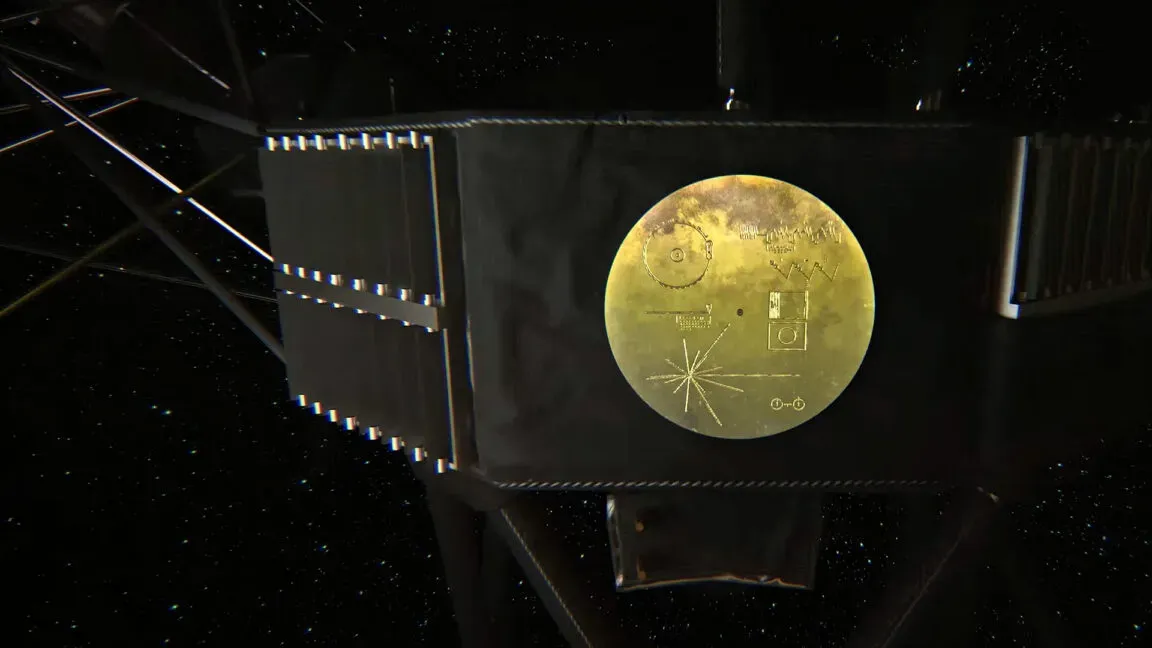
Voyager 1 has now traveled one light-day from Earth, a journey that began decades ago with a mission to explore Jupiter and Saturn. Launched in 1977, Voyager 1's initial objective was to fly by these two gas giants and their moons, including the enigmatic Titan.
The spacecraft carried a unique payload - a Golden Record, essentially a message in a bottle from humanity to any extraterrestrial life form that might encounter it. The record is a nod to the 100th anniversary of the phonograph and serves as a commemorative item. Its contents have been extensively documented over the years, but little attention has been given to its creation and preparation.
A historian's research has shed new light on the Golden Record's overlooked details. Glen Swanson, a renowned expert in spaceflight history, delved into the record's hardware, uncovering previously unknown information about its operating instructions. His investigation revealed that duplicate records were created almost five decades ago, but their existence had gone unnoticed until now.
Swanson, who has a long history of studying space exploration, explained his focus on the Golden Record's "bottle rather than its contents. As he noted in an interview, so much has been written about the message in the bottle... whereas I was more interested in the hardware. This approach allowed him to uncover new insights into the record's creation and distribution.
Further investigation by Swanson uncovered duplicate sets of operating instructions that were distributed decades ago. These overlooked details offer a fascinating glimpse into the development and preparation of the Golden Record, highlighting the complexities involved in creating this iconic message from humanity.
The Voyager probes' 50th anniversary is approaching, prompting historian Carl Swanson and design director Jon Lomberg to revisit the creation of the Golden Record in their upcoming book. The book, scheduled for release by the University of Chicago Press in August 2027, aims to provide a comprehensive account of this iconic message from humanity.
According to Swanson, existing resources on the topic are limited and often contradictory, making it essential to delve into primary sources and first-hand information. By examining these previously overlooked details, researchers can gain a deeper understanding of the Golden Record's development and its significance as an enduring reflection of human culture.
As Voyager 1 continues its journey into interstellar space, Swanson took the opportunity to share some of the book's findings on social media. On November 18, Voyager 1 reached one light-day from Earth, marking a significant milestone in its odyssey. This achievement serves as a poignant reminder of the vast distances that separate our planet from the rest of the universe.
The Golden Record's contents are designed to be relevant and accessible to an extraterrestrial civilization, even if they were to encounter it millions or billions of years into the future. The record's creators deliberately chose not to include any information about its origins or purpose, instead focusing on preserving a snapshot of human culture and society at the time of its creation.
Despite its advanced technology and robust design, the Voyager 1 spacecraft's Golden Record is not immune to potential damage from micrometeorites and other space debris.
The record's protective cover, which contains essential information on how to play the disc and access its contents, is particularly vulnerable to wear and tear.
According to Swanson, even small amounts of dust can erode the inscriptions on the cover over time, potentially rendering them unreadable.
The designers of the Golden Record faced a dilemma in deciding where to place the instructions for accessing the disc's contents. They had to balance the need for easy access with the risk of damage from environmental factors.
In retrospect, it seems clear that placing the instructions on the outside of the cover was not an ideal solution, as it makes them susceptible to erosion and degradation.
The instructions for playing the Voyager Golden Record were cleverly duplicated in case of damage or degradation.
Photographs taken before the launch of the Voyager probes hinted at a backup set of instructions, but they were unclear due to various obstructions, such as bags and other objects.
Swanson's discovery that the original blueprints confirmed the existence of these duplicate instructions suggests a thoughtful approach by the record's designers.
The repetition of instructions on both the inside and outside of the cover is likely a deliberate design choice, aimed at ensuring their legibility in the face of environmental degradation or damage.
Initially, only three copies of the Voyager Golden Record were produced, one for each spacecraft and a spare.
The Voyager Golden Record's distribution has been shrouded in uncertainty over the years. Some reports have suggested that as few as six copies were made, while others claim a total of 14. However, one thing is certain: the Jet Propulsion Laboratory in Pasadena, California, retains and displays a flight spare.
Swanson's research uncovered additional information about the original duplicates' whereabouts. These include the United Nations in New York, the US Library of Congress, NASA Headquarters, the Smithsonian National Air and Space Museum in Washington, DC, as well as several other major NASA centers across the country.
Interestingly enough, Swanson noted that NASA Headquarters did not originally receive a Golden Record. It is unclear how they came to possess one, although it may have been passed down from President Carter, who had reportedly received a copy. Archivists at the Carter Presidential Library and Museum confirmed that they never received a Golden Record, suggesting that Carter likely returned it to NASA.
The distribution of the Voyager Golden Records remains somewhat mysterious, with some individuals claiming to possess copies. In 2024, SpaceX founder Elon Musk responded to a social media post by stating I have one," but it is unclear whether he was referring to an original duplicate or a replica.
The production of replicas and duplicates of the Voyager Golden Record has been a complex process due to rights issues and material challenges. As a result, various formats have been used to make the audio tracks available, including vinyl records, CDs, playlists, and even a CD-ROM for visual content.
Full-size replicas of the record's cover have also been created in different sizes, but one notable project is Swanson and Lomberg's plan to produce a full-size replica of the copper record. Although this replica will not be playable, it will serve as a companion piece to their book about the Voyager mission.
Facts based on reporting originally published by Ars Technica.
You may republish this story, in full or in part, if you credit Noti Group and link to it (licence CC BY 4.0). Photos are not included.