






Trainee Parachutists Collide Mid-Air During US Training Jump
Two trainee parachutists were seriously injured after colliding mid-air during a high-altitude training jump in the US.
A group of eight trainee parachutists were on a high altitude training jump in the US when disaster struck mid-air.
The skydive had been going smoothly until Rob Bugden collided with his friend Brook Stebbings' knee at around 1,000ft. The two men were part of the landing stack formation, a vertical queue of parachutists flying in a holding pattern at different altitudes.
At the time of the collision, Bugden was checking for speed and altitude on his watch, while Stebbings was trying to get into position. But instead, their bodies tangled together, causing catastrophic injuries to both men.
Bugden's neck was broken, and he suffered severe damage to his spine and eye socket. He also had a severely injured heart that required immediate attention. Meanwhile, Stebbings broke his leg and tore his kidneys in the accident.
The special forces team on the ground rushed over to stabilise the two men, checking for pulses and making sure they didn't move and risk further injury. They looked after them like they were fragile pieces of luggage, trying not to disturb their delicate condition.
Bugden was flown by helicopter to St Joseph's hospital in Phoenix, where doctors worked tirelessly to save his life. Stebbings, on the other hand, was rushed to a hospital in Palm Springs for treatment.
The two men spent weeks in intensive care, fighting for their lives. Bugden had metal fixations inserted into his neck to stabilise his spine and eye socket. He also received a tracheostomy to help him breathe independently and a pacemaker to regulate his heart rate.
Bugden's first lucid thought when he woke up from the coma was about his brother, who had served in some of the most conflict-ridden parts of the world. His brother had been shot at multiple times during his military service, but Bugden's injury was something entirely different.
Bugden's parents were also present in the hospital room, their divorce a long-forgotten issue in the face of their son's critical condition. The reunion brought back memories of happier times, and it was clear that nothing would ever be the same again for this family.
Bugden's family background is steeped in military tradition, with three of his grandparents serving in the air force and his father spending 22 years in the Royal Navy. His brother continues to serve in the army, giving credence to Bugden's claim that joining the military was almost inevitable for him. "It was always going to happen," he says matter-of-factly.
At university in Cardiff, Bugden pursued a degree in sports coaching, only to discover that academics were not his strong suit. However, he did manage to make a name for himself as a long-distance runner, representing Great Britain under 23s. In 2006, he was part of the same British team as Mo Farah, who won the European cross country title that year.
Bugden's athletic career may have been marked by some notable achievements, but his own racing exploits are better left forgotten. "The less said about my race, the better," he quips dryly. Despite this, his time in university athletics laid the groundwork for a future career in the military.
In 2008, Bugden completed his basic training at RAF Halton in Buckinghamshire, before specialising as a physical training instructor. He later served a four-month stint in the Falkland Islands, where his father had been stationed during the conflict in 1982. This experience likely left an indelible mark on Bugden.
By March 2015, Bugden had decided to pursue a career as a parachute jumping instructor, despite harboring a deep-seated fear of heights. "I never got over it, but I think I faced it," he says reflectively. This decision marked a significant turning point in his life, one that would lead him down a path filled with thrills and challenges.
Bugden's initial training as a parachute jumping instructor took place in the UK, where the weather conditions were not conducive to high-altitude jumps. As a result, he was relocated to Blythe on the Arizona-California border for specialized training. This move marked the beginning of an exciting new chapter in his career.
The dream job for Bugden had always been to work with the special forces on missions like the Tristan da Cunha rescue in 2026. In this operation, six paratroopers and two medical clinicians parachuted onto one of the world's most remote islands to assist a British national suspected of having hantavirus. "It was so, so cool, Bugden says about the mission.
Bugden's experience as a parachute jumping instructor has been marked by moments of calm in the face of danger. He claims never to have felt calmer than during the 10 seconds before leaving an aeroplane. This paradoxical combination of fear and composure has likely served him well in his line of work, where split-second decisions can be the difference between life and death.
Bugden's dream of working with special forces on high-stakes missions remains a tantalizing prospect. However, it is clear that his career as a parachute jumping instructor has already brought its own unique set of challenges and rewards.
Following his medevac back to the UK, Bugden underwent extensive testing and treatment at a hospital near the Atlantic coast.
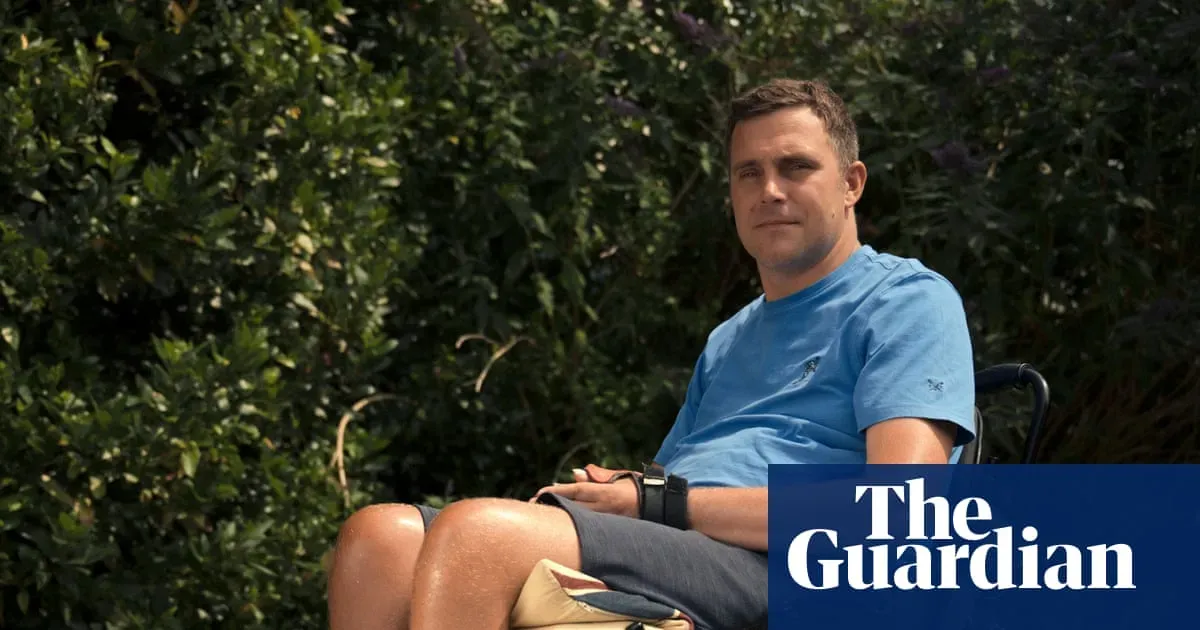
The extent of his injuries became clear: severe damage to his spinal cord left him tetraplegic, requiring constant care for the rest of his life.
For four months, Bugden was completely immobile. Even basic tasks like eating, brushing teeth, and washing were done by others for him.
In addition to mobility issues, he faced three major challenges typical of spine injuries: bladder, bowel, and sexual function problems made having children naturally difficult.
Regaining independence took time - 10 months in rehab before Bugden could perform simple actions on his own, like flipping a catheter or standing with assistance.
At the military hospital in the Midlands, where he eventually recovered, Bugden found a sense of camaraderie reminiscent of his air force days, and humor helped ease the pain.
The atmosphere was lively at the hospital cafeteria, where patients shared jokes despite their severe injuries.
The recovery process for Bugden was long and arduous, taking four years to complete.
He attributes his success in rehabilitation to patience, a quality he believes is essential in overcoming both physical and psychological hurdles.
There are inevitable ups and downs during the recovery journey, with periods of significant progress followed by plateaus or setbacks.
Bugden describes this fluctuating pattern as peaks and troughs, but surprisingly, he finds it enjoyable, especially when compared to his darkest moments spent lying in bed.
The adapted bungalow where Bugden resides is a testament to his remarkable resilience, boasting a range of sporting memorabilia that fills its walls.
These mementos include England running vests from his competitive days and a signed shirt from the Cornish Pirates, his beloved rugby team, which was sent to him while he was in hospital.
The room also features images from Bugden's time training with the Royal Air Force, serving as a reminder of his previous life before the accident.
In the corner of the living area is a bar that has seen better days, having been drained by friends who gathered to watch rugby matches.
In his darkest moments, Bugden has always been able to find solace in laughter and camaraderie.
The memories of his friends feeding him airplane snacks and making silly noises are etched vividly in his mind, bringing a smile to his face even now. I was just crying with laughter, he recalls, still chuckling at the thought. These carefree moments remind him of the joy that can be found amidst adversity.
His friends' unwavering support has been instrumental in his recovery, and Bugden appreciates their willingness to push him beyond his limits when needed. They have a knack for knowing exactly what he needs, whether it's a gentle nudge or a helping hand, as evidenced by the time they physically lifted him up a hill.
The rugby team his friends formed, Horus, has become an integral part of Bugden's rehabilitation journey. This initiative not only brought together military personnel and their families but also raised vital funds for charities supporting injured veterans. It was one of the most important parts of my rehab, he says matter-of-factly about the game that set a world record.
Bugden's accident has forced him to reassess his career, which is now medically discharged from the air force. However, he continues to work closely with the military and its associated charities, using his experience to make a positive impact. He still faces tough times but remains resolute in his determination.
As an ambassador for Sandville, Bugden lends his voice to raising awareness about life-limiting conditions. His involvement extends to several other organizations that support veterans struggling with disability, mental health, or financial challenges. We've got a long way to go, he admits candidly about the current state of accessibility for people in wheelchairs.
Despite the obstacles, Bugden remains hopeful about the progress being made towards greater inclusivity and support for those affected by injury or illness. His tireless efforts have earned him recognition from organizations like the Royal Air Force Benevolent Fund, which has been instrumental in his own rehabilitation.
Bugden's involvement with various charities has not only helped him cope with his accident but also given him a sense of purpose, he continues to advocate for change and raise awareness about the importance of support systems for those who need them most.
Bugden's competitive spirit has not wavered despite his accident, as evident from his recent participation in five half-marathons across Wales in a custom-built sports wheelchair. This impressive feat raised £8,000 for charities that have supported him during his recovery. The months of rigorous training paid off, allowing him to build strength in his arms using a ski machine, focusing specifically on his shoulders and biceps.
Bugden's determination is rooted in his philosophy, inspired by the 1999 sports drama Any Given Sunday. He often quotes Coach D'Amato's motivational speech, which emphasizes that even small steps can lead to significant progress. The coach's words resonate deeply with Bugden, who believes that overcoming adversity requires perseverance and a willingness to take on challenges.
Bugden's mantra Inches make metres, metres make miles, and miles make a lifetime" encapsulates his outlook on life, where every incremental improvement counts towards achieving greater goals.
Facts based on reporting originally published by The Guardian Life and Style.
You may republish this story, in full or in part, if you credit Noti Group and link to it (licence CC BY 4.0). Photos are not included.