






New Ferry Uses Hydrofoil Technology to Reduce Drag and Increase Speed
The VS-9 electric ferry has been unveiled in Brooklyn, using advanced hydrofoil technology to lift its hull out of the water.
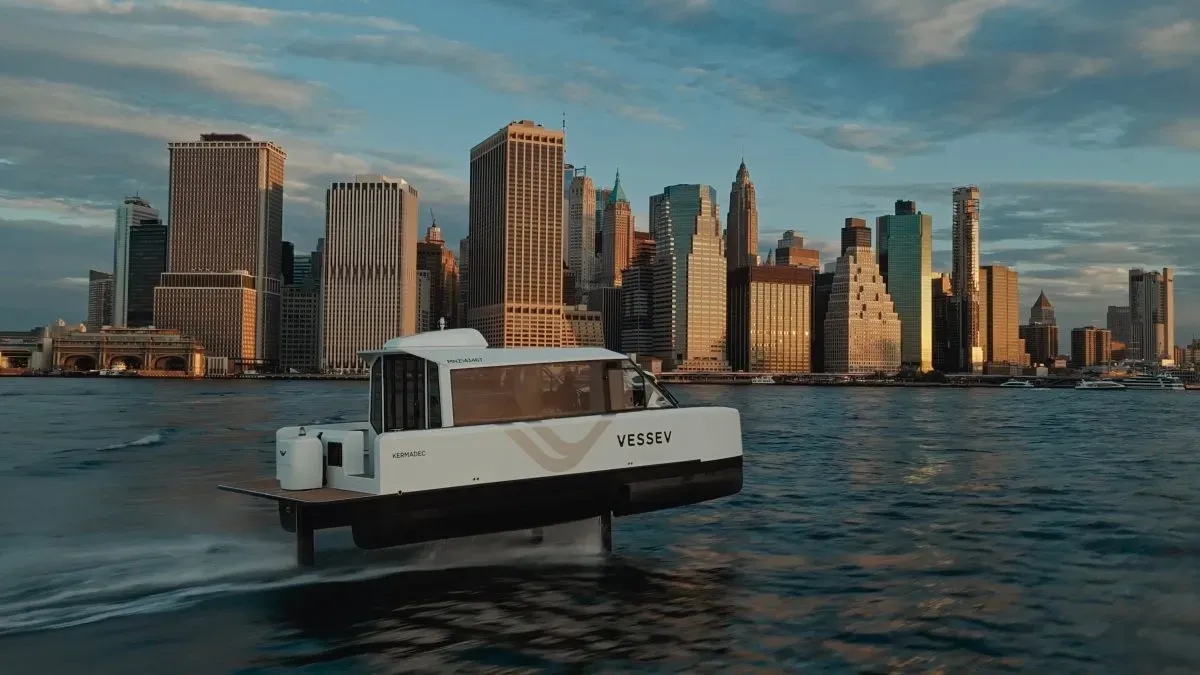
A revolutionary new ferry has been unveiled in Brooklyn, one that defies conventional boat design with its ability to "almost fly across the water. The VS-9 electric ferry, developed by startup Vessev, uses advanced hydrofoil technology to lift its hull out of the water, reducing drag and increasing speed.
As I boarded the VS-9 at the Brooklyn Marina, I couldn't help but wonder when it would transition into its flying mode. But according to Eric Laakmann, co-founder and CEO of Vessev, we already are" in that mode. I was a bit underwhelmed by this response, expecting a more dramatic shift.
Despite my initial disappointment, the ride itself proved to be an exhilarating experience. As we picked up speed on the East River en route to Governors Island, the hydrofoil's wing-like structures began to do their work, lifting the boat out of the water and reducing its contact with the surface. This resulted in a smoother, more stable ride than I've experienced on traditional boats.
At around 30 feet in length, the VS-9 is a relatively small vessel, but its design allows it to operate at speeds that would normally cause larger boats to bounce and slap the water. The computer-controlled underwater flaps play a crucial role in maintaining this smooth ride, adjusting as needed to ensure stability.
The lifting mechanism is primarily handled by the front foil, with about 20% of the load shared by the rear foil. This efficient design enables the VS-9 to achieve remarkable speeds without sacrificing comfort or stability.
The VS-9's design is not just about speed; it's also about efficiency. The electric motor, built in-house by Vessev, plays a crucial role in achieving remarkable speeds without sacrificing comfort or stability.
Vessev chooses to keep costs in line by building the electric motor themselves, rather than outsourcing it. Laakmann explained that this decision ensures they can maintain control over production and avoid potential future complications. The company does not manufacture batteries, however, as these have become a commodity item.
Hydrofoils offer several advantages over traditional boat designs. By lifting the hull out of the water, hydrofoils can operate more efficiently, which is particularly important for electric boats where every kilowatt-hour counts.
The VS-9's use of hydrofoils allows it to sail smoothly and efficiently. However, this design has its limitations. The foils work best in waters that are shallow enough for the boat to clear when sailing on its foils, about two and a half feet or 0.75 meters deep.
Vessev is targeting transit operations as its primary market. Laakmann believes that combining electric propulsion with hydrofoils can make smaller vessels more cost-effective to operate, while also providing a comfortable ride suitable for augmenting urban mass transit systems.
The Vessev team envisions a future where cities like New York can efficiently transport people between boroughs without needing extensive infrastructure development.
Hotels and tour operators are among the early adopters of this technology, drawn to its potential for novelty and luxury experiences. Public demonstrations have also caught the attention of wealthy individuals looking to acquire an exclusive mode of transportation. These events showcase the comfort and speed that electric hydrofoils can offer.
For now, the VS-9 remains a one-of-a-kind prototype, but Vessev plans to build more vessels in the future. The company may eventually shift its focus to developing electric hydrofoil kits, which would allow other boatbuilders to design their own vessels incorporating this technology.
The production of these kits could make the technology more accessible and cost-effective for various industries, including transportation and tourism. This move could also pave the way for larger-scale adoption and deployment of electric hydrofoils in urban areas.
Vessev's innovative approach combines electric propulsion with hydrofoils to create a unique mode of transportation that is both efficient and environmentally friendly.
The innovative transportation solution developed by Vessev has garnered attention for its unique combination of electric propulsion and hydrofoils.
This approach enables the ferry to travel efficiently while minimizing environmental impact, making it a promising alternative for coastal communities seeking sustainable transportation options.
As the company continues to refine its design, Vessev's vision is poised to transform the way people move around waterways, offering a cleaner and more efficient mode of transportation.
Facts based on reporting originally published by TechCrunch.
You may republish this story, in full or in part, if you credit Noti Group and link to it (licence CC BY 4.0). Photos are not included.