






James Cameron's Avatar Becomes Highest-Grossing Film Worldwide After 15 Years
The tide of fortune has shifted in favor of 3D movies with advancements in video glasses and VR technology.
The tide of fortune has finally shifted in favor of 3D movies, which were once touted as a revolutionary technology but ultimately failed to impress audiences. It's been over 15 years since James Cameron's Avatar wowed viewers with its groundbreaking visuals and went on to become the highest-grossing film worldwide.
For many enthusiasts like myself, watching 3D movies has always been an awkward experience. When visiting a movie theater, we were forced to wear polarized glasses that compromised on resolution and brightness. This was not just a minor issue; almost every 3D technology available today cuts down on something essential, whether it's the resolution or the refresh rate.
The problem with traditional 3D viewing is that it requires splitting one reflected image between our two eyes, which inevitably results in reduced quality. However, what if we had access to a full screen for each eye? This is precisely where video glasses come in, offering an immersive experience without sacrificing visual fidelity.
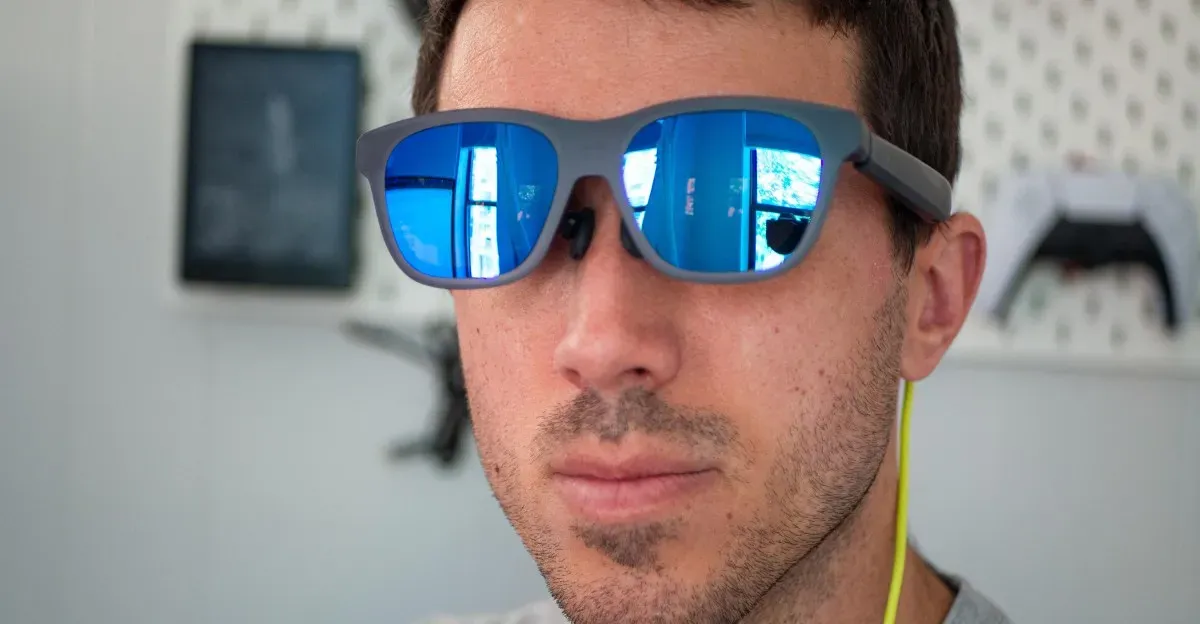
In my own testing last year, I experimented with the Xreal One Pro glasses, which provide a massive flat screen that can be used for various content. But here's the interesting part: if you press and hold the right button on these glasses, they can deliver independent left and right views for side-by-side (SBS 3D) content.
These video glasses have the potential to revolutionize the way we experience 3D movies at home, or anywhere else, for that matter. With their ability to provide a full screen for each eye, they may finally be worth the investment for those who have been waiting patiently for a better 3D viewing experience.
The improved 3D viewing experience is now available for those who use popular video player apps on VR headsets such as Meta Quest and Steam Frame.
These apps offer SBS 3D toggles that allow users to switch between 2D and 3D modes while watching content, providing a full 1080p view for each eye when in 3D mode.
The latest high-end VR devices, including the Apple Vision Pro and upcoming Meta VR Glasses, also enable native streaming of 3D films without the need for additional software or toggles.
This enhanced viewing experience is particularly noticeable in scenes with transparent glass or water effects, where the added depth creates a more immersive environment.
In these moments, even seemingly mundane elements like reflections on glass surfaces or rippling water take on a new level of realism.
The latest advancements in 3D technology have brought immersive experiences to life, allowing viewers to feel as though they are an integral part of the scene. This was evident during a demo of Billie Eilish's concert film, which was shot using 16 twin cameras and four remote-controlled AGITO camera rigs. The footage looked stunning when viewed through Meta VR Glasses.
The level of detail in these VR experiences is remarkable, with even minor elements taking on a new level of realism. For instance, the demo of Galapagos: The Last Eden featured breathtakingly realistic depictions of baby seals, complete with intricate textures and shading that made their fur appear almost palpable.
The interactive nature of some 3D documentaries adds another layer of engagement for viewers. When watching Cave of Forgotten Dreams, a 3D documentary about the world's oldest surviving art, it was fascinating to see how the three-dimensional canvas brought the ancient cave paintings to life. The ability to appreciate the depth and dimensionality of these artworks is truly captivating.
The effect of 3D on our emotional connection to characters is also noteworthy. When watching a scene from an unspecified film, it felt as though I could reach out and touch the character's face, sense their emotions and expressions with heightened clarity. This level of immersion can be quite disorienting, making it easy to lose track of time.
The capabilities of 3D technology are not limited to entertainment; they also offer new ways to appreciate art and culture. The demo of Gravity, a film that might have been intended as a brief test, ended up being watched from start to finish, a testament to the captivating nature of immersive 3D experiences.
The experience of watching 3D movies is often marred by poor quality or fake effects, but recent advancements in technology have made it possible to enjoy immersive experiences that transport viewers into new dimensions.
Not all 3D content is created equal, and live-action movies filmed with twin cameras are a rare commodity. The absence of true depth in poorly converted 3D movies can be jarring, resulting in a "billboard" effect where objects appear as flat layers rather than three-dimensional entities.
This phenomenon can be seen even in popular films like Doctor Strange in the Multiverse of Madness when viewed through VR glasses. While the flat effects may not be entirely convincing, they do serve to highlight the textures and details that are often overlooked in traditional viewing experiences.
However, accessing high-quality 3D movies is still a challenge for consumers. Despite being available in some theaters, it's difficult to stream or purchase 3D films due to their limited availability on digital platforms.
The physical format of 3D Blu-rays has also become obsolete, with many discs offering only subpar quality at 1080p resolution and 24 frames per second without high dynamic range. Even finding these rare discs can be a daunting task, requiring extensive searches and sometimes hefty price tags.
Meta is poised to shake up the 3D movie landscape by making it possible for users of its VR headsets to stream Hollywood's 3D collections directly from their devices.
The Meta Quest 3S and Quest 3 will soon be able to access a vast library of 3D films through various streaming apps, including Disney Plus, HBO, Paramount Plus, and Peacock. This marks a significant shift in the way users can experience 3D movies, eliminating the need for expensive headsets or cumbersome discs.
The Meta VR Glasses, set to launch in spring, will also offer access to hundreds of 3D films through Meta's TV app, with some content available for rent or purchase and others offered for free. This move is expected to make high-quality 3D movies more accessible to a wider audience.
Meta director of entertainment Sarah Malkin has confirmed that the company's VR headsets will be able to stream 3D movies from various streaming services, including Disney Plus, HBO, Paramount Plus, and Peacock. Some content is set to become available as early as this fall.
The Meta VR Glasses are expected to offer a vast library of 3D films through their TV app, with hundreds of titles available for rent or purchase, in addition to some free content.
The resurgence of 3D technology has made it possible for users to access and enjoy 3D movies without relying on expensive cinema equipment or outdated hardware.
Thrift stores have become a treasure trove for 3D enthusiasts, with many browsing through racks to find 3D Blu-ray discs at affordable prices. Once acquired, these discs can be played back using an external USB Blu-ray reader and specialized software like MakeMKV, which extracts the multi-view (MVC) file from the disc.
This extracted MVC file is then processed by BD3D2MK3D to produce a high-quality Full-SBS file, significantly reducing its size while maintaining excellent picture quality.
Facts based on reporting originally published by The Verge.
You may republish this story, in full or in part, if you credit Noti Group and link to it (licence CC BY 4.0). Photos are not included.