







Crows Found to Process Visual Information Twice as Quickly as Mammals
Researchers have discovered that crows can evaluate visual information twice as quickly as mammals by putting two carrion crows through a complex visual task.
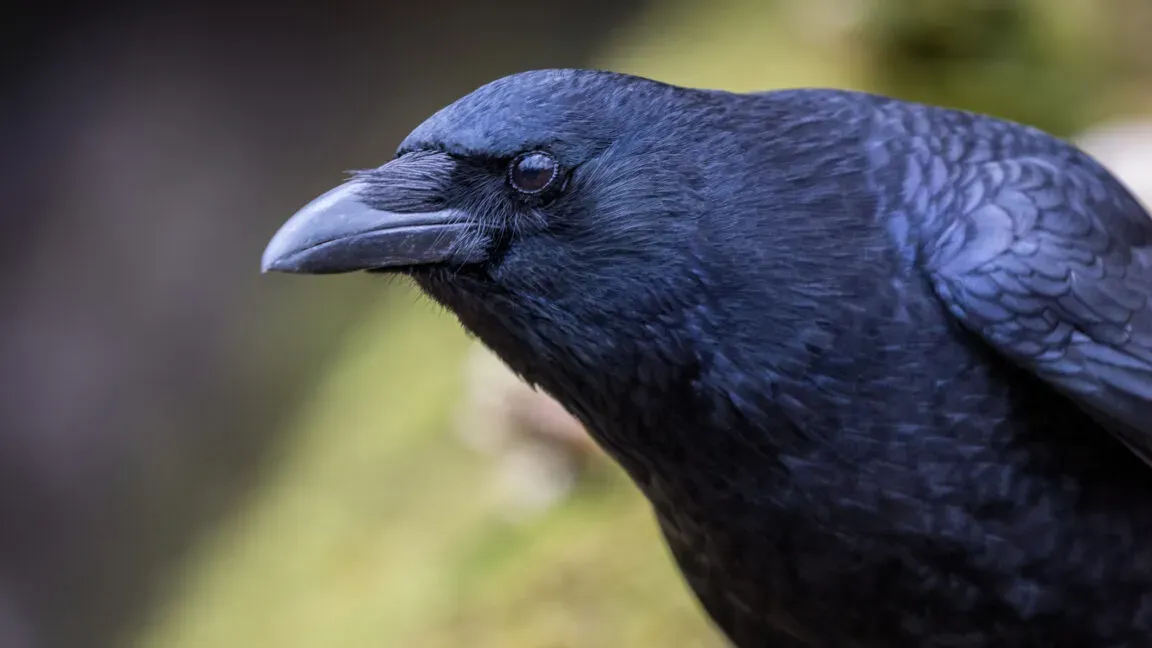
A team of researchers has made a groundbreaking discovery about the decision-making abilities of crows. By putting two carrion crows through a complex visual task, they found that these birds can evaluate visual information twice as quickly as mammals.
The task involved displaying a cloud of white dots on a black screen, with some of them moving in a specific direction. The crows' job was to identify the overall direction by pecking one of the targets flanking the display. They were rewarded with mealworms for correct answers.
This study is significant because it challenges our understanding of how brains make decisions. Most of what we know about decision-making comes from studying monkeys, but their brain structure is very different from that of birds. The avian brain lacks a neocortex, making it unclear how crows would process visual information.
Neurobiologist Andreas Nieder and his colleague Philipp Schmidbauer were determined to find out how crows make decisions. They put two hand-raised crows through the same task as the monkeys, recording their brain activity in real-time. The results showed that the crows solved the task using a similar mathematical logic despite having a very different brain structure.
The most surprising finding was that the crows completed the task twice as fast as mammals. This suggests that the avian brain is highly efficient when it comes to processing visual information and making decisions.
Further research will be needed to fully understand how crows' brains work, but this study provides valuable insights into the decision-making abilities of birds.
The researchers at the University of Tubingen designed a task to test the visual processing abilities of both crows and monkeys. They employed a random-dot motion paradigm, where participants had to determine the direction of moving dots on a screen. The motion was created by changing the position of individual dots over time, with varying degrees of coherence.
To ensure that any observed differences in performance were due to the species rather than the task itself, the researchers carefully controlled the conditions under which the task was presented. They varied the percentage of dots that moved coherently, ranging from 81 percent down to just 3 percent, and included a condition where no dots moved at all.
Both birds and monkeys performed remarkably well on this task, even when only a small minority of dots were moving in sync. In fact, crows scored above chance levels when as few as three percent of the dots were coherently moving. This suggests that both species possess impressive visual processing abilities.
The researchers recorded neural activity from 248 neurons in the nidopallium caudolaterale (NCL), a region at the top of the avian processing hierarchy. The NCL is thought to be equivalent to the primate prefrontal cortex, but its architecture differs significantly between birds and mammals. In particular, bird brains are organized into dense clusters rather than layered sheets.
Despite these differences in brain structure, the crows' visual processing abilities proved to be surprisingly fast. On average, it took them just 235 milliseconds to process the visual information and make a decision. This is roughly half the time taken by monkeys, which averaged around 410-600 milliseconds across multiple studies.
The researchers carefully checked whether the birds were sacrificing accuracy for speed, but found no evidence of this. In fact, both crows and monkeys performed with high accuracy on this task, even when the motion was very subtle. This suggests that the birds' faster processing times are not due to any compromise in their ability to accurately perceive visual information.
The results suggest that crows are not sacrificing accuracy for speed in their visual processing abilities. Their brains are able to evaluate visual information at a rate significantly faster than that of mammals.
Crows were given a self-paced decision-making task and performed just as well as monkeys or humans in the same test, despite being twice as fast. The researchers did not push the birds to work as quickly as possible; instead, they allowed them to complete the tasks at their own pace.
At first glance, it seemed that crows' brains might be operating on a fixed deadline, with reaction times remaining relatively consistent even when the task became more difficult. However, this initial interpretation was later found not to hold up under closer examination.
Further analysis revealed that while crows do show an increase in reaction time as the difficulty of the task increases, it is much less pronounced than what has been observed in mammals. This suggests that crows are indeed processing visual information and accumulating evidence to make decisions.
The brain activity recordings reveal a fascinating pattern of evidence accumulation in crows as they decide which direction to move towards a target. When the bird's head eventually moved, about 70 milliseconds after the dots appeared, nearly one-quarter of the sampled neurons fired differently depending on the chosen direction.
These neurons started registering their decision remarkably early, roughly 170 milliseconds before the movement of the bird's head. The pattern is reminiscent of what has been observed in monkey brains, specifically in the neocortex, where sensory evidence is accumulated to inform decisions.
The phenomenon is similar to a "decision variable, a running tally of evidence that builds towards a commitment. In this case, the team found that the crow brain exhibits essentially the same behavior as its mammalian counterparts, despite having evolved distinctly.
Nieder suggests that the crows' exceptional speed may be due in part to the faster operation of nearly every biological process in birds compared to mammals. This cascade of accelerated processes likely begins with vision, given avian visual systems are highly sensitive to movement.
Birds have evolved unique brain structures that enable them to process visual information at incredible speeds. One key factor is their compact size, which allows for a high concentration of neurons in a small space. This is particularly relevant for flying birds like crows, as the weight constraints imposed by flight require efficient use of space.
Neuroscientist Avian Nieder notes that shorter axons, the fibers that transmit signals between cells, are a major contributor to this speed advantage. Long lines take time," he explains. "Short lines speed everything up." This is because shorter distances mean less energy is required for signal transmission, allowing birds to process information more quickly.
Birds also have higher body temperatures than mammals, which accelerates chemical processes in their bodies. Nieder points out that this higher temperature has a significant impact on the speed of neural activity. "Every ion channel would open and close faster," he explains. "Every transmitter would move through the synaptic cleft faster." This is a critical adaptation for birds, as it enables them to respond rapidly to changing environments.
However, there are some limitations to consider when evaluating the decision-making abilities of crows. The study on which Nieder is commenting included only two birds, which is a relatively small sample size. Additionally, the specific task being used, random dot-motion, requires waiting to see which direction movement is occurring, and may not be representative of all decision-making scenarios.
The speeds at which crows and other birds process visual information are also not necessarily absolute limits. The 235 millisecond response time observed in crows, for example, may be influenced by the specific task being used.
The results of this study may not be exclusive to corvids or crows. One challenge in determining whether these findings apply more broadly is that many other bird species lack the intelligence and cognitive abilities necessary to perform complex tasks.
This could mean that the exceptional decision-making skills observed in Nieder's lab are due to factors specific to crows, rather than being a general characteristic of birds with fast brain processing speeds. The corvid family, which includes crows, is renowned for its high level of intelligence among bird species.
Facts based on reporting originally published by Ars Technica.
You may republish this story, in full or in part, if you credit Noti Group and link to it (licence CC BY 4.0). Photos are not included.