







US Economists Awarded Nobel Prize for Macroeconomic Policy Models
Two US economists have been awarded the Nobel economics prize for their groundbreaking work on developing models that help central bankers and finance ministers stabilise their economies.
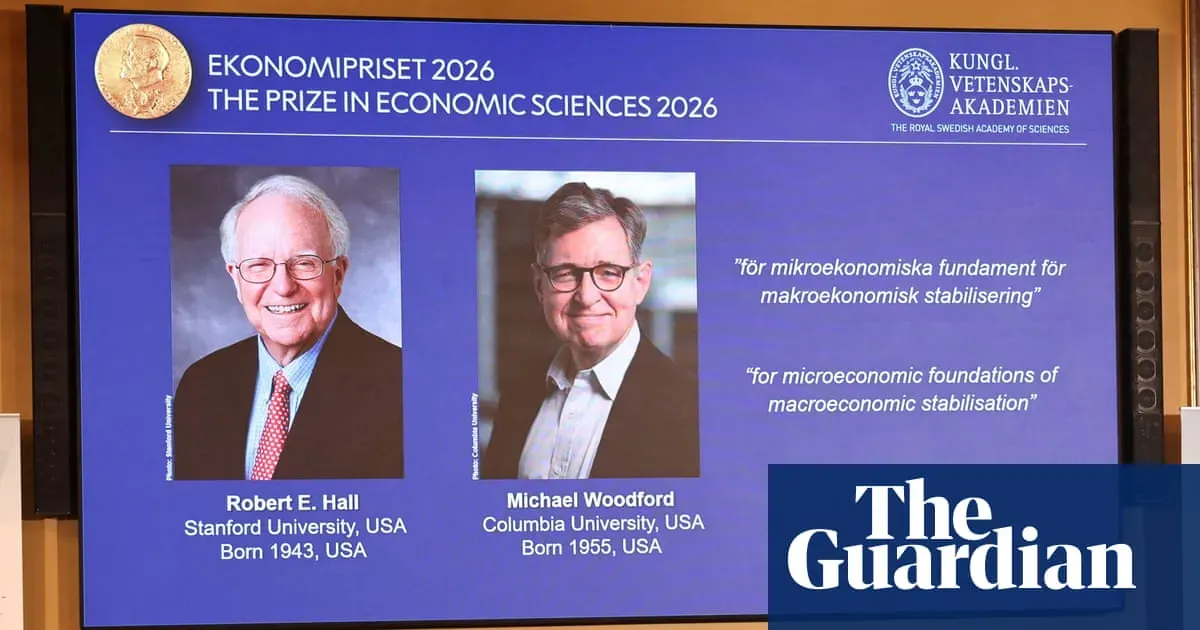
Two US economists have been awarded the Nobel economics prize for their groundbreaking work on developing models that help central bankers and finance ministers stabilise their economies.
Robert Hall of Stanford University in California and Michael Woodford of Columbia University in New York were honoured for creating a new framework for macroeconomic policy, providing policymakers with better tools to smooth out economic fluctuations. Their research focuses on the microeconomic foundations of macroeconomic stabilisation, which has led to significant improvements over traditional models. This shift is expected to have far-reaching implications for economic policy-making.
The Royal Swedish Academy of Sciences acknowledged the pair's contributions by awarding them the prize worth $1.2m combined. The academy praised their work as generating a paradigm shift in stabilisation policy, enabling policymakers to better understand and quantify the impact of their decisions on business cycles. This has led to widespread adoption of their New Keynesian models among central banks and finance ministries worldwide.
The pair's research builds upon John Maynard Keynes' original stabilisation models, which struggled to cope with the economic shocks of the 1970s, such as high inflation, weak growth, and high unemployment. By addressing these limitations, Hall and Woodford have created more effective tools for policymakers, allowing them to navigate complex economic challenges.
Their research focused on how individual households and businesses contribute to the overall economy through their actions, rather than relying solely on mechanical rules of thumb.
Hall's approach centered on forward-looking consumer behavior, taking into account variables such as inflation, unemployment, and GDP in a more nuanced way than traditional models.
Woodford built upon this foundation by developing the New Keynesian model, which serves as a comprehensive framework for macroeconomic stabilization.
This model has become the primary tool used by policymakers to navigate economic challenges, including those arising from external shocks like energy crises or sudden changes in consumption patterns.
The New Keynesian model's impact was particularly evident during and after the 2008 financial crisis, when it helped guide central banks and governments as they worked to prevent a second great depression.
The New Keynesian model's influence on monetary policy has not been without controversy. Some critics argue that forward guidance, a key component of this approach, should be used sparingly to avoid creating confusion among market participants.
For instance, the current chair of the US Federal Reserve has expressed reservations about the role of forward guidance in normal times, suggesting it could lead to ambiguity rather than clarity. This view highlights the ongoing debate surrounding the model's applicability and potential pitfalls.
The Bank of England's former governor was also criticized for his use of forward guidance in 2014, with some accusing him of creating uncertainty by hinting at interest rate rises that never materialized. This episode underscores the challenges of implementing this approach in practice.
Hall's work has been widely praised for its impact on stabilisation policy, and he is being recognized alongside Michael Woodford for their groundbreaking contributions to the field.
Economists affiliated with inland universities near the Great Lakes, such as the University of Chicago, tend to subscribe to a set of principles including free markets and neoclassical price theory. They also advocate for rational expectations and monetarism.
In contrast, economists based at coastal universities, like Harvard, MIT, and UC Berkeley, often hold Keynesian views and believe in the role of governments and central banks in shaping demand within their respective economies. It's worth noting that the Sveriges Riksbank prize in economic sciences, commonly referred to as the Nobel Prize for economics, was established by Sweden's central bank rather than Alfred Nobel himself.
Facts based on reporting originally published by The Guardian Business.
You may republish this story, in full or in part, if you credit Noti Group and link to it (licence CC BY 4.0). Photos are not included.