



Roman Abramovich's wealth allegedly hidden from tax authorities through falsified documents
A joint investigation by BBC Panorama and the Bureau of Investigative Journalism has uncovered evidence of alleged tax evasion involving Deloitte and Roman Abramovich.
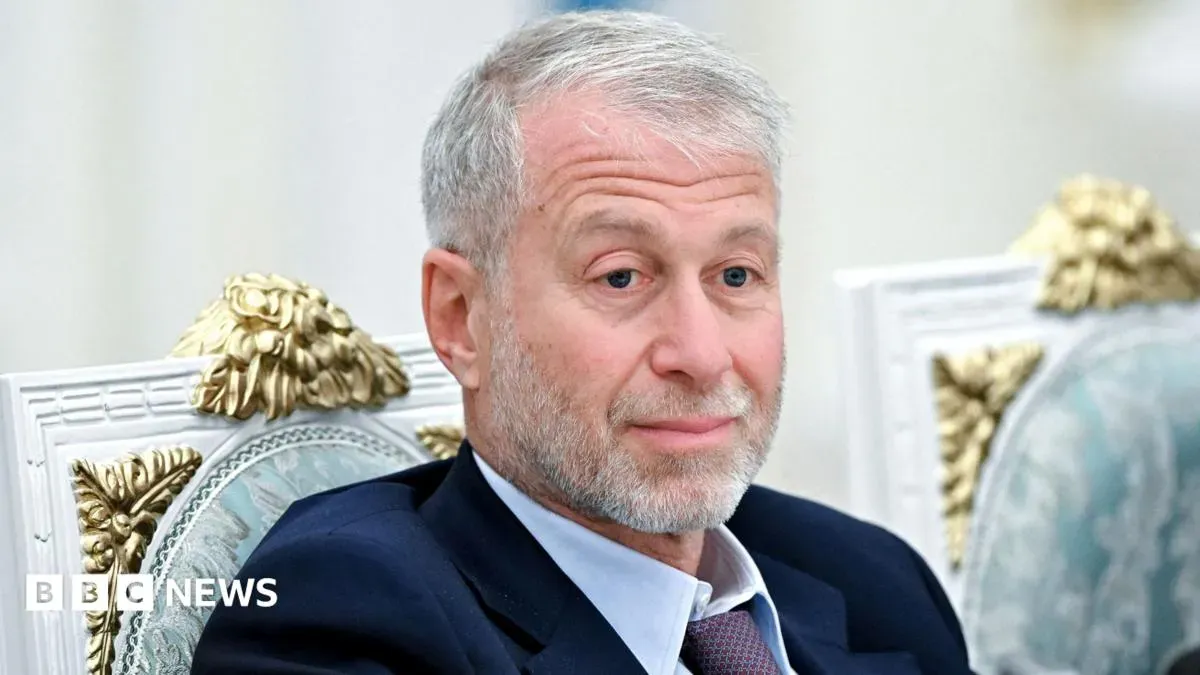
Roman Abramovich's wealth was allegedly hidden from tax authorities through falsified documents, according to evidence uncovered by BBC Panorama in a joint investigation with the Bureau of Investigative Journalism.
Deloitte, the world's largest accountancy firm, is accused of being involved in this process, specifically in Cyprus where it signed off on accounts that erased assets worth $672m from Abramovich's company records. These hidden assets included luxury items such as superyachts, mansions, and private jets.
Experts have described the alleged scheme as straightforward tax evasion, saying it couldn't be more blatant. Barrister Andrew Mitchell KC, an expert in financial services law, has stated that Panorama's evidence clearly shows a deliberate attempt to evade taxes through document falsification.
Abramovich's lawyers have denied any wrongdoing on his part, claiming he did not authorise or direct the falsification of documents and that it was reasonable to rely on professional advice. They also pointed out that Abramovich had used legitimate tax planning strategies in conjunction with his accountants.
Deloitte Cyprus has responded by stating that it operates within applicable laws. This statement comes as part of a wider investigation into Abramovich's financial dealings, which have been scrutinized following his sanctioning by the UK government in 2022.
As a result of these sanctions, Abramovich was forced to sell Chelsea Football Club and a significant portion of his assets remain frozen in Jersey, valued at £5.4bn. A four-year-long criminal investigation into Abramovich's activities is still ongoing.
The leaked documents reveal a complex network of offshore companies set up by Abramovich's business empire between 1995 and 2022. These companies were administered from Cyprus, a country that was previously known for its tax haven status, particularly among Russian investors.
The investigation into Abramovich's finances has been ongoing since the leak of thousands of documents in 2023. Media partners including the Guardian, Paper Trail Media, and others have been working together to uncover the details of his business dealings through the International Consortium of Investigative Journalists' Cyprus Confidential investigation.
A corporate services firm called MeritServus played a key role in managing Abramovich's global fortune from its base in Limassol, the second-largest city on the island. Until 2005, MeritServus was owned by Deloitte, one of the largest accounting firms in the world and now part of the "big four industry leaders.
The leaked documents highlight how profits from Abramovich's oil deals in Russia were channeled into a web of offshore companies managed by MeritServus. The firm worked closely with Abramovich's associates to oversee his global financial interests.
Abramovich has previously denied allegations of corruption surrounding the sale of a Russian state-owned oil company, claiming that such claims are false. He has maintained that the sale was legitimate and profitable for all parties involved.
The investigation into Abramovich's activities remains ongoing, including a four-year-long criminal probe into his business dealings.
The leaked documents from MeritServus reveal some of their practices related to Roman Abramovich's wealth. In 2006, a new law in Cyprus required company accounts to be made public, threatening to expose Abramovich's vast fortune.
This transparency law led to the preparation of draft accounts for 2003 by Deloitte Cyprus for Amiscan Investments, a Cypriot company owned by Abramovich. The accounts detailed $672m worth of luxury property, including a mansion in West Sussex and an estate in the south of France.
Abramovich's associates and Meritservus decided to rewrite history to keep these assets secret. They devised a plan to transfer the assets to Amiscan's parent company in the British Virgin Islands (BVI), where they could remain hidden from public view.
The asset transfer was backdated by three years, making it appear as though it had occurred in 2003. Deloitte Cyprus reviewed the revised documents and deemed them adequate for removing the assets from Amiscan's accounts.
When the 2003 accounts were finalized by Deloitte in 2006, the luxury properties, planes, and yachts vanished from the records at the stroke of a pen. Only $75,000 worth of assets remained listed.
The backdated documents allowed Abramovich to conceal his vast wealth from public scrutiny, taking advantage of loopholes in the law to evade tax on his assets.
The investigation into Roman Abramovich's financial dealings has uncovered further evidence of tax evasion through the use of falsified documents. Deloitte, the accounting firm that signed off on Abramovich's company accounts, appears to have been aware that the documents were misleading.
Experts have described the actions of Deloitte as a violation of a statutory duty" and "pretty scandalous. This is because they failed to ensure that the accounts accurately reflected the company's financial situation. Instead, they allowed backdated documents to be used to conceal the true nature of Abramovich's wealth.
Another one of Abramovich's Cypriot companies, Kravin Investments, was found to have almost $2bn in its bank account in 2003. The company should have been paying tax on the interest it earned from this money to the Cypriot authorities. However, a plan was devised to rewrite history and avoid paying taxes.
According to emails obtained by investigators, MeritServus informed Abramovich's Russian associates that a plan had been devised after a meeting with Deloitte. The email stated that certain changes will have to be made to the accounts" due to backdated changes to Kravin's assets. This was in August 2005.
A month later, an associate in Russia emailed in response to agree to the plan. MeritServus then created a series of backdated documents which falsely purported to show that Kravin did not actually own the money. This made it look like the company was only holding and investing funds on behalf of its parent company in the BVI.
Deloitte's involvement in this scheme has raised questions about their role as auditors. They were aware of the backdated changes being made to Kravin's accounts, yet still signed off on them. This has sparked concerns that Deloitte may have been complicit in Abramovich's tax evasion activities.
Evidence suggests that Deloitte allowed Abramovich's company to evade millions in tax by advising on the falsification of financial records.
According to experts, this would be considered straightforward tax evasion if it were to occur in England, with HMRC likely to consider prosecution for amounts in the millions.
Cypriot officials have also expressed concern about the potential tax evasion, stating that those responsible should face the consequences according to their country's laws and that efforts should be made to recover any lost revenue.
In addition to the documents Deloitte helped backdate, another set of records was falsified by Abramovich's advisers at MeritServus. This involved a significant portion of his business fortune, exceeding $10bn.
The company behind this scheme, Electus Investments in Cyprus, was made to appear as though it did not own the massive fortune, when in fact it had been acknowledged by MeritServus that Electus did indeed hold this wealth.
The investigation revealed that documents were falsified to conceal Roman Abramovich's vast wealth, making it appear as though he did not own the massive fortune.
Andrew Mitchell KC, a lawyer featured in the documentary, expressed his concerns about professionals willing to bend and break the law to serve their clients' interests. He noted that these individuals are prepared to go to great lengths to create false documents. This raises questions about the accountability of those involved in such activities.
Vladimir Milov, Russia's deputy minister of energy and a former critic of Abramovich's business dealings, commented on the role of Western financial and legal services providers in whitewashing the reputations of corrupt oligarchs from around the world. According to Milov, these individuals are often willing to accept money for their services, making it easier for those involved in illicit activities to avoid detection.
The story has significant implications for Abramovich's reputation, with his lawyers denying any wrongdoing and claiming that he was not directly involved in the operation of companies linked to his wealth. However, the investigation has raised serious questions about the legitimacy of these arrangements, leaving many wondering if Abramovich's claims can be trusted.
Facts based on reporting originally published by BBC News Business.
You may republish this story, in full or in part, if you credit Noti Group and link to it (licence CC BY 4.0). Photos are not included.