







Student Protests Sweep Across UK as Thousands Walk Out of Schools and Universities
Thousands of students across the UK walked out of schools and universities on Friday in one of the largest student mobilisations since 2010.
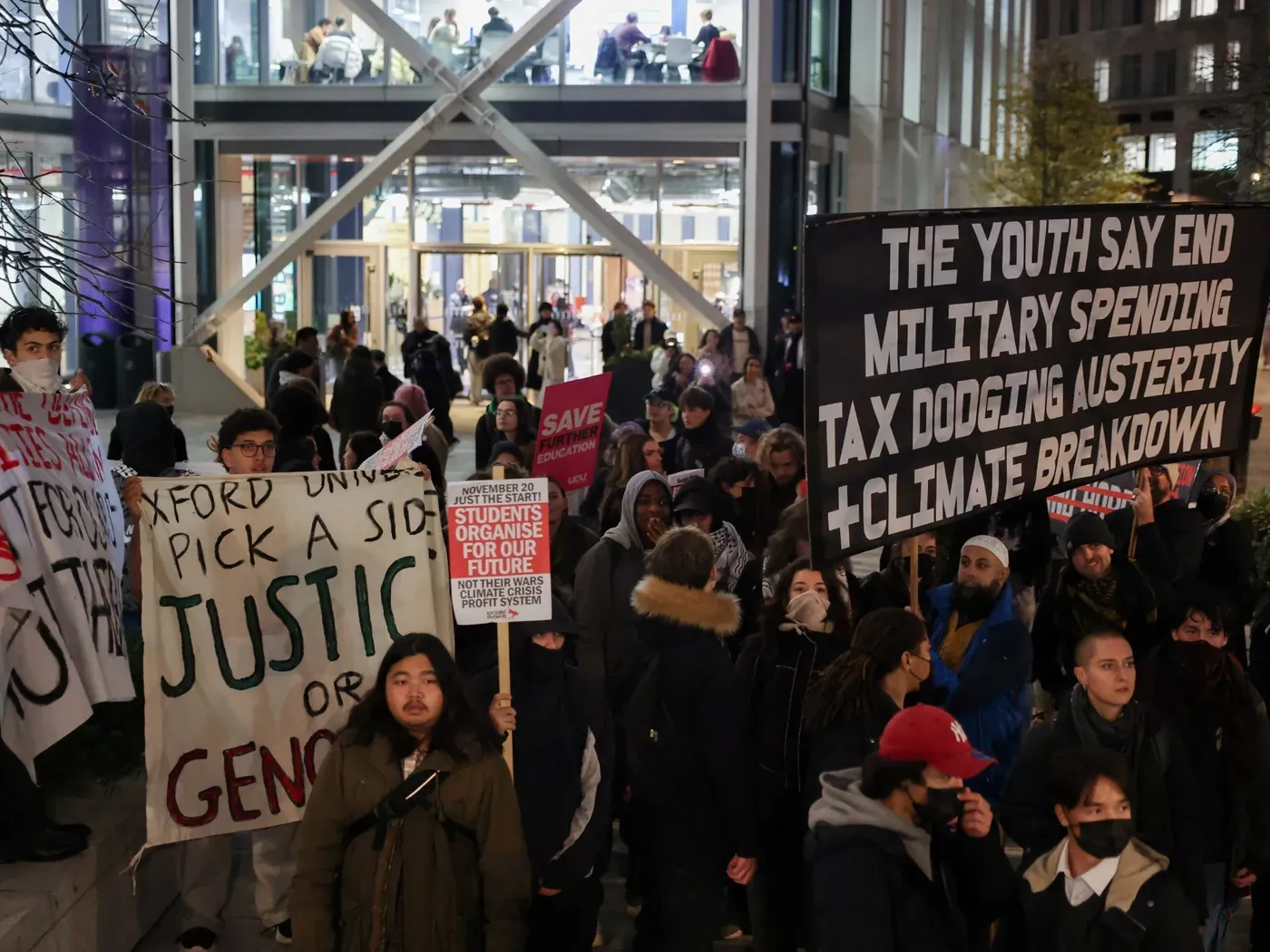
Thousands of students across the UK walked out of schools and universities on Friday, marking what is likely to be the beginning of a wave of youth-driven demonstrations in the country.
The protests, which took place from Aberdeen to Brighton, Swansea to Nottingham, were one of the largest student mobilisations since the tripling of tuition fees in 2010. Organisations involved in the International Conference Against War had called for the walkouts as part of a pan-European initiative aimed at coordinating movements against militarism.
Major unions have been quick to back the protests, with several key unions announcing their support for the National Day of Action. The University and College Union (UCU) was among the first to pledge its backing, urging members across the university sector to hold protests and rallies alongside students.
The union support is significant, given the potential for coordinated action between students and workers. Several major unions, including Unison, Unite, the National Education Union (NEU), GMB and the Educational Institute of Scotland (EIS), have now pledged their backing for the initiative.
In London, thousands of protesters from universities and colleges converged on Trafalgar Square, chanting slogans such as "fight for our future, not their wars" before marching on Downing Street to hear student activists and trade union leaders denounce government priorities.
The convergence of economic woes in Europe has finally reached British shores, where young people are facing a perfect storm of high inflation, unemployment, and stagnant economy. The situation is further exacerbated by cuts to public services, deteriorating living standards, and a housing crisis fueled by property speculation.
Government estimates reveal that nearly one million young Brits between 16 and 24 years old are not in education, employment, or training - a staggering 13 percent of their age group. This demographic accounts for more than 40 percent of the country's unemployed youth, highlighting the bleak job market they face every day.
The mental health of British youth is also under siege, with a rampant epidemic that shows no signs of abating. To make matters worse, the education system has become increasingly inaccessible due to rising costs and fees, leaving many young people in financial straits.
As if these challenges weren't enough, the government's response has been to propose further austerity measures - a recipe for disaster that threatens to unleash a full-blown social and economic crisis. This approach ignores the root causes of the problem and instead seeks to privatize solutions to the benefit of corporate interests.
The appointment of Alan Milburn, a former Labour minister with a track record of promoting private finance in public services, to write a report on Neets has raised eyebrows. His recommendations, unsurprisingly, focus on market-driven solutions that include cutting benefits for young people - including those with disabilities.
The British higher education sector has been hit hard by years of austerity measures, leading to widespread job cuts and course closures as university management struggles to cope with dwindling direct government funding.
The resulting extreme dysfunction, chaos, and mismanagement have prompted accusations of "academic vandalism from many quarters, where the pursuit of efficiency and profit over quality provision has become the norm. This is evident in Faustian bargains struck with banks, management consultants, and corporate outsourcing firms.
Meanwhile, British youth are being offered an alternative to dwindling education and civilian job opportunities: a fully paid 18-month foundation scheme in the army. Military training, bolstered by a public campaign around warfighting readiness, is now being promoted as part of last year's Strategic Defence Review.
This trend is not unique to Britain; across Europe, there is a worrying pattern emerging where military spending is on the rise even as funds for public services dwindle. Young people are well aware of this fact and are likely to be affected by it.
The push for increased European military cooperation, driven in part by NATO's growing influence and Trump's insistence that EU countries contribute more to maintaining the alliance, has Ukraine at its centre: a key battleground in Russia's encroachment into Eastern Europe.
The UK's education system is facing a potential crisis, mirroring the protests seen in France where youth mobilisation has been a key factor. The French government has faced repeated strikes over education, with the latest wave of protests sparked by concerns about funding for schools.
In contrast, the UK spends significantly less on education as a percentage of GDP, at 4.1 percent compared to France's 5.1 percent. Furthermore, even this limited budget is being diverted towards defence spending, leading to reduced funding for schools in the coming years.
The UK has experienced unprecedented political instability over the past decade, with seven prime ministers serving during this period. Each of these leaders has failed to address the pressing issue of income and wealth redistribution, allowing the rich to accumulate vast amounts of wealth while many others struggle to make ends meet.
Labour's leadership under Starmer was expected to bring about significant change, but he ultimately continued the tradition of failing to deliver on social democratic promises. His party's performance in recent local elections was disappointing, with Labour being hammered by Reform and the Greens who capitalised on public discontent over the government's handling of key issues.
The current prime minister has maintained a similar stance to his predecessor, despite claims that the government has recognised its mistakes on Palestine. The new foreign secretary's admission that the government got it wrong" is a significant development, but it remains to be seen whether this will translate into tangible action and policy changes.
A growing number of people in the UK are taking to the streets to protest against the government's policies, forcing politicians to reconsider their approach. Privatisation, deregulation, and cuts to social welfare have been a hallmark of economic policy over the past half-century, but they have not brought about the desired prosperity.
The current crisis is deepening, with unemployment and poverty on the rise. The protests are not just about economics; they also reflect a broader desire for change in the way society is organised. People are demanding real, lasting change that addresses the root causes of their grievances.
The parallels between the present day and the 1848 revolutions in Europe are striking. Then, as now, severe economic crisis, unemployment, and social unrest sparked widespread protests. The task ahead is to build an international movement that can generalise these grievances, coordinate action, and deliver concrete solidarity against austerity and war.
Facts based on reporting originally published by Al Jazeera.
You may republish this story, in full or in part, if you credit Noti Group and link to it (licence CC BY 4.0). Photos are not included.