






Israeli Outpost Set Up Near Deir Abu Mishal Village in West Bank
A recent Israeli High Court decision granted coordinated harvesting permits to farmers in Area B of the Occupied West Bank.
A stark change has taken hold in Deir Abu Mishal, a village west of Ramallah in the Occupied West Bank, where farmland once teemed with life and activity. Saleh Zahran inherited his family's 120 olive trees from his grandfather and father, splitting the land among his brothers.
The villagers relied heavily on their land for sustenance, with between 70 to 80 percent of residents depending on it for income. Just a few years ago, settlers were nowhere near, allowing families like the Zahrans to live off the land without interference. But that changed abruptly when an Israeli outpost was set up about 1km from their property in June.
Life has become increasingly difficult for the Zahran family and others in Deir Abu Mishal since then. Settlers have been attacking their cars, making it nearly impossible for them to reach their farmland. Elderly family members, like Saleh's father, were even targeted with pepper spray when they tried to access their property.
The situation escalated further on November 10, when an Israeli High Court decision granted the village two days of "coordinated harvesting in Area B, a region under joint Israeli-Palestinian control. This marked a significant shift in policy, as such permits were once unheard of in this area.
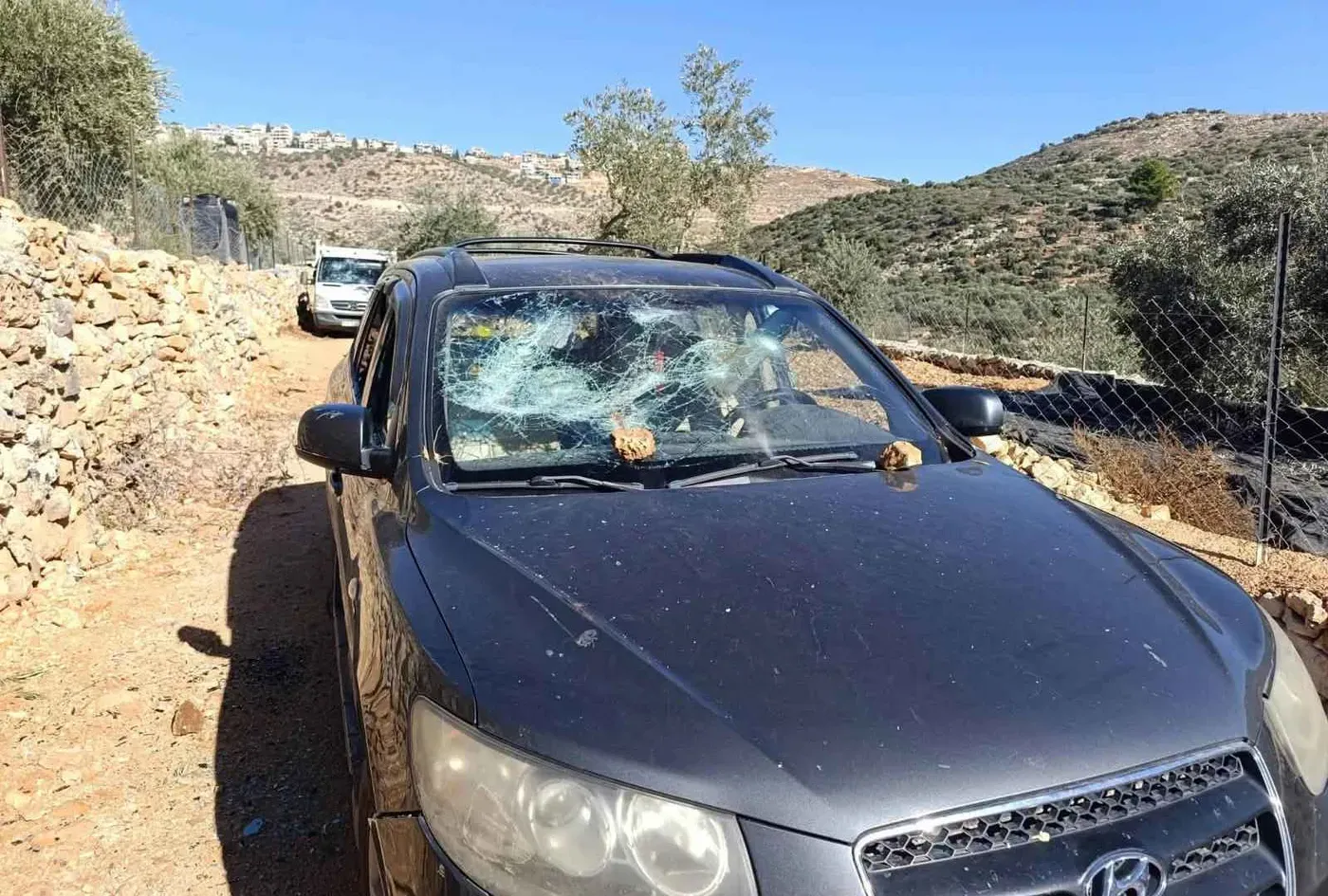
Saleh Zahran and his brothers attempted to reach their land for the first time in five months but faced a violent confrontation with around 20 settlers. The attackers hurled stones, smashed two vehicles, and slashed tires, leaving the family members shaken. Notably, no soldiers or police arrived on the scene despite the family's frantic calls.
The next day, army personnel and their liaison office were present at the site, but they imposed restrictions on the farmers' access to their land. The villagers were shown a map of permitted areas and told to leave by 2:30 pm, limiting their ability to harvest even further. According to Ghiyath Nasser, the family's lawyer, the farmers managed to reach less than a third of their land, allowing Saleh Zahran to harvest only about 20 of his 120 trees.
The ordeal has left the villagers frustrated and worried about their future. The once-thriving farmland is now under threat, and it remains to be seen whether the Israeli authorities will continue to allow the settlers' aggressive behavior or take steps to protect the rights of the Palestinian farmers.
The Zahran family's farm room had been a target of settlers' aggression, with their belongings stolen or smashed. The settlers had also begun to use the two wells that Zahran had restored as a source of water for their sheep. Meanwhile, the saplings he had planted last year were dying from thirst.
In theory, it is the settlers who are barred from the Zahran family's property and surrounding land in Deir Abu Mishal. However, in practice, Palestinian owners like Zahran are often kept out by Israeli military declarations. The result is a situation where settlers can operate freely while Palestinian residents face significant challenges.
Nasser, another affected farmer, reported that the army had twice demolished an outpost on his land before declaring it a closed military zone for Israelis only. According to Nasser, this means soldiers are not required to demand permits or coordination from Palestinian owners, their job is to prevent settlers from entering.
Lawyer Wail Qut from Madama explained that the Israeli army often declares areas closed to both Palestinians and settlers on paper. However, in reality, these closures disproportionately affect Palestinian residents who rely on those lands for farming and livelihoods. Sometimes they declare an area closed to settlers, but in the application they close it to Palestinians, Qut said.
The expansion of farm outposts has resulted in a significant portion of the West Bank being effectively controlled by Israeli settlers. A recent report found that at the end of 2025, these outposts had taken control of more than 1 million dunams, roughly 18 percent of the West Bank's landmass. This is an area equivalent to about 750,000 dunams that was taken since late 2022.
In Madama, closures came before the establishment of outposts, with the army gating off the road from the village to Nablus citing security concerns. The only access to a significant portion of the land remained blocked despite a petition by villagers being dismissed by the Israeli High Court.
The situation in Madama has become increasingly dire as farmers like Qut are still barred from entering a significant portion of their land despite a petition being dismissed by the Israeli High Court.
In April, an outpost made up of around 10 caravans appeared inside the closed area, and the army suddenly reopened the gate for the settlers to use. This move allowed the settlers to establish a foothold in the area, effectively taking control of the land.
The presence of settlers is not unique to Madama; Dror Etkes, founder of Kerem Navot, notes that closures without orders are common across the occupied West Bank. Once an area is closed to Palestinian access, it's only a matter of time before settlers move in and take it over.
Qut believes that even the courts are complicit in this land grab. When he petitioned over the outpost north of Madama, the court gave the state until 2027 to respond, rather than the few days he had expected.
The issue of settler expansion is not limited to Madama; on November 13, a wedding was disrupted in al-Mughayyir, located at the northeastern edge of the Ramallah governorate. The festivities were cut short when soldiers surrounded the hall and started throwing stun grenades between men and women.
Samir Abu Alia, a village council member, recalls the events of that day. The moment the patrols came down, they surrounded the hall with 20 army jeeps, he said. Soldiers then took the groom and relatives away from his bride for two hours. Abu Alia and others claim that the groom was beaten during this time.
The incident began earlier in the day when a settler claimed to have been attacked by someone from al-Mughayyir, although he was unhurt. The army accepted the settler's claim at face value and then sealed and raided the village, quickly targeting the wedding under the pretext of gunshots and firecrackers.
The eastern entrance to al-Mughayyir has been closed for years, effectively blocking access to a significant portion of the village's land. Approximately 80 percent of its 43,000 dunams lies beyond this entrance, leaving villagers with limited freedom to move about on their own property.
Village council member Marzouq Abu Naim points out that only around 900 dunams (222.4 acres) are now accessible to the public. The rest of the land has been taken over by Israeli settlers, who claim it is a military zone or cite security concerns as an excuse for restricting access.
The first settler outpost on the eastern plain emerged in 2018 and has since grown from 200 dunams to a massive 5,000 dunams. There are now a dozen such outposts surrounding the village, with settlers pitching tents on hilltops and receiving unauthorized infrastructure support from authorities.
When villagers attempted to use the eastern entrance about two months ago, they were met with violence from settlers who attacked cars and tractors, but army forces failed to intervene. This incident highlights the escalating tensions between local residents and Israeli settlers in al-Mughayyir.
Marzouq Abu Naim has suffered personal losses due to the settler presence, including the death of his son Jihad at the hands of a settler during an invasion of the village school in April. He also lost a 10-dunam grove containing around 250 olive trees planted by his ancestors.
The removal of olive trees in August 2025 was sparked by a shooting that wounded an Israeli teenager, leading to army orders for the clearing of nearby trees as a security threat. Settlers then joined in the uprooting process, which ultimately claimed more than 10,000 trees, including 230 belonging to Abu Alia.
Documents from Yesh Din, an Israeli NGO, reveal that the area was initially closed for 30 days to allow the clearing operation to proceed without interference. The closure was later extended through July 2026 and then again until December, with revised boundaries each time.
The military order at issue bars everyone without a permit from entering the closed zone, but Yesh Din's lawyers argue that it is enforced unevenly. According to their legal objection, while Palestinian landowners are barred from accessing their plots, settlers are free to graze, plough and build on them.
This selective enforcement has led one lawyer to accuse the military of effectively transferring ownership of the land from its rightful Palestinian owners to Israeli settler trespassers. Lior Zur, a Yesh Din lawyer representing the petitioners, noted that the military turns closure orders into a mechanism for transferring possession of land. The claim highlights a broader pattern in the West Bank.
The incident at Duma is just one example of how this policy plays out on the ground. In March, a closed zone was enforced around Duma against Israeli solidarity activists who were trying to protect Bedouin families from settler encroachment. After soldiers removed the activists, settlers moved in and forcibly displaced the community.
In some areas, farmland is being left idle due to repeated closures, while settlers are allowed to continue operating on it. In Burin, for instance, five greenhouses have been destroyed by settlers who had access to the area despite the closure order. The situation is replicated in other villages as well.
The result of this policy has been that even areas not used for decades by the Israeli army are being taken over by settlers. According to one expert, these settlements are filling in closed and firing zones where orders formally apply to both Palestinians and Israelis alike.
As the olive harvest season gets underway, violence and access restrictions have reached unprecedented levels. The United Nations Humanitarian Country Team for the occupied Palestinian territory reported that more than 400 settler attacks had caused casualties or damage since September. These incidents often follow brief coordination windows that are frequently cancelled or denied.
The pattern of uneven enforcement is evident in multiple locations across the West Bank, including Ein al-Duyuk, Qusra and Umm al-Khair. In each case, settlers are able to operate freely while Palestinian landowners face restrictions on their access to their own property.
The Israeli military's support for settler outposts in the occupied West Bank has become a de facto policy, according to Etkes. While these outposts may not be officially sanctioned, they are fully backed by the government and military without being formally acknowledged.
Military closed-zone orders and settler takeovers of Palestinian land are two interconnected tactics used to displace local residents. The military utilizes these orders to force Palestinians off their property, while settlers often remain or establish new settlements on the same land.
In Deir Abu Mishal, a village in the occupied West Bank, olives have begun to rot as the harvest season draws to a close. Zahran's children are eager to return to the farm room for barbecues and olive picking, but their father warns them that it is too perilous due to the presence of settlers.
The villagers are subjected to harassment by settlers who effectively block access to the land, affecting thousands of people in the village. Zahran described this situation as the pinnacle of injustice."
Facts based on reporting originally published by Al Jazeera.
You may republish this story, in full or in part, if you credit Noti Group and link to it (licence CC BY 4.0). Photos are not included.