






Agility Robotics Lists on Nasdaq Stock Exchange
Agility Robotics' listing marks a milestone in the development of humanoid robots, as the company outlines plans for commercializing its technology.
Agility Robotics has made history by becoming the first dedicated developer of humanoid robots to list on the Nasdaq stock exchange in the United States. This milestone comes as the company continues to push the boundaries of robotics technology, despite the challenges and risks associated with commercializing humanoid robots.
In a candid admission, Agility acknowledges that its humanoid robots have yet to prove themselves at scale, unlike their industrial robot counterparts which have been successfully deployed in warehouses and factories for decades. The company's decision to go public has brought these concerns into sharper focus as it outlines plans to build a business around renting out or selling humanoid robots.
The company's co-founder and chief robot officer, Jonathan Hurst, notes that the "robots-as-a-service model can reduce risks for customers by offering a return on investment from day one. According to him, this is because customers pay a rate comparable to human labor costs, making the economics straightforward.
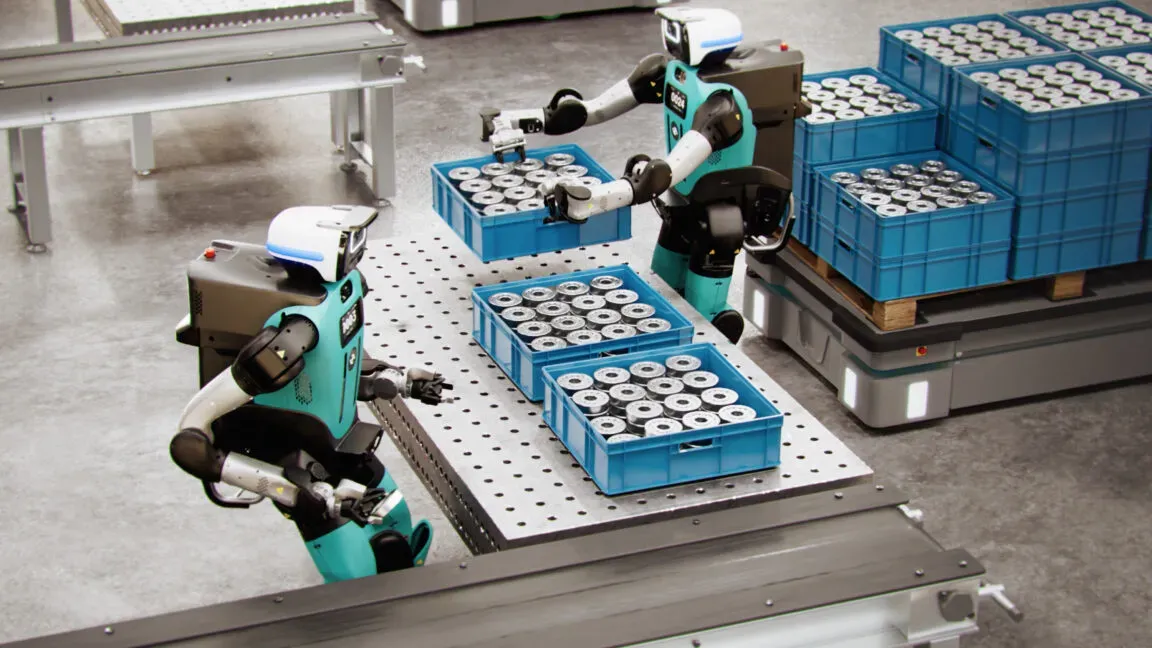
Agility's lead in deploying and operating Digit humanoid robots with multiple customers has set it apart from its competitors. The company has successfully deployed its robots at the warehouses of logistics giant GXO, the South Carolina factory of German automotive manufacturer Schaeffler, and Toyota Motor Manufacturing Canada's automotive production lines.
One of Agility's earliest customers, GXO, plans to expand deployments of Digit robots beyond a warehouse in Georgia to additional facilities in North Carolina and Tennessee. This expansion is a testament to the growing acceptance of humanoid robots in industrial settings.
Agility Robotics' public listing on Nasdaq has shed light on the company's ambitious plans for commercializing humanoid robots. As it navigates this uncharted territory, Agility will face intense scrutiny from investors and industry experts alike.
The filings accompanying Agility's path toward becoming a publicly traded company have shed light on the business prospects and potential unit economics of humanoid robots, an area that has been relatively opaque due to most startup competitors remaining privately held.
Another exception is China's Unitree, which went public on the Shanghai Stock Exchange STAR Market in August 2026. The move provided a rare glimpse into its financials.
Agility has outlined its illustrative unit economics for two business models: a subscription service and an ownership model. The details are found in an S-4 registration statement filed with the US Securities and Exchange Commission on September 4.
Under the subscription model, customers would pay a one-time fee of approximately $25,000 per robot for delivery and deployment to a work site, followed by recurring monthly fees of around $8,500 for software and maintenance.
The ownership model allows corporate clients to purchase robots outright, with a one-time payment of $200,000 plus another $20,000 for delivery and deployment. However, this still comes with an annual subscription fee of $36,000, or about $3,000 per month, for software and maintenance.
Customers who opt for either model will gain access to the latest Agility robot, known as Digit 5, starting in 2027. This bipedal robot features swappable end-effector hands and can lift up to 50-pound loads, while also performing over 20 hours of work within a 24-hour period thanks to its fast-charging battery system.
Agility Robotics' fast-charging battery technology partnership with Nyobolt has yielded significant results for its humanoid robots. The UK-based company's battery chemistry can deliver 90 minutes of robot runtime in just nine minutes of charging time.
This collaboration is a testament to the close working relationship between Agility and Nyobolt, which spanned over a year to design a custom battery pack for the Digit 5 robot. As a result, the battery pack is exclusive to Agility's robots and utilizes Nyobolt's proprietary chemistry.
The onboard safety system of the Digit 5 is another notable feature that enables it to detect humans in its vicinity and take necessary precautions. This advanced capability could pave the way for deploying the robot in more complex environments beyond isolated work cells, according to Pras Velagapudi, chief technology officer at Agility.
Agility's chief financial officer, Michael Beer, highlighted the cost savings of using the Digit subscription model during a recent presentation. According to him, customers can replace $200,000 in annual labor costs with $100,000 in robot costs through this model.
Furthermore, buying a Digit robot outright can result in significant cost savings over five years, replacing $1.1 million in labor costs with about $400,000 in robot costs. Agility's own annual operating costs per robot are estimated to be $15,000 for software and maintenance, along with an initial deployment cost of $15,000.
Each Digit v5 humanoid robot is initially estimated to cost Agility $150,000 based on the bill of materials, with a useful operational lifespan of about five years.
Agility Robotics is anticipating significant cost reductions as it scales up production of its humanoid robots. The company estimates that once it reaches an annual production level of 1,000 robots, the bill of materials for each Digit v5 robot will drop to $75,000 from the current estimate of $150,000.
Further economies of scale are expected as production increases, with Agility projecting a cost of $30,000 per robot if it can produce 10,000 units annually. This reduced cost is seen as crucial in making the company's robots more competitive in the market and potentially driving revenue growth.
To understand the potential revenue streams from its humanoid robots, Agility has provided some financial projections. Under its subscription model, the company expects to earn around $500,000 per robot each year, while sales of the robots outright could generate about $400,000 annually, assuming customers pay for ongoing software and maintenance fees.
A recent customer order provides a glimpse into the potential size of these revenue streams. Agility disclosed that it has secured an unidentified customer's contract for 1,000 Digit 5 robots over three years, with the total value estimated at $300 million. This order was used as the basis for the company's subscription revenue calculations.
However, this large order does not guarantee Agility a smooth ride to profitability. The contract comes with conditions and requirements that the company must meet before it can earn the full amount, including specific contractual milestones, product features and specifications."
Agility's financials paint a picture of a company still in its early stages of development. Despite earning just $1.8 million in revenue last year against an operating loss of $140 million, Agility continues to devote most of its resources to research and development, with plans to expand its manufacturing facilities in Oregon and open a new facility in Pittsburgh, Pennsylvania.
Agility Robotics' financial disclosures highlight the intense competition in the humanoid robot market, with several well-funded companies actively developing competing systems.
These competitors have significant advantages over Agility, including greater brand recognition, customer relationships, and access to more resources. This is a major challenge for Agility as it tries to establish itself in the market.
Despite these challenges, co-founder Hurst remains optimistic about the potential of humanoid robots. He believes that there are millions of manual tasks that require low-skilled human labor, but could be performed by robots like Digit.
Hurst expects multiple customers to start using Digit robots within the next year, and plans to share videos of the machines performing mundane tasks. This is intended to demystify the technology and make it seem more ordinary and practical.
As the market for humanoid robots develops, Hurst sees different companies filling different niches. Just as there are various types of cars, such as high-performance models or family sedans, he expects to see a range of multi-purpose human-centric machines.
Hurst has consistently ruled out the idea of deploying humanoid robots in riskier environments like people's homes. He believes that Digit 5 is designed for industrial use and will not be capable of performing tasks like household chores.
Agility Robotics' Nasdaq debut has sparked interest and scrutiny within the humanoid robot market. The company's Digit 5 robot is designed to navigate complex industrial settings, but its capabilities are limited compared to other robots on the market.
While some experts consider the humanoid design a hindrance in certain applications, others see it as an advantage for tasks that require dexterity and precision. As Agility Robotics continues to grow and evolve, its journey will likely serve as a benchmark for the broader industry's development.
Facts based on reporting originally published by Ars Technica.
You may republish this story, in full or in part, if you credit Noti Group and link to it (licence CC BY 4.0). Photos are not included.