






Sceye Completes Round-Trip Flight from New Mexico to Japan
A modern airship has successfully completed a round-trip flight from New Mexico to Japan and back, marking an important milestone for Sceye, a US aerospace company based near Albuquerque.
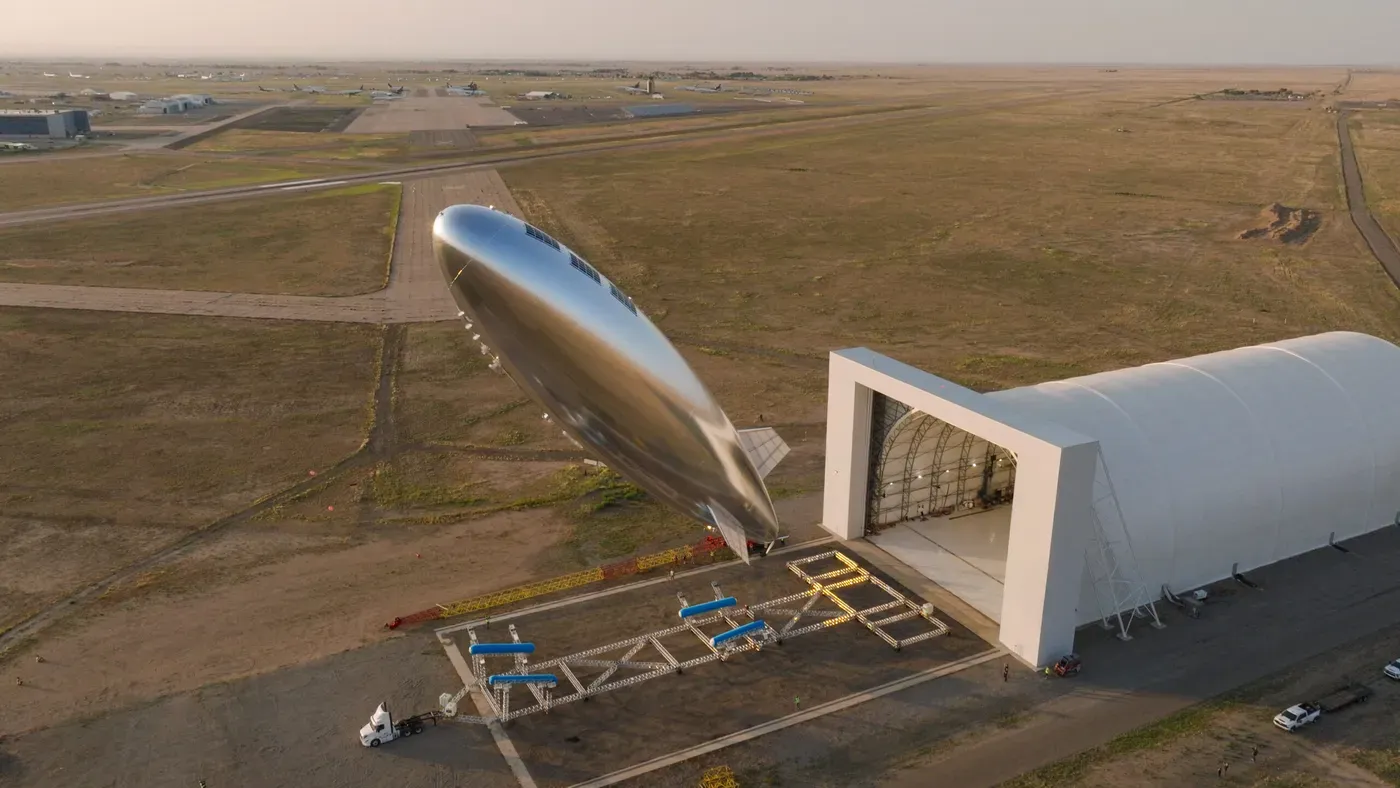
A modern airship has successfully completed a round-trip flight from New Mexico to Japan and back, marking an important milestone for Sceye, a US aerospace company based near Albuquerque.
The flight took place over a month between August and September 2026, demonstrating the potential of stratospheric platforms as cell phone towers in the sky. This feat is significant not only because of its length but also due to its purpose, which goes beyond mere record-breaking.
Sceye's uncrewed platform is filled with helium for buoyancy and equipped with an electric-powered propeller for active propulsion. The platform can resist strong winds and keep hovering over the same location for long periods, thanks to top-mounted solar panels and onboard batteries that provide power around the clock.
At 60,000 feet above ground level, Sceye's platform operates in the stratosphere, twice as high as air traffic and above the jet stream. This altitude also allows the platform to stay powered through day and night until morning sunlight recharges its batteries.
Mikkel Frandsen, founder and CEO of Sceye, explained that their technology enables them to fly through day and night while remaining at the same altitude over a specific area. This ability is crucial for providing stable connectivity in remote or hard-to-reach areas.
Sceye's journey towards developing stratospheric platforms began with smaller prototypes tested in 2016. The company reached the stratosphere with a 215-foot-long version of their platform in 2021 and has since extended its length to 270 feet.
The success of this trans-Pacific flight marks an important step for Sceye's mission to make stratospheric platforms commercially viable, building on years of research and development.
Advances in material sciences have played a significant role in the development of Sceye's stratospheric airship platform. According to Frandsen, the discovery of graphene in 2004 has greatly improved the strength-to-weight ratio of the hull, battery efficiency, and solar panel performance.
The design of the airship is capable of lifting payloads as heavy as 551 pounds, a capacity that surpasses other stratospheric platforms such as drones. This increased payload capability would enable Sceye's platform to carry more equipment and provide greater services from the stratosphere.
Sceye's current platform has demonstrated its capabilities through multiple flight tests with payloads exceeding 220 pounds and an onboard power generation of up to 1 kilowatt. This opens up new possibilities for the use of stratospheric platforms, including providing mobile broadband coverage equivalent to hundreds of ground-based cell towers.
The concept of using a single Sceye platform to provide mobile broadband coverage is particularly appealing for both commercial telecommunications services and disaster scenarios. In such situations, a stratospheric platform could offer emergency coverage while also enhancing existing communication networks.
Sceye's airship successfully completed its trans-Pacific journey from New Mexico to Japan in 13 days, navigating through strong winds and avoiding potential bad weather during typhoon season. According to Johnny Truong, chief technology officer of Sceye, the flight test was a crucial step in evaluating the platform's capabilities.
The success of this flight marks an important milestone for Sceye's mission to make stratospheric platforms commercially viable. The company has been working towards this goal for years and is now one step closer to achieving it with its latest flight demonstration.
Sceye's stratospheric airship has demonstrated its ability to fly autonomously between two points while taking into account factors such as local wind conditions.
The airship's auto-navigation system allows human operators to focus on higher-level decisions like monitoring weather forecasts and running flight simulations for possible paths.
This capability was first used during a previous 12-day flight from New Mexico to Brazil, but the month-long mission to Japan and back marked the longest test flight and deployment yet for Sceye's platform.
During the Japan leg of the trip, the airship encountered unexpected weather disruptions that forced it to change course. In response, the airship simply parked itself at a safe place until conditions improved.
The arrival over Shikoku Island in western Japan provided an opportunity to demonstrate how Sceye's uncrewed airship could provide mobile broadband service from an operational altitude of around 54,000 feet.
In partnership with Japanese telecommunications firm SoftBank Corp, the airship carried a simulated 4G LTE base station that aimed to provide backup coverage in case of emergencies such as earthquakes.
The airship's communications platform was put to the test by SoftBank's team, who conducted a range of experiments to assess its capabilities. These included voice calls, text messaging, and internet browsing, as well as streaming YouTube videos and making video calls.
Additionally, SoftBank verified that the Sceye-supported connectivity could support emergency alert systems for earthquakes and tsunamis, as well as provide access to a maritime emergency number. The team also explored the potential of using drones equipped with LTE cards to remotely control them over long distances.
To evaluate the airship's performance in various environments, SoftBank ran data throughput tests on an open beach, in a forest area with tree cover, and indoors within a building. In all three scenarios, the Sceye-supported connectivity proved capable of delivering stable connections.
Initially, there were concerns about the indoor test succeeding due to potential interference issues. However, Sceye's team had deliberately chosen not to run the communications antenna at full power to minimize any risks and comply with local regulations.
As part of a separate experiment, SoftBank demonstrated the capabilities of edge computing by processing data on a server aboard the airship. The results showed an average roundtrip data-processing response time of 68 milliseconds, representing a 40 percent reduction in latency compared to traditional cloud-based processing times.
The companies also explored optical wireless communications using lasers to transmit data between the stratospheric platform and ground infrastructure. This involved sending laser pulses from a ground-based system towards Sceye's moving platform, which reflected the signals back down to the ground for analysis.
The Sceye High Altitude Platform Station (HAPS) has demonstrated its potential as a key component in a network that could provide seamless global communication services. According to its developers, the airship can act as a "reenergizer" for optical signals received from space, allowing them to be retransmitted down to Earth more efficiently.
This capability is crucial for the development of sixth generation (6G) mobile communications services, which are expected to require much higher data rates than their predecessors. Broader deployments of optical wireless communication could also help bridge the connectivity gap in remote regions that lack access to ground-based fiber-optic networks.
The Sceye HAPS can switch between different types of communication modes as needed, including radio frequency signals that can travel through cloud cover more effectively. This flexibility is essential for ensuring that everyone has access to real-time services promised by 6G technology, according to the project's leaders.
The increased resiliency provided by wireless communication networks is also a major advantage in today's global connectivity landscape. With intentional sabotage and accidental damage from fishing boat nets or ship anchors posing significant threats to undersea fiber-optic cables, having backup systems like Sceye's can help mitigate these risks.
In the event of a disaster, the airship could quickly be deployed to restore communication services, potentially saving lives in search-and-rescue operations. SoftBank is already exploring this possibility with its partners, along with equipping the airship with cameras and sensors for enhanced situational awareness.
The Sceye HAPS has completed its maiden voyage, traveling nearly 18,641 miles (30,000 kilometers) during its 30-day roundtrip from New Mexico to Japan and back. As it returns to base, plans are already underway for future testing and development of the airship's capabilities.
The Sceye airship's maiden voyage has not only demonstrated its potential for providing temporary cellular coverage but also highlighted its role in addressing connectivity gaps in underserved regions.
Sceye's ultimate goal is to offer a more cost-effective solution than installing fiber-optic cables, which can be prohibitively expensive in many areas. The company plans to use the airship to provide regular cellular coverage to communities that currently lack reliable access to high-speed internet.
Future missions are expected to be longer-term endeavors, with some lasting up to a year or more. This shift towards extended operations will enable Sceye to establish a presence in regions and offer consistent connectivity services to local populations.
Facts based on reporting originally published by Ars Technica.
You may republish this story, in full or in part, if you credit Noti Group and link to it (licence CC BY 4.0). Photos are not included.