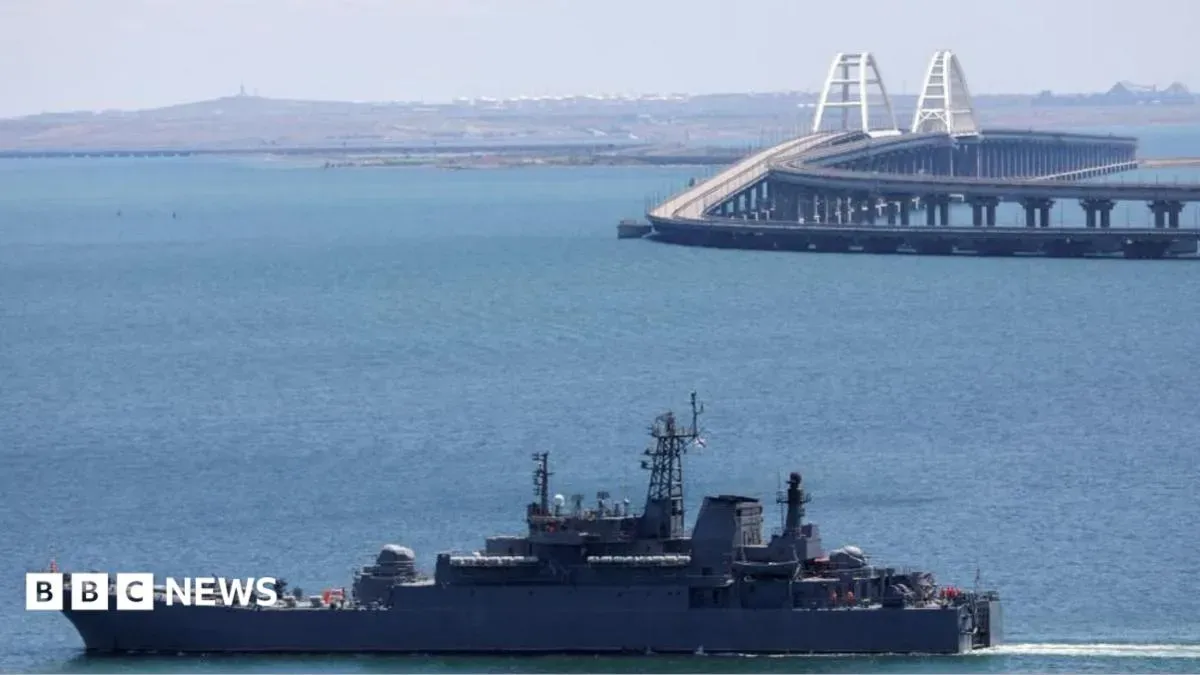







Russian President Vladimir Putin's Kerch Strait Bridge Damaged in Ukrainian Missile Strike
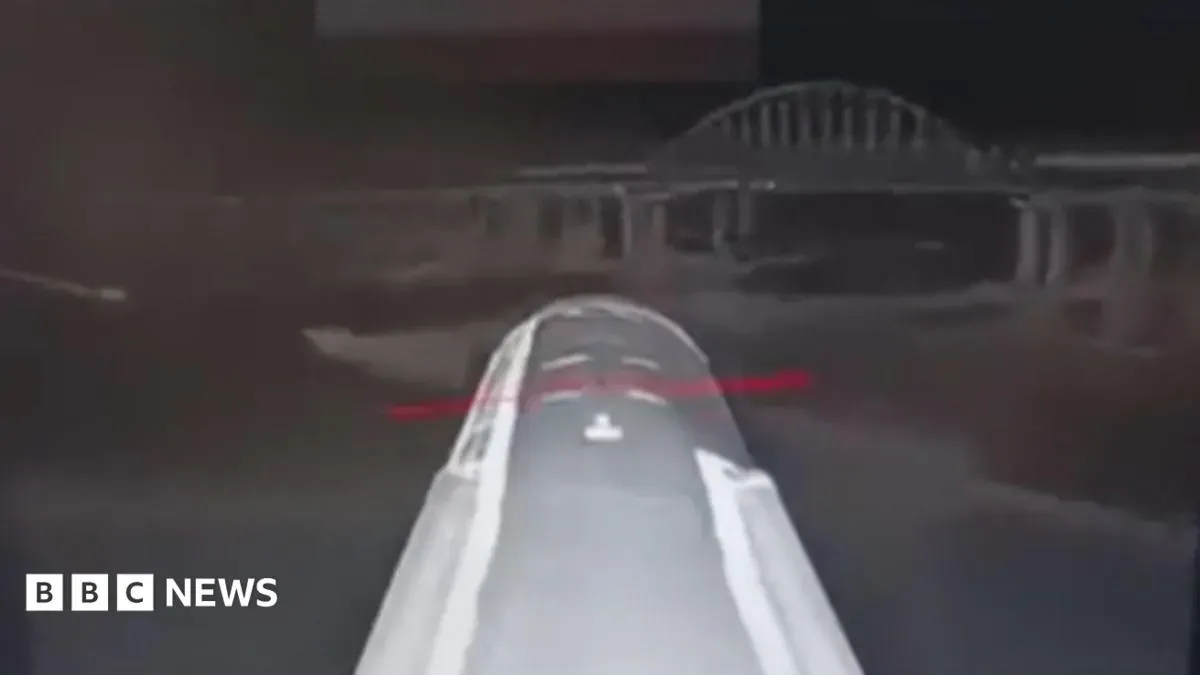
A barrage of Ukrainian missiles and drones collapsed a crucial segment of the Kerch Strait Bridge on November 15-16.
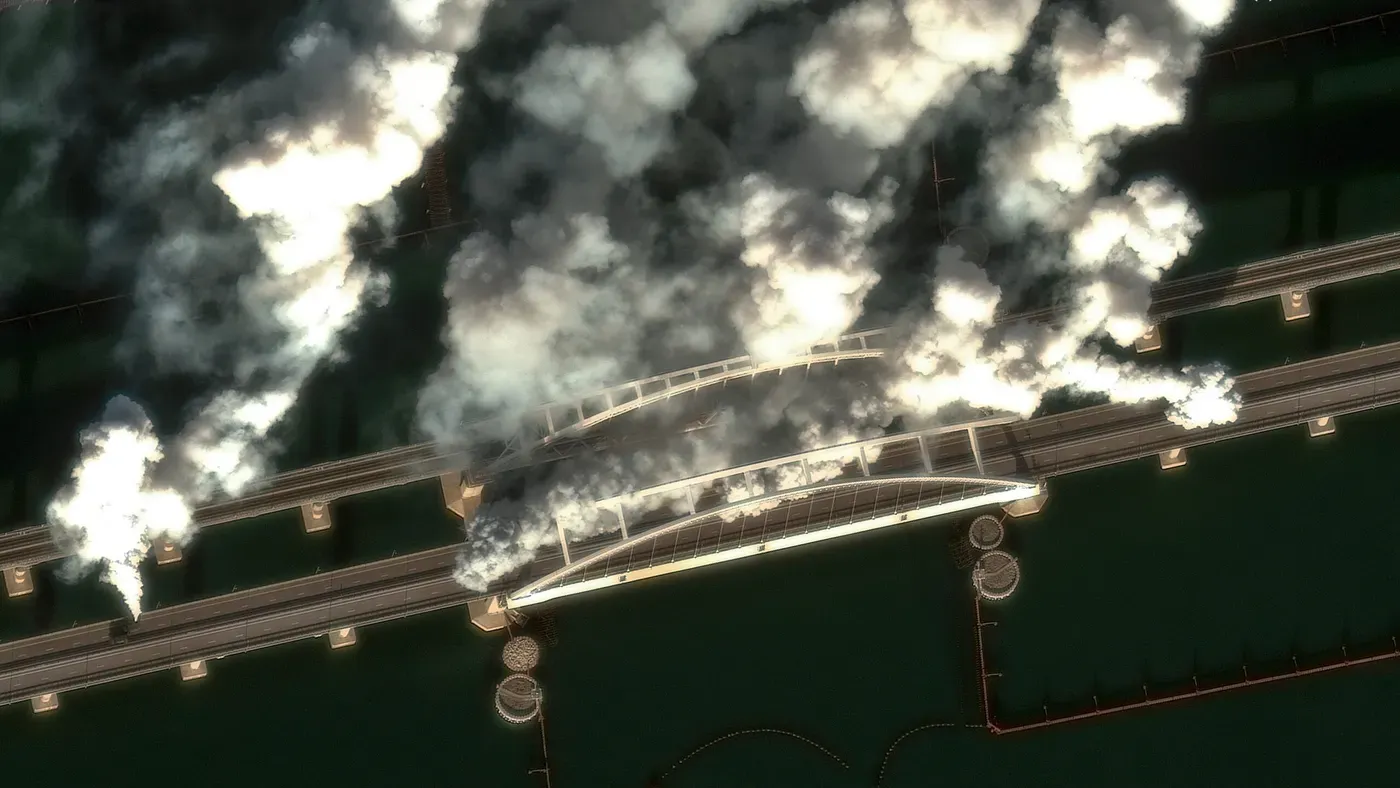
A devastating blow was dealt to Russian President Vladimir Putin's prized Kerch Strait Bridge when a barrage of Ukrainian missiles and drones collapsed a crucial segment of the bridge. The attack, which occurred in the early hours of November 15 and continued into the night of November 16, involved coordinated waves of strikes that caused significant damage to one of the two steel arches supporting the roadway for automobile traffic.
According to an update from the Institute for the Study of War, the Ukrainian military was able to execute this daring operation deep within Russian-occupied territory without relying on the military-grade version of Elon Musk's Starlink satellite communications. This suggests that Ukraine has found alternative ways to guide its missiles and drones in the absence of access to Starlink.
Russian sources claimed that several hundred Ukrainian drones initially overwhelmed their air defenses, creating an opening for remote-controlled missile strikes focused on the bridge. Among these strikes were the Flamingo cruise missiles developed by Ukraine, which have proven to be a capable addition to their arsenal.
The Ukrainian operation's success can be attributed in part to its adaptation of a Russian battlefield innovation: using drones equipped with mesh radios to create an airborne communications network. This technique allows each drone to act as a relay node, extending the communication link between human operators and remotely piloted missiles and strike drones.
Russia had begun employing this method to support long-range drone and missile strikes on Ukrainian cities, but it appears that Ukraine has now turned this tactic against them.
Ukraine's military has been employing a sophisticated tactic in its ongoing conflict with Russia, leveraging advanced relay technology to evade air defenses and precision strike targets.
The use of this method was first observed during Ukraine's attacks on the Kerch Strait Bridge, where operators located hundreds of kilometers away were able to guide missiles and drones to their target while avoiding Russian defenses. This network allowed for real-time coordination between multiple units, enabling a more effective and precise attack on the bridge's structural weak points.
In the weeks leading up to the November 15 night attack on the bridge, Ukraine conducted a series of preparatory strikes that systematically degraded or destroyed Russian air defense systems, radars, and electronic warfare equipment. This deliberate targeting of Russia's defenses created an opening for the subsequent attack on the bridge.
The Ukrainian military chose not to use Starshield, the military version of Musk's Starlink satellite network, in its coordinated strike due to recent US restrictions that limit its use on drones or vehicles exceeding 100 miles per hour. Instead, Ukraine relied on domestically developed or adapted technologies to execute the operation.
Ukrainian President Volodymyr Zelenskyy has expressed frustration with the current limitations imposed by the US on Starshield's usage, which he claims hinders certain drone interceptor technologies designed to counter Russian drones attacking Ukrainian cities and infrastructure.
Ukrainian military strategists have been adapting to limitations imposed by US restrictions on Starshield's usage, which has hindered their ability to develop certain drone interceptor technologies designed to counter Russian capabilities.
The recent strike on the Kerch Strait Bridge is a prime example of Ukraine's resourcefulness in exploiting available technology, rather than solely relying on Western satellite connectivity. By employing relay drones to bypass Starlink limitations, Ukrainian forces have demonstrated an innovative approach to countering Russia's military assets. This tactic has proven effective in disrupting Russian supply chains and transportation links.
The bridge's railway section may have sustained only moderate damage, but the destruction of its arch and roadway sections has severely impacted Russia's ability to maintain its occupation of Crimea. According to assessments by the Institute for the Study of War, this development will complicate Russia's military basing within the peninsula.
The destruction of the Kerch Strait Bridge has significant implications for Russia's military operations in Crimea. A Telegram channel owner based in Crimea reports that fallen debris from the collapsed arch may block large ship traffic through the strait, which connects the Sea of Azov and the Black Sea.
This development would severely limit Russia's ability to resupply the Crimean peninsula by sea, a crucial aspect of its military logistics. Ukrainian drones have already demonstrated their effectiveness in targeting Russian ships in the Sea of Azov, striking dozens of vessels in previous attacks.
The Kerch Strait Bridge was constructed at a cost of $3.5 billion as a physical manifestation of Russia's claim over Crimea. Putin has personally commemorated the bridge's opening on two separate occasions: first by driving a construction truck across it in 2018 and again by crossing it in his Mercedes in December 2022, following a Ukrainian truck bomb attack that temporarily damaged the structure.
The destruction of this critical infrastructure represents a symbolic blow to Russia's ambitions in Crimea. The peninsula has been a strategic hub for Russian military operations since its seizure from Ukraine in 2014, serving as a base for the Black Sea Fleet and a logistics hub for the ongoing invasion of Ukraine.
A recent strike on the Kerch Strait Bridge has left its future uncertain, following a pattern of damage and repair. The bridge was first damaged in 2018 when Ukraine's Security Service planted mines under its supports, causing significant destruction.
The bridge's engineering is complex, with repairs to the roadway taking two years to complete, according to experts who spoke with The New York Times. However, any damage to the piers could prolong repair time even further, and Russian efforts may be threatened by future Ukrainian attacks. It seems likely that the Kerch Strait Bridge will not survive this latest round of strikes unscathed.
Facts based on reporting originally published by Ars Technica.
You may republish this story, in full or in part, if you credit Noti Group and link to it (licence CC BY 4.0). Photos are not included.