





New Era in 3D Printing Unveiled with Bambu Lab's H3C Printer
Bambu Lab's latest offering is a cutting-edge machine that redefines what's possible in 3D printing, boasting an impressive feature set and rapid switching capability.
A new era in 3D printing has dawned, marked by a significant leap forward in technology and capabilities. Gone are the days when home 3D printers were limited to producing parts at a snail's pace.
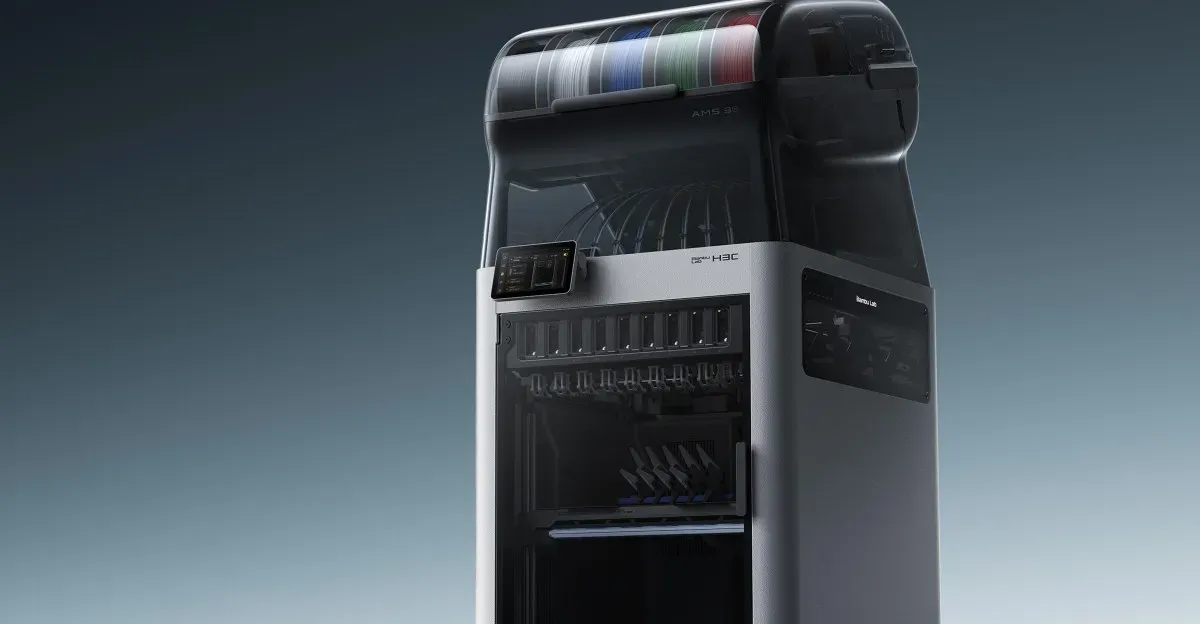
Bambu Lab is at the forefront of this innovation with its latest offering, the H3C printer, priced at $2,499. This cutting-edge machine boasts an impressive feature set that redefines what's possible in 3D printing.
The H3C can switch between materials on the fly, allowing users to mix different colors and produce a wide range of hues almost matching the entire visible spectrum. Furthermore, it can combine soft and hard materials, as well as swap between high-speed and fine detail printing in a single print run.
At the heart of this technology is Bambu's "Swaptek system, which enables the printer to switch between eight other nozzles in just six seconds. This rapid switching capability sets the stage for even more advanced capabilities in future 3D printers.
The design of Bambu's H3C printer includes a unique toolchanger system known as Swaptek. This system allows for nine tools to be stored in a rack at the front of the printer, where they can independently preheat to the correct temperature before being used.
This setup enables users to easily switch between different tools and filaments without having to manually change them. The H3C's toolchanger system is particularly useful for printing with multiple colors or materials, as it allows for quick and easy switching between different rolls of filament.
In testing the H3C, I was able to print a range of objects using different types of filament, including flexible TPU and rigid PLA. For example, I printed a wristwatch housing with an integrated flexible watchband by combining these two materials.
The printer's ability to store its filaments in an airtight container called the AMS 3H is also a notable feature. This helps to keep the filaments dry when not in use, which can be a problem with other toolchangers that do not have this feature.
The Bambu H3C boasts an impressive array of features, including two built-in dryers that can reach temperatures of up to 85 degrees Celsius. These dryers work continuously while printing, ensuring that filament stays dry and ready for use.
This is a significant upgrade from the company's previous AMS systems, which lacked this level of sophistication. The addition of these dryers helps maintain optimal print quality by preventing moisture-related issues.
In testing the H3C, some quirks have become apparent. Prints often require restarting due to initialization problems with the toolhead camera, and false-positive failure detection has caused delays in printing.
Loading flexible TPU filaments into the printer can be a bit finicky, requiring manual insertion and careful slot selection, not all slots are compatible with TPU rolls.
The Bambu H3C's design allows for more flexibility in printing materials, but it also comes with its own set of challenges. Slot #6 can load standard filaments without issue, but inserting flexible TPU filaments into this slot is a different story.
If flexible filaments are loaded into slot #6 and another printhead gets snagged on them, the result can be a jam that's difficult to resolve. This issue is not just a minor annoyance - it's actually something that Bambu itself warns reviewers about in its fine print.
The printer's design also makes maintenance more complicated than it needs to be. Unlike some other printers, the H3C does not have toolless nozzle replacement capabilities, and repairing a clogged nozzle requires disassembling parts of the printer.
Despite these quirks, the Bambu H3C seems to be an improvement over its predecessor in terms of reliability and ease of use. So far, prints have come out well without producing excessive waste when switching between colors - a benefit that's directly related to having multiple nozzles available.
The current state of 3D printing is often restrictive, requiring users to carefully plan their projects around the limited color options available. This can be particularly frustrating for those who need a wide range of colors on hand at all times.
However, Bambu's nine-nozzle H3C printer appears to be taking steps towards changing this paradigm. By incorporating multiple nozzles and toolchanger systems, it enables users to quickly switch between different colors without the need for extensive planning or storage.
This approach is reminiscent of traditional inkjet printers, which offer a vast array of color options at a moment's notice. Bambu's H3C printer seems poised to bring this same level of convenience to the world of 3D printing.
As the company continues to refine its technology, it appears that more affordable options may be on the horizon, with certification filings suggesting a smaller P3C" model in development, featuring seven tools and rolls of filament storage.
Facts based on reporting originally published by The Verge.
You may republish this story, in full or in part, if you credit Noti Group and link to it (licence CC BY 4.0). Photos are not included.