






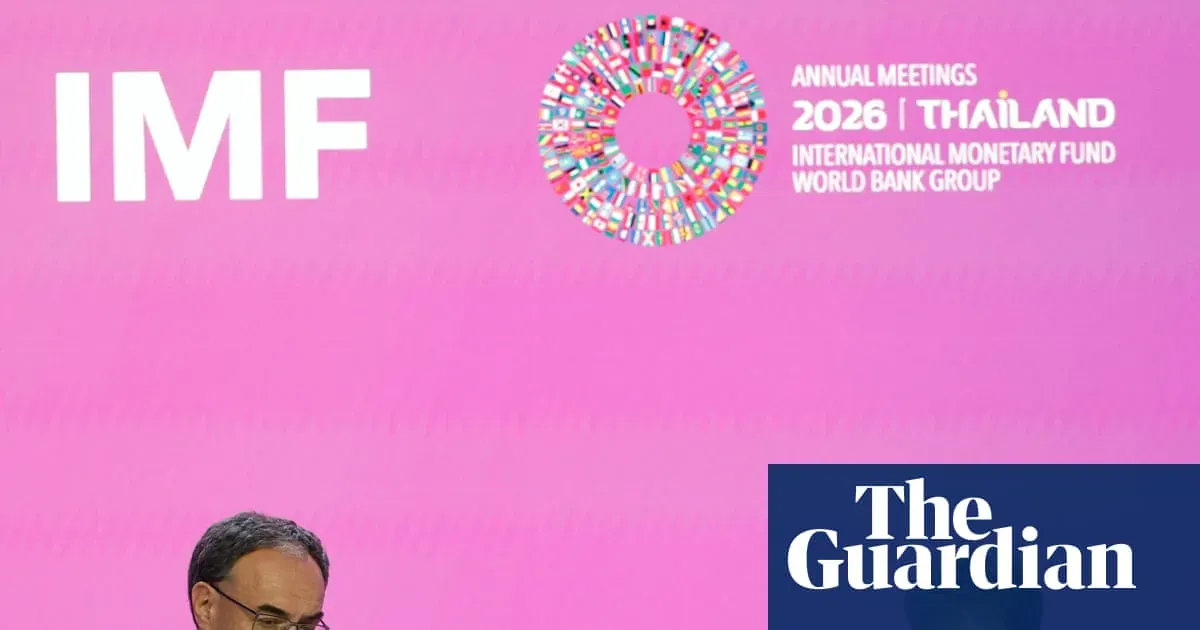
IMF Warns of Global Financial Vulnerabilities at Annual Meeting in Thailand
The International Monetary Fund is sounding warning notes about the debts of major economies worldwide, highlighting growing concerns over financial vulnerabilities.

The International Monetary Fund (IMF) is sounding a warning note at its annual meeting in Thailand about the debts of major economies worldwide.
This year's gathering has highlighted growing concerns over financial vulnerabilities, and the IMF is doing what it does best - monitoring and warning about potential risks to global economic stability.
Meanwhile, finance ministers from countries that have experienced economic crises in the past are taking pride in their nations' relatively low borrowing costs compared to other major economies, such as the United States.
In a surprising twist, top IMF officials have publicly praised the UK's efforts to reduce its annual levels of borrowing, setting it apart from other G7 countries like Canada, France, Germany, Italy, Japan, and the US.
This shift in perception is notable, with the IMF's managing director, Kristalina Georgieva, commenting that the UK has taken decisive action to reduce debt and deficit.
The UK's economy has undergone a significant shift in perception, with the IMF now viewing it as a model for fiscal consolidation. This change in opinion is reflected in the latest assessment of global economic prospects, which shows that among G7 countries, only the UK has a serious plan to reduce its annual borrowing over the next few years.
The UK's efforts to rein in its deficit have paid off, with borrowing rates falling significantly since the Liz Truss mini-budget. This is a notable turnaround for a country that was once considered one of the most indebted among its peers. The IMF's assessment highlights the UK's commitment to fiscal discipline, which has earned it a top spot in the G7 table for reducing deficits.
The implications of this shift are significant, particularly in the context of the upcoming Budget. With the UK's borrowing plans on track, Chancellor John Healey will face limited room for extra spending in his budgetary decisions. To maintain this momentum, he is likely to opt for modest tax rises rather than large-scale increases.
Furthermore, the IMF's assessment suggests that the UK may need to provide a buffer against rising energy prices due to global inflation pressures. This could lead to a decrease in the margin for error around meeting debt rules, often referred to as headroom. The government will aim to strike a balance between fiscal prudence and addressing the impact of higher energy costs on living standards.
The UK's economic trajectory has been influenced by various factors, including political and economic crises affecting other governments. However, its commitment to reducing deficits has set it apart from its G7 peers. The IMF's assessment serves as a reminder that sustained efforts towards fiscal consolidation can yield positive results.
As the government prepares for the upcoming Budget, it will need to navigate these challenges while maintaining its focus on debt reduction. With limited room for extra spending and modest tax rises on the agenda, the Chancellor's decisions will be crucial in determining the UK's economic trajectory over the coming years.
The UK's public services are bracing themselves for a disappointing Budget as it appears that any additional funding will be limited due to the government's tight fiscal constraints.
This situation is set against the backdrop of rising inflation, which has been highlighted by the Institute for Fiscal Studies in its recent report. The resulting pay discussions with public sector workers are likely to be challenging, and some may have been expecting a more generous allocation of funds.
The Chancellor will aim to present his plans as prudent and responsible, aligning with the International Monetary Fund's characterization of the UK government's austerity measures as relatively modest compared to other advanced countries.
Facts based on reporting originally published by BBC News Business.
You may republish this story, in full or in part, if you credit Noti Group and link to it (licence CC BY 4.0). Photos are not included.