





Porsche 718 Boxster Electric Vehicle Design Features Low Profile Seating Position
The all-electric Porsche 718 Boxster features a unique design choice where the seating position is unusually close to the road due to the placement of the battery pack behind the driver.
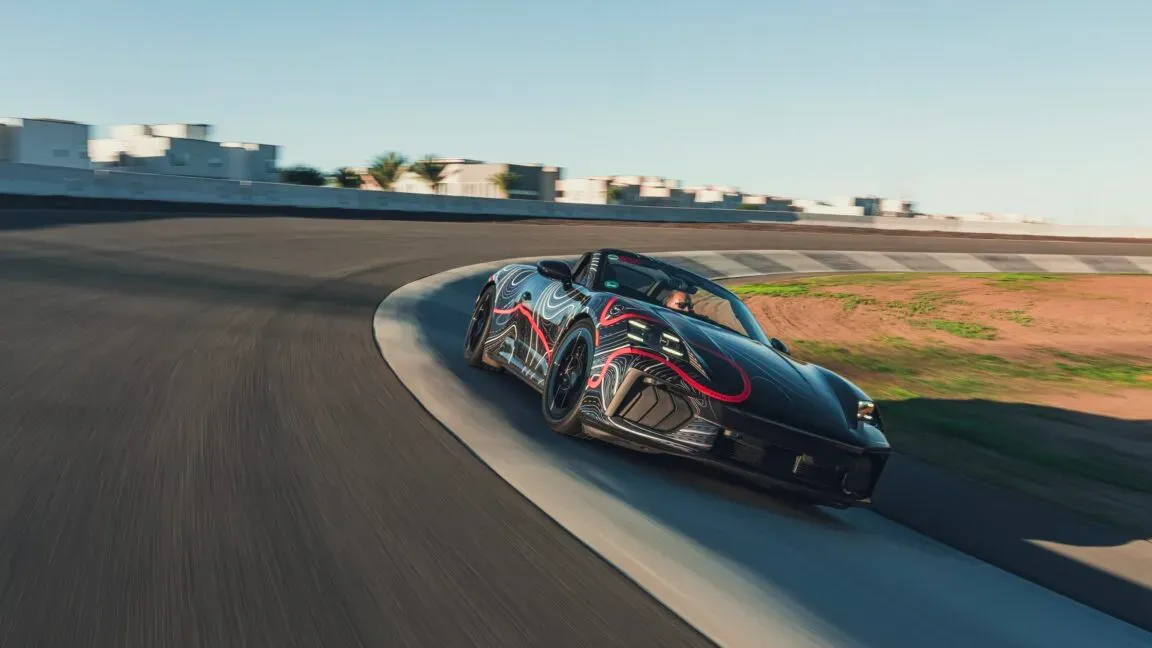
The all-electric Porsche 718 Boxster has been making waves, but it wasn't until one journalist was stuck in traffic that they truly appreciated its low profile. The car's seating position is unusually close to the road, a deliberate design choice by Porsche engineers who wanted to maximize driving dynamics.
In most electric vehicles, the battery pack sits on top of the skateboard-style platform, elevating the driver and passenger seats by about 3 inches. However, this setup can be beneficial in larger SUVs, where it provides a higher seating position and a more commanding view of the road. In contrast, the Porsche's low-slung design is perfectly suited to its mid-engined sports car configuration.
The decision to place the battery pack behind the driver was likely motivated by the desire to create a driving experience that feels connected and intimate with the road. With a single motor powering the rear wheels, the 718 Boxster promises to deliver exceptional performance and agility on twisty roads.
Porsche is expected to officially unveil its all-electric 718 Boxster next year, but enthusiasts have been eagerly anticipating this development for some time now. The car's innovative design and impressive specs are set to make it a major player in the world of electric sports cars.
The Porsche 718 Boxster's unique blend of performance, style, and innovation is sure to turn heads on the road and at dealerships around the world. With its low profile and rear-mounted battery pack, this car is poised to deliver an unparalleled driving experience that will leave even seasoned drivers grinning from ear to ear.
The use of a rear-mounted battery pack in Porsche's new electric 718 Boxster is not an innovative design choice. It's a layout that was previously employed by Tesla on its original Roadster back in 2008, which was done primarily for cost-saving reasons.
At the time, Tesla repurposed a Lotus chassis meant to hold an internal combustion engine, and it allowed them to save money by not having to redesign the entire platform. This same approach has been taken with Porsche's new Boxster, which shares its platform with the Audi Concept C.
The rear-mounted battery pack in the new Boxster also enables a low seating position and delivers a rearward weight bias of 40:60 front/rear, similar to the internal combustion model that preceded it. The last-generation 718 Boxster, which was killed off by EU cybersecurity regulations last year, had this same weight distribution.
Porsche is not providing any details about the size of the new roadster's battery in terms of charge capacity, only stating that its size was chosen to strike a balance between range and weight. The company has also declined to reveal information on rated range, charging speed, or battery composition.
The battery pack in the new Boxster is based on an 800 V architecture, similar to the electric Macan SUV. This means that it should be able to charge at speeds comparable to the Macan's 270 kW, which would be a significant improvement over many other electric vehicles on the market.
With its shared motor with the Macan, the new Boxster is expected to have plenty of power under the hood, in fact, it could even outdo the Macan Turbo's 500 hp (370 kW) output. Regardless of the exact specs, this electric roadster should be able to accelerate from 0-62 mph in under 3.0 seconds, making it the quickest Boxster ever.
The new Boxster's curb weight has increased significantly, putting it in the same ballpark as a current-generation 911, weighing anywhere from 3,300 to 3,700 pounds. This is roughly equivalent to 1,500 to 1,700 kilograms, indicating that the electric roadster has gained at least a few hundred pounds.
The extra weight is noticeable on the road, particularly when compared to its gasoline-powered predecessors. The 718 Boxster lacks the lively eagerness of its latest siblings, but this doesn't necessarily make it less enjoyable to drive. In fact, many would argue that it's actually more fun to be behind the wheel.
The car's performance is not solely about acceleration; it also boasts impressive handling and agility. Its suspension, steering, and chassis are all borrowed from the current-generation 911, a testament to its Porsche heritage. The 718 Boxster's behavior on the road is unmistakably that of a high-performance sports car.
Despite being heavier than expected, the electric powertrain offers a more responsive driving experience compared to internal combustion engines. Turbochargers and modern emission regulations often result in a lackluster throttle response, but this isn't an issue for the 718 Boxster. Its electric powertrain delivers a sharper and more engaging drive, even surpassing that of the 911 GTS.
The combination of its Porsche DNA and electric powertrain makes the 718 Boxster a formidable driving machine, capable of delivering both exceptional performance and handling. Its unique blend of characteristics sets it apart from other sports cars on the market, making it an exciting prospect for enthusiasts.
Porsche's electric 718 Boxster has been designed to mimic the driving experience of its internal combustion-powered counterparts, including synthesized shifting and engine noises. This feature is not new, as other electric vehicles have also employed similar techniques to recreate the sounds associated with gasoline engines.
The company has opted for a unique approach by sampling the sound of a specific 718 model - the 981-generation Boxster GTS - which its engineers deemed to be particularly pleasing. The resulting audio is then used in conjunction with a simulated dual-clutch transmission, controlled via paddles behind the steering wheel.
When enabled, Porsche's E-Shift system brings the driving experience to life by replicating the sounds and sensations of an internal combustion engine. This includes not only the audio cues but also physical vibrations that mimic the pulsing of an electric motor, similar to those found in some high-performance motorcycles.
The result is a truly immersive experience, with the 718 Boxster accelerating from standstill to 60mph in under three seconds while its synthetic engine screams and shifts through mock gears. The driver can choose to take control manually using the paddles or opt for automatic shifting, which will trigger an abrupt halt in acceleration when reaching an artificial rev limiter.
The 718 Boxster's electric powertrain is accompanied by an artificial engine sound that adds to the car's emotional appeal while also serving a practical purpose in helping drivers gauge their speed through corners.
Judging your speed is easier when you can hear the engine noise, and this feature is likely to remain enabled for most drivers, especially those who enjoy driving for fun or want to make an impression at local car shows like Cars & Coffee.
The 718 Boxster's adaptive suspension is another notable improvement over its predecessor, allowing it to handle uneven road surfaces with ease even when dialed down to Normal mode on the highway.
One of the rare advantages of electric vehicles is the ability to offer true drop-top motoring, and the new 718 Boxster delivers on this promise by quickly folding its top down in around 10 seconds.
The car's design also prioritizes practicality, with a front trunk (frunk) that can accommodate a carry-on suitcase or two backpacks, although space behind the seats is limited to just a few small bags.
The Porsche 718 Boxster's electric powertrain has significantly altered its dynamics, making it more comfortable and flexible in everyday driving situations compared to its predecessor. However, this shift is accompanied by a noticeable increase in weight and wheelbase, which may be jarring for some drivers.
Despite these changes, the car still manages to retain an unmistakable essence of Porsche's DNA, particularly when it comes to its performance capabilities. In fact, it can be argued that the 718 Boxster now embodies a unique blend of characteristics from both the Boxster and Carrera models, which is likely to have its own set of enthusiasts.
Facts based on reporting originally published by Ars Technica.
You may republish this story, in full or in part, if you credit Noti Group and link to it (licence CC BY 4.0). Photos are not included.