





Concentrated Solar Energy Systems Redesigned as Backup Power Sources
A small company claims its technology can eliminate the need for separate backup facilities by combining concentrated solar energy with fossil-fueled backup systems.
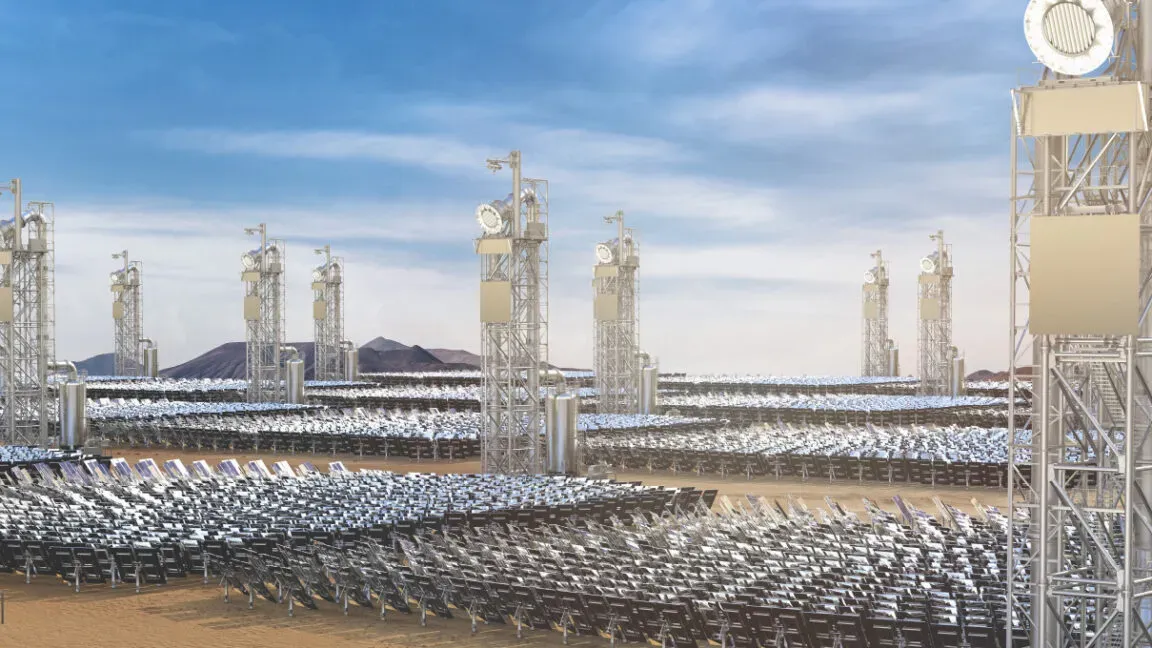
Concentrated solar energy systems are being reimagined as their own backup power sources by a small company that claims its technology can eliminate the need for separate facilities like batteries or natural gas generators.
The company's innovation is centered around a design where a fossil-fueled backup system shares most of the generating hardware with the solar side, effectively turning a concentrated solar energy system into its own backup. This approach has the potential to simplify the infrastructure needed for power generation and reduce costs associated with building separate facilities.
Concentrated solar energy works by using mirrors to focus sunlight onto a single point, heating up a working fluid in a tower. The heat from this fluid can then be used to drive traditional steam turbines or stored for later use when the sun is not shining.
While concentrated solar was once seen as a promising technology due to advancements in heat storage that allowed it to generate power around the clock, its prospects have been overshadowed by the plummeting cost of photovoltaic panels. PV panels are now often the cheapest source of power in most locations, making other forms of generation less competitive.
The small company's design combines the benefits of concentrated solar with those of traditional fossil-fueled backup systems, creating a hybrid system that can generate power both during the day and at night. This approach could potentially reduce the need for separate facilities like batteries or natural gas generators.
Advancements in heat storage had previously made concentrated solar energy a viable option for around-the-clock power generation, but its competitiveness was ultimately undermined by the falling cost of photovoltaic panels.
The development of concentrated solar energy has been hindered by its high costs and complexity, which has made it difficult for it to compete with photovoltaic panels.
One major issue with concentrated solar is that it requires a lot of moving parts, including heat storage systems and potentially corrosive working fluids, which can be expensive to maintain and replace. This lack of standardization has also contributed to the high costs associated with these plants.
Despite advancements in heat storage technology, concentrated solar energy has struggled to keep pace with photovoltaics, whose falling costs have made them a more attractive option for generating renewable power. As a result, construction of new concentrated solar plants has largely come to a standstill.
India's recent contract with 247Solar, a US-based startup, is an exception to this trend. The company will build and operate a small concentrated solar plant that can be powered by either the sun or fossil fuels during periods of low renewable energy generation.
The innovative approach of 247Solar involves a unique configuration that sets it apart from other solar thermal systems. The company's plan includes using a field of heliostats to focus sunlight onto a receiver, but this hardware has been designed to operate at ambient pressure, unlike its predecessors.
This modified receiver is capable of producing extremely high temperatures, with air exiting the system at approximately 970 degrees Celsius. This hot air can be utilized in various ways - either directly for industrial process heat or channeled into a separate unit that generates electricity. In most cases, however, it will be directed towards the storage component.
The storage aspect of 247Solar's system is another key innovation. Instead of relying on molten salts, which can pose challenges related to phase transition, the company uses ceramic pellets roughly the size of golf balls. These pellets are capable of storing heat generated by the heliostats and can be used to produce power for extended periods.
The duration of power generation after sunset is dependent on the specifics of the storage configuration, according to von Keszycki. In some cases, this could range from nine to 20 hours, although actual times may vary depending on how much heat is utilized during daylight hours. To maximize efficiency, 247Solar plans to integrate its system with photovoltaic installations for daytime power generation.
This integration will enable the company's system to function as a seamless backup solution, providing reliable power even when sunlight is scarce. By combining thermal and photovoltaic energy production, 247Solar aims to create a more comprehensive and efficient solar power system.
The innovative heat exchanger designed by 247Solar plays a crucial role in the company's solar power system. It serves as a drop-in replacement for a combustion unit on a traditional turbine, heating compressed air to drive generation.
This heat exchanger is positioned after the compression stage and before the expander in the turbine assembly, exactly where a combustor would be located in a conventional setup. Bruce Anderson of 247Solar explains that it performs the same function as the combustor, albeit without the need for combustion.
The system's flexibility becomes apparent here, as it doesn't specify how the air in the exchanger is heated. This means various fuels can be burned to provide equivalent heat, making the system adaptable to different energy sources.
The addition of the capability to burn fossil fuels would increase the overall cost by less than 10 percent, according to von Keszycki's suggestion.
The first solar power system installation will be a relatively small one, consisting of two 200 kW generators. This initial setup is intended primarily as a test bed to validate the technical feasibility of the system's design. Engineers are particularly concerned about unforeseen issues that could arise during operation.
To further demonstrate its capabilities, the company is already working on scaling up the technology. A larger installation with a capacity of 3 megawatts is being engineered, featuring multiple units sharing a single tower equipped with receivers and heat storage facilities.
The pilot project will also provide valuable insights into the system's financial viability. In traditional grid environments, there are limited incentives for generating continuous renewable energy. Moreover, the costs associated with ensuring sufficient backup power often fall on other parties rather than the solar plant operators themselves.
The flexibility to generate fossil-fuel-based backup power without building a separate facility could potentially save money in various settings. However, extracting these savings can be challenging due to market constraints that are not always aligned with this cost-saving potential.
247Solar is exploring multiple markets for its technology, including remote mining sites where diesel fuel is often transported at significant expense. The company believes its system could provide a more efficient and environmentally friendly alternative by eliminating the need for costly fuel shipments.
The company's innovative approach to solar power generation could potentially fill a niche on the grid by providing a reliable backup source without relying on dedicated fossil fuel plants that operate at minimal capacity during certain times of the day.
If this concept proves feasible and economically viable, it may carve out a space for itself within the existing energy infrastructure, offering an alternative to traditional backup systems.
Facts based on reporting originally published by Ars Technica.
You may republish this story, in full or in part, if you credit Noti Group and link to it (licence CC BY 4.0). Photos are not included.