






All Blacks Face England in Crucial Test Match
New Zealand's rugby team, the All Blacks, have long been a benchmark for success in the sport and will face off against England on Saturday.
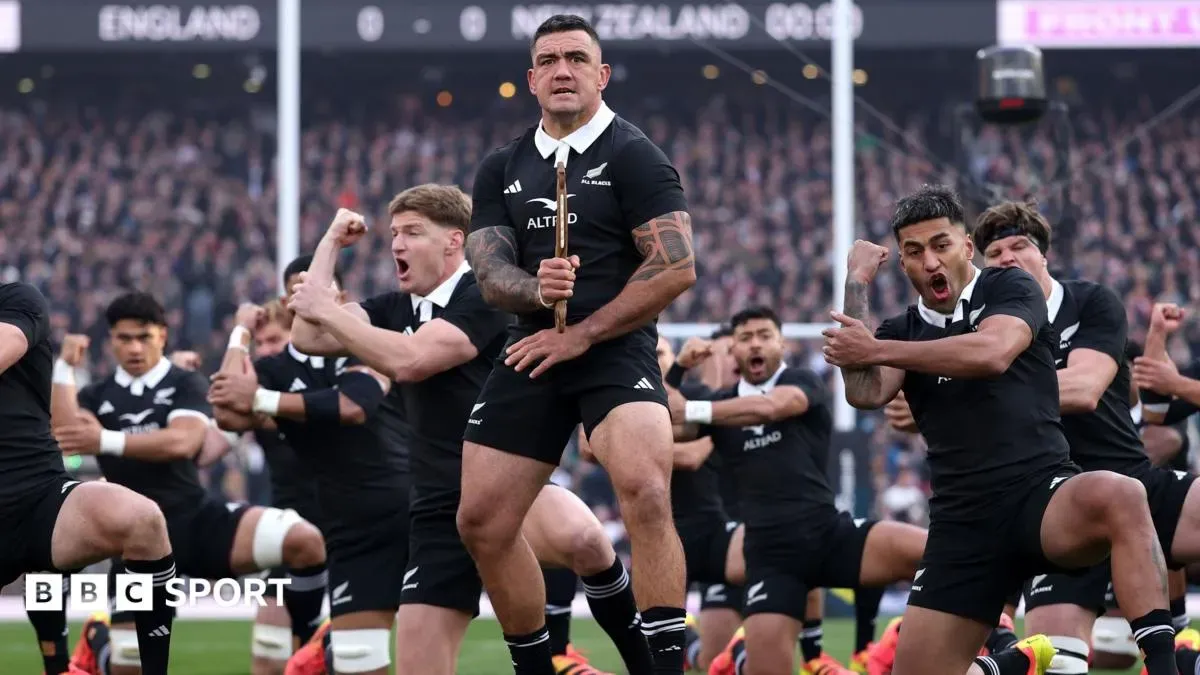
New Zealand's rugby team, the All Blacks, have long been a benchmark for success in the sport. Their impressive record has defied expectations, given their relatively small population and player pool compared to other top teams. Despite this, they have consistently outperformed their rivals over the years.
One of their most significant challenges comes from England, who beat them both last year and this year. The two teams are set to face off again on Saturday, with England aiming for a hat-trick. However, it's worth noting that even if England were to win every time they met the All Blacks until 2050, their overall record would still be significantly behind.
The statistics tell an interesting story about the All Blacks' dominance in Test rugby. They have won 36 matches against England's 10 over a 121-year period. This lopsided head-to-head is mirrored in their record against other nations as well, with the All Blacks boasting superior records against every country they've played.
The team's website highlights their rivalries, including a notable 40% winning percentage by South Africa in their meetings. However, this statistic only serves to underscore the All Blacks' own impressive performance over the years. Despite facing stiff competition from other teams, they have consistently emerged victorious.
New Zealand's grip on the global game appears to be loosening, however. The team is set to face off against England again soon, and a loss could signal a shift in their fortunes. If that were to happen, it would mark only the second time in history that the All Blacks had suffered six defeats in a calendar year, the first instance being back in 1949 when they played two separate Test series simultaneously.
New Zealand's win percentage in 2026 is significantly lower than in previous years, standing at 58.3%. This ranking marks a downward trend for the All Blacks, placing them among their lowest winning percentages since professionalism began.
The current season's grueling schedule and four away Tests against the world champion Springboks are part of a larger pattern of decline for New Zealand rugby. The team has struggled to replicate the success of the 2010s, when they won back-to-back world titles under an all-time great squad.
A decade into the 2020s, New Zealand is on course to experience their least successful period since the 1970s. This slump is not just relative to their previous generation; it's also compared to every other modern predecessor team.
The All Blacks' traditional approach to promoting from within and maintaining coaching dynasties may be contributing to their struggles. The recent succession of coaches, Graham Henry, Steve Hansen, and Ian Foster, was built on a thread of continuity and shared rugby traditions.
This in-house production line of leaders has been both a source of strength and a potential weakness. As modern opposition tactics are quickly analyzed and best practices spread rapidly, adherence to tradition may be limiting the team's ability to innovate and stay ahead of the competition.
New Zealand's rugby rivals have not been slow to adapt when it comes to hiring coaching talent from outside their own borders.
South Africa's Rassie Erasmus may be at the helm of the Springbok team, but behind him are Irishmen Jerry Flannery and Felix Jones, who bring specialist expertise in different areas. Tony Brown, a former All Black himself, is also part of the team. This blend of international experience has clearly had an impact on the team's performance.
France, known for their strong sense of national pride when it comes to hiring staff, have benefited from the input of Englishman Shaun Edwards and South African Vlok Cilliers in recent years. The pair brought valuable expertise behind the scenes, contributing to the team's success. It's clear that other nations are willing to look beyond their own borders for top coaching talent.
England, Ireland, Scotland, and Wales have all had head coaches from outside their countries at some point. This trend is not unique to these teams, however - it's a common strategy being employed by many nations in the rugby world.
The All Blacks' new coach, Dave Rennie, has brought his own international experience to the role, including spells coaching Australia and Glasgow Warriors. His team now includes a Scottish contingent, with attack coach Mike Blair a notable addition.
The All Blacks' relentless touring schedule has been a boon for their coffers, but it's come at a cost - literally. Playing matches in bigger stadiums overseas brings in more revenue, but it also means players are away from home for extended periods.
As a result, costs are rising faster than the team's income, putting pressure on New Zealand Rugby to keep its centrally contracted stars. A key requirement for playing internationally is representing a domestic team, which creates tension when top players consider leaving their homeland.
The All Blacks' financial woes have been compounded by recent departures. Beauden Barrett's proposed move to Bristol Bears has grabbed headlines, but it's other departures that are causing concern in New Zealand Rugby circles. Back-row stars Wallace Sititi and Luke Jacobson are among those rumored or confirmed to be leaving for French clubs.
Rising costs are a significant challenge for the All Blacks, with chairman David Kirk acknowledging they won't be able to compete financially with top-paying nations like Japan and France. For Kirk, the problem lies in players leaving New Zealand in their mid-20s, potentially never to return.
The allure of playing for the All Blacks is a powerful draw for many New Zealand rugby players, but it's not enough to keep them all at home. The desire to have a memorable career representing their country is a strong motivator, and most players are content with that.
However, when talented individuals do leave New Zealand, they often become notable exceptions rather than the norm. This can create a sense of intrigue around their decision to depart.
One such player who has struggled to find his footing since returning from an overseas stint is someone who was once considered one of the world's top fly-halves. Despite being part of the last World Cup squad, he has yet to fully regain his form after spending time in Japan and international exile.
The reality is that many New Zealand players will inevitably spend time playing for clubs abroad, particularly around major tournaments like the World Cup. This can help them develop their skills and gain valuable experience, but it also creates challenges when they return home.
The departure of South African teams from Super Rugby has left a significant void in the competition landscape.
With fewer opponents to contend against, Kiwi provincial sides are now facing a more subdued schedule that doesn't quite live up to the intensity of international rugby.
New Zealand Warriors, an Auckland-based NRL side, provide a pathway for young rugby talent to transition into the 13-man game and potentially reap financial rewards. This has become a vital lifeline for emerging players as grassroots rugby league participation numbers have begun to recover from the pandemic slump.
While New Zealand Rugby and the All Blacks are aware of the challenges ahead, they're also cognizant that this is a long-term strategy, one that requires careful management if they hope to maintain their dominance in world rugby.
Facts based on reporting originally published by BBC Sport.
You may republish this story, in full or in part, if you credit Noti Group and link to it (licence CC BY 4.0). Photos are not included.