




Yemen's City of Taiz Under Siege by Houthi Rebels
Taiz, a city of between 600,000 and 1 million residents, is under siege by Houthi rebels.
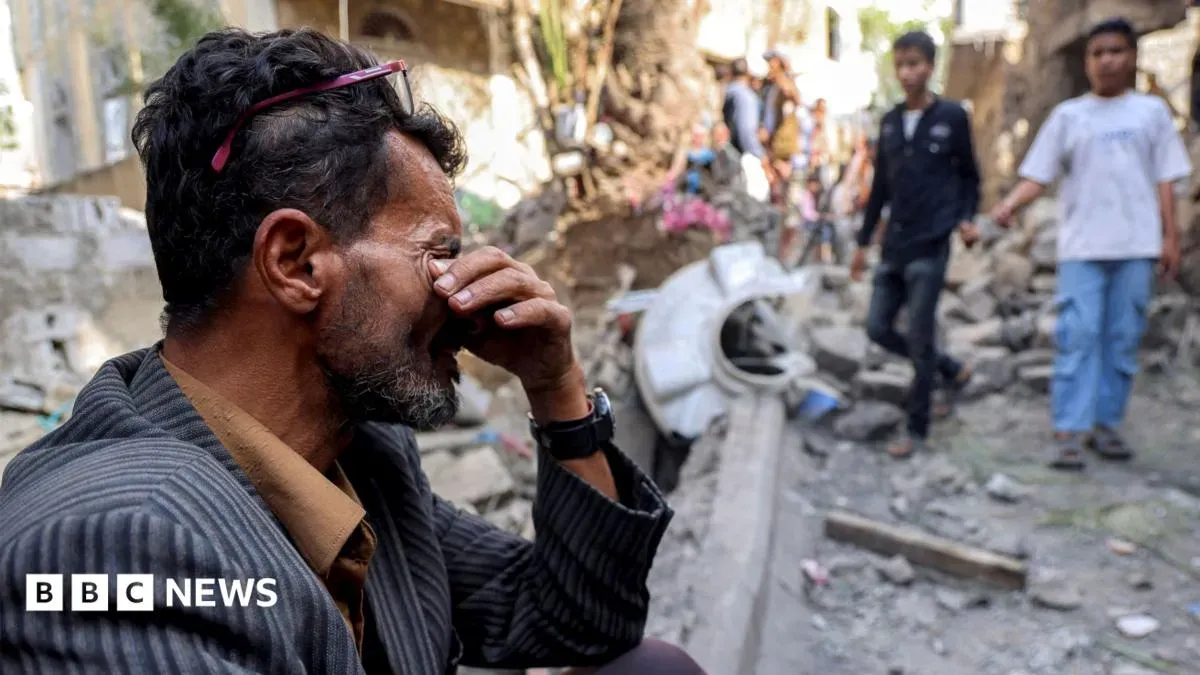
The Yemeni city of Taiz is under siege, its residents struggling to cope with the harsh realities of war. Ashwaq, a mother living in the city, has devised a way to reassure her 11-year-old son about the constant sounds of gunfire and explosions.
She tells him it's just fireworks, but deep down she knows he's old enough to understand what's happening around him. Her son has lived through most of his life amidst war, and Ashwaq is desperate not to traumatize him further.
Taiz has been a key battleground in Yemen's civil war for years, with Houthi rebel forces tightening their grip on the city last month. The government-controlled city is now fully encircled by these rebels, leaving its population of between 600,000 and 1 million residents cut off from the world.
The siege has had a devastating impact on the city's economy, with prices for basic necessities like rice, sugar, and cooking oil skyrocketing to double or triple their original value. The supply of essential goods, including medicine, water, and fuel, is dwindling rapidly.
Life in Taiz has come to a standstill, with streets that once hummed with traffic now eerily silent. Schools are closed, restaurants shuttered, and the city's residents are struggling to cope with the mounting suffering. Piles of rubbish are accumulating inside the city, posing a new threat to public health as people try to burn them, filling the air with toxic smoke.
The Houthi rebels have positioned themselves on hills surrounding the city, from where they can wage war on the population below. The exact number of civilian casualties is unknown, but estimates vary widely, with some sources claiming that 148 civilians have been killed by Houthi attacks since August.
As the siege continues to tighten its grip on Taiz, residents are facing an increasingly desperate situation, with even basic necessities becoming scarce. Ashwaq's efforts to reassure her son about the dangers outside their doorstep are a testament to the resilience of those living under siege.
The city of Taiz is under siege, its residents living in constant fear of Houthi shelling and sniper fire. Many have lost hope for their future, as the once-thriving metropolis has become a mere shadow of its former self.
Taiz's strategic location makes it a crucial gateway to Aden, the temporary seat of the internationally recognized government, and southern Yemen. The city's significance is matched only by its vulnerability, as it lies at the mercy of warring factions.
Houthi rebels, backed by Iran, have been laying siege to Taiz from three sides since 2015, cutting off roads and restricting movement. Their advance marked a significant escalation in the conflict, which had flared up after a four-year lull.
The war has become a long-running affair, with no end in sight for the people of Taiz. Despite the backing of Saudi Arabia and its air strikes, the government has failed to reclaim control over much of north-western Yemen.
The Houthis have made significant gains in recent months, taking territory from the government and striking Saudi Arabia with missiles and drones. Their actions have sparked concerns about regional stability, as the conflict continues to spread.
The situation on the ground remains dire, with residents like Ashwaq yearning for a return to normalcy. Her words serve as a poignant reminder of the human cost of war, as she struggles to keep her family safe amidst the chaos and destruction.
Yaser's hospital is overwhelmed with war wounded, including four children who were shot by Houthi snipers and brought in recently. He treats them alongside other doctors, who are also exhausted from working long hours without adequate supplies. The medical team struggles to cope with the influx of patients, many of whom have been injured by shelling.
The hardest part for Yaser, a father himself, is treating children who have been badly hurt. "I have to rise to the responsibility, compose myself and support the families," he says, struggling to convey the emotional toll of his work. The situation is so dire that even he finds it hard to put into words.
The hospital's resources are severely strained, with many essential items in short supply. Sterilising fluid for surgical instruments is one such item that is running low, further complicating the doctors' efforts to treat their patients. Yaser's team works tirelessly to provide care despite these challenges.
Most of the injured are victims of shelling, which has become a common occurrence in Taiz. Reaching the hospital can be an ordeal for families who live in outlying areas and have to walk for hours to get there. This grueling journey is often made worse by the fact that many patients arrive exhausted before even receiving treatment.
As a result of the siege, basic necessities like food are scarce, leading to widespread suffering among the population. The situation has become so dire that people are dying not just from bombs and bullets but also due to supply shortages and lack of income. Every day, dozens of residents are buried in Taiz's graveyards.
The city's Governor, Nabil Shamsan, remains inside the besieged city and is witness to its plight. He describes the scene as funerals heading to the cemeteries around the clock, highlighting the devastating impact of the conflict on civilians.
Hospitals in Taiz have been severely impacted by the ongoing conflict, with their capacity reduced by a staggering 70%. The shortage of medical facilities has led to a surge in diseases and an increase in neonatal deaths. Malnutrition is also rampant due to the lack of access to food and healthcare services.
One of the most pressing concerns is the inability of kidney patients to receive dialysis treatment. Many are unable to reach hospitals due to the fuel shortages, while others cannot afford the cost of transportation when they do manage to get there. This has resulted in hundreds of patients being denied life-saving treatment.
The Houthi leader, Abdul Malik al-Houthi, claims that routes remain open for food, medicine, and humanitarian aid. However, this is vehemently denied by the government, residents of Taiz, aid agencies, and the United Nations. Despite these assurances, the situation on the ground remains dire.
Shamsan emphasizes that the battle for Taiz is not just about territorial control, but also about the city's character. He believes that the Houthis aim to impose their strict religious doctrine on the predominantly Sunni population, dragging them "back to the dark ages. This would be a stark contrast to Taiz's reputation as a hub of culture and learning.
The city's governor is resolute in his determination to defend Taiz against the Houthi forces. He insists that they will never win, stating that the Houthis' goal is for the population to perish" before they can achieve their objectives. The people of Taiz are fighting on multiple fronts, with relatives, friends, and neighbours joining pro-government troops in a desperate bid to repel the Houthi advance.
Training camps have been set up to prepare volunteers for battle, but these courses are often brief and inadequate. Akram, a 31-year-old veteran, is already experienced in combat and has a child on the way. He is one of many who are fighting to protect their city from what they see as an oppressive force.
The city of Taiz has been under siege for months, and those living there are struggling to cope with the constant bombardment.
Many residents have taken up arms to defend their homes against the Houthi forces, which they see as an oppressive force trying to take control of the city.
For some, like a young man who wished to remain anonymous, this is not the first time they've had to fight for Taiz. He was forced to abandon his studies in 2015 when the Houthis took over his district on the outskirts of the city.
The cost of arms has increased significantly since then, with a Chinese-made Kalashnikov now costing around $1,200, nearly double what it used to be.
Despite the high costs, many residents feel they have no choice but to defend their city, and this fight is seen as different from the one in 2015 due to the Houthis' new technology and missiles.
The Houthi forces are using drones to wage war in the air, which has left residents fearing for the safety of their families and civilians.
Akram, a resident who wishes to remain anonymous, sees defending Taiz as his duty, saying that all sons of Taiz will fight against the Houthis and their extremism.
The Houthi forces claim they have been given the right to rule Yemen by God, but residents like Akram reject this idea, saying they live in freedom and cannot surrender or leave the city.
The residents of Taiz have grown accustomed to the sounds of war, but their lives remain precarious.
Their greatest fear is that the Houthi forces will exert control over the city from outside its walls, crushing any remaining resistance and settling scores with those who oppose them.
For Ahmad, the thought of his children being caught in the crosshairs is unbearable - he tries to reassure them by telling them it's just fireworks, but deep down he knows that's a fragile comfort.
As the city endures bombardment and hunger, Ashwaq, a teacher, has a heartfelt plea for the international community: don't forget about Taiz and its ordinary families who want nothing more than for their children to live normal lives.
The city's residents are caught in a desperate situation, struggling to make ends meet amidst growing hunger and abandonment - it's a cry that falls on deaf ears as the war rages on.
Ashwaq's words echo the sentiments of many: they're not just numbers in news reports, but families who want their children to have the chance to study, play, and dream like kids anywhere else in the world.
In Taiz, hope is a scarce commodity - but for Ahmad and Ashwaq, it's not about winning or losing; it's about surviving another day amidst the chaos.
Facts based on reporting originally published by BBC News World.
You may republish this story, in full or in part, if you credit Noti Group and link to it (licence CC BY 4.0). Photos are not included.