

Pelé and Diego Maradona: A Turbulent Friendship
A new book explores the complex relationship between two of football's greatest legends, Pelé and Diego Maradona, whose friendship was built on shaky ground.
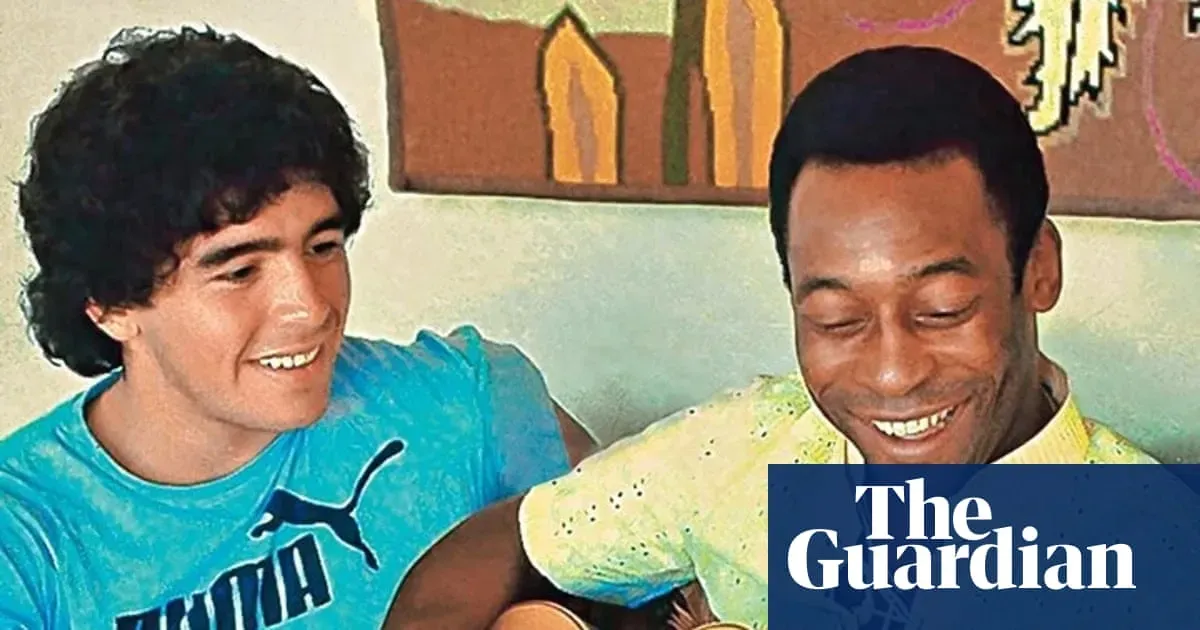
A new book delves into the complex and often tumultuous relationship between two of football's greatest legends, Pelé and Diego Maradona.
The story begins on a sunny afternoon in Rio de Janeiro in 1979, when the Argentinian sensation Maradona had just led his country's under-20 team to the finals of the World Youth Cup.
At that time, Maradona was eager to meet his idol Pelé, and he confided in a journalist friend about his dream. However, their initial attempts to arrange a meeting were thwarted by Maradona's reluctance to travel on Mondays due to his commitment to his girlfriend Claudia.
A few weeks of false starts later, the meeting finally took place in Rio, facilitated by reporter Guillermo Blanco, who was writing for Argentinian sports magazine El Gráfico. Blanco had managed to secure permission from Pelé's representatives and went to great lengths to make it happen.
Blanco even checked Maradona onto a flight without telling him, before collaring the young player after an Argentine Juniors match against Huracán, and then racing to the airport with his entourage.
The encounter between these two football legends was about to take a dramatic turn. As their mutual admiration began to wane, it became clear that their relationship had been built on shaky ground.
Pelé's criticism of Maradona at the 1982 World Cup marked a significant turning point in their friendship. In his column, Pelé not only questioned Maradona's footballing abilities but also his character, sparking a heated debate. His words would go on to fuel the growing animosity between them.
Their disagreement was further complicated by the moralistic undertones that surrounded it. Good vs evil, establishment vs people, and conformist vs rebel - these labels were applied to both men as their feud gained momentum. Their fans took sides, and the media eagerly fed off the controversy.
The gulf between Pelé and Maradona continued to grow, with neither man willing to back down from his stance. Maradona's infamous quote - 'We're oil and water' - summed up the incompatibility that had been brewing beneath their surface for so long.
The rift between Maradona and the Brazilian football establishment had been growing for some time, fueled by Pelé's skepticism about the Argentine's abilities.
Maradona's behavior on the pitch in Argentina's second-round match against Brazil proved to be a turning point in their relationship. He lost his cool and was sent off after committing a reckless foul in the dying minutes of the 3-1 loss. The defeat meant that the champions were out, and Maradona had failed to live up to the hype.
Pelé's scathing assessment of Maradona's performance was published in his column the next day, where he described him as an "immature young man who had yet to prove himself as a great player. The words cut deep for Maradona, who had considered Pelé a friend and ally until that moment.
Maradona's anger simmered beneath the surface for a while before boiling over in the aftermath of Argentina's World Cup victory in 1986. He was still relatively young at the time, only 21 years old, but he was already beginning to assert his opinions and defend himself against criticism.
As Maradona's ego grew, so did his desire for revenge against those who had doubted him. He started speaking out more frequently, responding to critics with increasing ferocity and disdain. Pelé, once a respected figure in the Argentine camp, was now one of his most vocal detractors.
The seeds of their bitter rivalry were sown during this period, as Maradona began to see himself as a rival to Pelé's throne rather than just a young player seeking guidance.
Pelé's legacy had long been unchallenged as the greatest footballer of all time, but a new threat emerged in the form of Maradona, who began to make waves in the sport.
Maradona's exceptional talent was matched by his ability to inspire and elevate those around him, making his team more than just the sum of its parts. His performances on the field were nothing short of remarkable, leading Argentina to a World Cup victory in 1986 that left many in awe.
As Maradona's star continued to rise, Pelé began to feel the heat, subtly questioning his rival's achievements and playing up his own accomplishments. He grudgingly acknowledged Maradona's brilliance but couldn't help but wonder how anyone could compare him to a player whose most iconic goal was scored with his hand.
The comparison between the two footballing legends sparked a sense of unease among Brazilians, who felt their nation's reputation as the best in the world was under threat. The thought of Argentina surpassing Brazil in World Cup titles, particularly given the questionable manner of their wins, sent shivers down the spines of Brazilian fans.
Pelé's concerns were rooted in his own sense of right and wrong, as well as a deep-seated pride in Brazil's footballing history. He couldn't bear the thought of Argentina robbing Brazil of its honour, particularly when it came to the one thing that mattered most: winning World Cup titles.
Maradona's impact on Argentine football was profound, transforming his team into a force to be reckoned with on the international stage. His teammates grew in stature and confidence under his leadership, becoming an unstoppable force as they marched towards victory.
Pelé's reaction to Maradona's rise was a mix of defensiveness and competitiveness, as he began to defend his legacy against what he saw as a growing threat. He had long been recognised as the greatest footballer of all time, but Maradona's emergence forced him to confront the possibility that his reign might be coming to an end.
As the rivalry between Pelé and Maradona intensified, it became clear that their on-field battles were only the tip of the iceberg, a deeper conflict was brewing, one that would have far-reaching consequences for both players and their respective nations.
The perception of Argentines as cunning or even deceitful had long been a point of contention between Brazilian and Argentine fans. Brazilians often viewed their South American neighbors with suspicion, accusing them of exploiting loopholes in the game. This attitude was ironic, given that Brazilians themselves were not immune to questionable tactics on the pitch.
Maradona's involvement in several high-profile controversies only exacerbated tensions between Pelé and himself. The infamous handball against England during the 1986 World Cup final was a particularly egregious example of Maradona's willingness to bend the rules. The hand of God", as he infamously referred to it, not only sparked outrage among English fans but also offended those who took their faith seriously, like Pelé.
Pelé's distaste for Maradona's antics extended beyond his on-field behavior to his off-field lifestyle as well. The Brazilian legend was appalled by Maradona's struggles with addiction and the overall lack of remorse he displayed in the face of controversy. As a result, their once-amicable relationship had deteriorated into a bitter rivalry that would have far-reaching consequences for both parties involved.
Facts based on reporting originally published by The Guardian Sport.
You may republish this story, in full or in part, if you credit Noti Group and link to it (licence CC BY 4.0). Photos are not included.