








Martian Meteorite Teghaza 001 Estimated to be at Least 4.1 Billion Years Old
The discovery challenges existing knowledge about the age of Martian meteorites, which are typically classified into three main categories: shergottites, nakhlites, and chassignites, all of which are less than 2.4 billion years old.
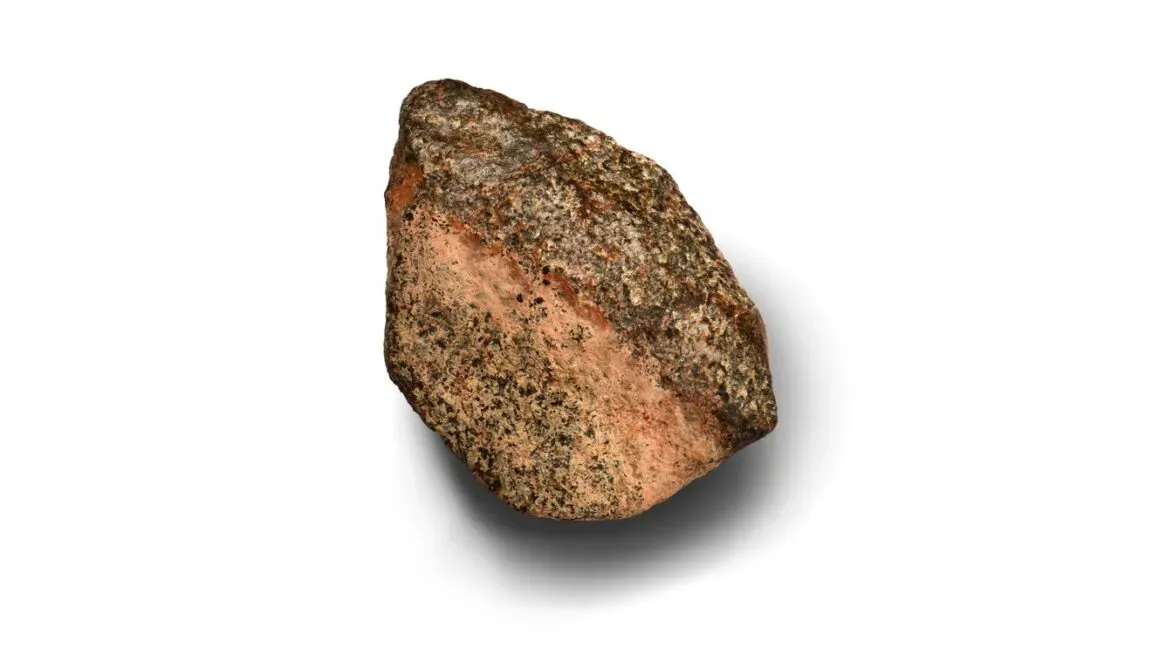
A newly discovered Martian meteorite has provided scientists with a unique glimpse into the ancient crust of the Red Planet. The Teghaza 001 meteorite, found in the Sahara Desert in Mali in 2022, is estimated to have formed at least 4.1 billion years ago.
This discovery challenges existing knowledge about the age of Martian meteorites, which are typically classified into three main categories: shergottites, nakhlites, and chassignites, all of which are less than 2.4 billion years old. The two previously known genuinely ancient Martian meteorites were Allan Hills 84001 from Antarctica and Black Beauty from northwest Africa.
The Teghaza 001 meteorite is significant not only because of its age but also due to its similarity to some of the oldest rocks found on Earth. According to lead researcher Yang Liu, a planetary scientist at NASA's Jet Propulsion Laboratory, this meteorite offers valuable insights into Mars' ancient geology.
Scientists are still trying to understand why old Martian rocks are relatively rare among those that have landed on Earth. One possible explanation lies in the process of how these rocks are ejected from Mars and travel through space. It appears that a large impact is required to launch a rock off the planet, but not all rocks can withstand this event.
The natural selection process that occurs during an impact may act as a filter, favoring stronger rocks over weaker ones. This could be why so few ancient Martian rocks have made it to Earth, with Teghaza 001 being a rare exception.
The Martian meteorite Teghaza 001 defies expectations, its unique characteristics setting it apart from other rocks of its kind that have made their way to Earth.
Unlike most Martian meteorites, which are a mix of soil and small rock fragments, Teghaza 001 is an intact igneous rock. This singularity has puzzled scientists, who note that none of the collected Martian meteorites bear any resemblance to what they've observed on the surface.
Teghaza 001 was acquired through the desert meteorite trade, where collectors scour the Sahara for dark stones that stand out against the sand. A private collector purchased the rock and sent a sample to the University of New Mexico for classification, where it was measured for its oxygen isotopes by planetary scientists Carl Agee and Karen Ziegler.
The oxygen isotope values of Teghaza 001 matched those of other Martian meteorites, but further analysis revealed some anomalies. The rock's mineral composition showed signs of alteration that were not typical of weathering on Earth, with the inside of the rock being altered while its outer part remained pristine.
Agee initially classified Teghaza 001 as a shergottite, the most common and young type of Martian meteorite. However, he later noticed some unusual features, including manganese-rich material similar to what was found in Black Beauty, another Martian meteorite that has been studied by Liu's team.
The Martian meteorite Teghaza 001 has a unique composition that sets it apart from other space rocks. Initially, Liu thought the sample was unremarkable, but upon closer inspection, he discovered manganese-rich material similar to what's found in Black Beauty, another Martian meteorite studied by his team.
Liu's findings revealed that Teghaza 001 is primarily composed of feldspar, a common mineral in rocky planets' crusts. This is accompanied by darker pyroxene crystals, which bear resemblance to lunar highlands rocks. The size of the crystals, reaching up to a millimeter across, suggests that they cooled slowly over time.
The team's analysis indicates that Teghaza 001 cooled at an extremely slow rate, roughly 0.01° Celsius per year. This implies that the rock formed from magma that solidified within the Martian crust, rather than being ejected through volcanic eruptions.
Multiple independent dating methods yielded similar results for Teghaza 001's age: around 4.11 billion years old. The team used zircon grains and phosphate minerals to arrive at this conclusion, with rubidium-strontium dating providing further confirmation.
The consistency of these ages is striking, considering the difficulties involved in resetting zircons' age. According to Liu, high-pressure minerals can be forged through impacts, but not hot enough to reset zircon ages without hydrothermal fluids being present.
The presence of sodium-rich rims on feldspar grains within the Teghaza 001 meteorite suggests that hot water percolated through the rock shortly after it formed. This process likely occurred multiple times over a period spanning billions of years, with the most recent event occurring approximately 4.1 billion years ago.
The Teghaza 001 meteorite is also notable for its unusually high levels of oxygen-18, a heavier form of oxygen that makes up about two parts per thousand more than in other Martian meteorites. This anomaly cannot be attributed to crystallization or gas escaping from magma, as these processes would not produce such a significant difference.
The team believes that the heavy oxygen signature in the Teghaza 001 meteorite is indicative of water reacting with rock at low temperatures near the planet's surface. This could have occurred either through the incorporation of crustal materials into the magma or through direct interaction between the magma and fluids carrying the same heavy oxygen signature.
The presence of a hydrosphere on Mars, interacting intensely with its crust, is supported by these findings. The water must have been circulating through the crust and reacting with magma before it had cooled completely, indicating that early Mars was more dynamic and active than previously thought.
This discovery fits into the picture of a wet early Mars, pointing to potentially habitable environments within its crust. The implications of this finding are significant, shedding light on the geological history of the Red Planet and its potential for supporting life in the past.
The discovery of Teghaza 001 has provided scientists with a unique opportunity to study the geological history of Mars in unprecedented detail. The meteorite's chemistry reveals that its magma came from a depth of over 160 kilometers, where garnet is stable, suggesting that it originated from the Martian mantle.
Studies of other Martian meteorites have suggested that the planet's mantle separated into three to five reservoirs as an early ocean of magma solidified around 4.5 billion years ago. However, Teghaza 001's source does not match any of these reservoirs, indicating a more complex evolution of the Martian mantle in its early years.
The team has used orbital maps to narrow down the possible source location of Teghaza 001 to an area in the southern highlands, northwest of the giant Hellas impact basin. This region is characterized by unique geological features that may have played a role in shaping the Martian crust.
Orbital data can only pinpoint the meteorite's source to a patch of around 100 meters by 100 meters, which is roughly equivalent to one pixel in remote sensing data. Despite this limitation, scientists are eager to study Teghaza 001 further to gain insights into its origin and history.
The fact that multiple research groups are already studying Teghaza 001 highlights the importance of this discovery and its potential to advance our understanding of Mars' geological evolution. Further analysis is likely to reveal more about the Martian mantle's composition and structure.
The study of Teghaza 001 also underscores the challenges involved in tracing the origin of meteorites, which can be difficult to pinpoint due to the limitations of orbital data.
The findings from the meteorite Teghaza 001 have shed light on Mars' ancient crust, but more samples are needed to paint a comprehensive picture of the Red Planet's geological history.
Carefully collected samples with detailed geological context could be the key to unlocking new discoveries about Mars and its early solar system. Liu is eager to see samples from terrains as old as Teghaza 001 or even older returned to Earth, which he believes have the potential to revolutionize our understanding of Mars.
Facts based on reporting originally published by Ars Technica.
You may republish this story, in full or in part, if you credit Noti Group and link to it (licence CC BY 4.0). Photos are not included.