







Blue Origin Expands Launch Facilities in Florida
The company aims to increase its rocket flight capacity to over 100 missions annually from its existing sites at Cape Canaveral.
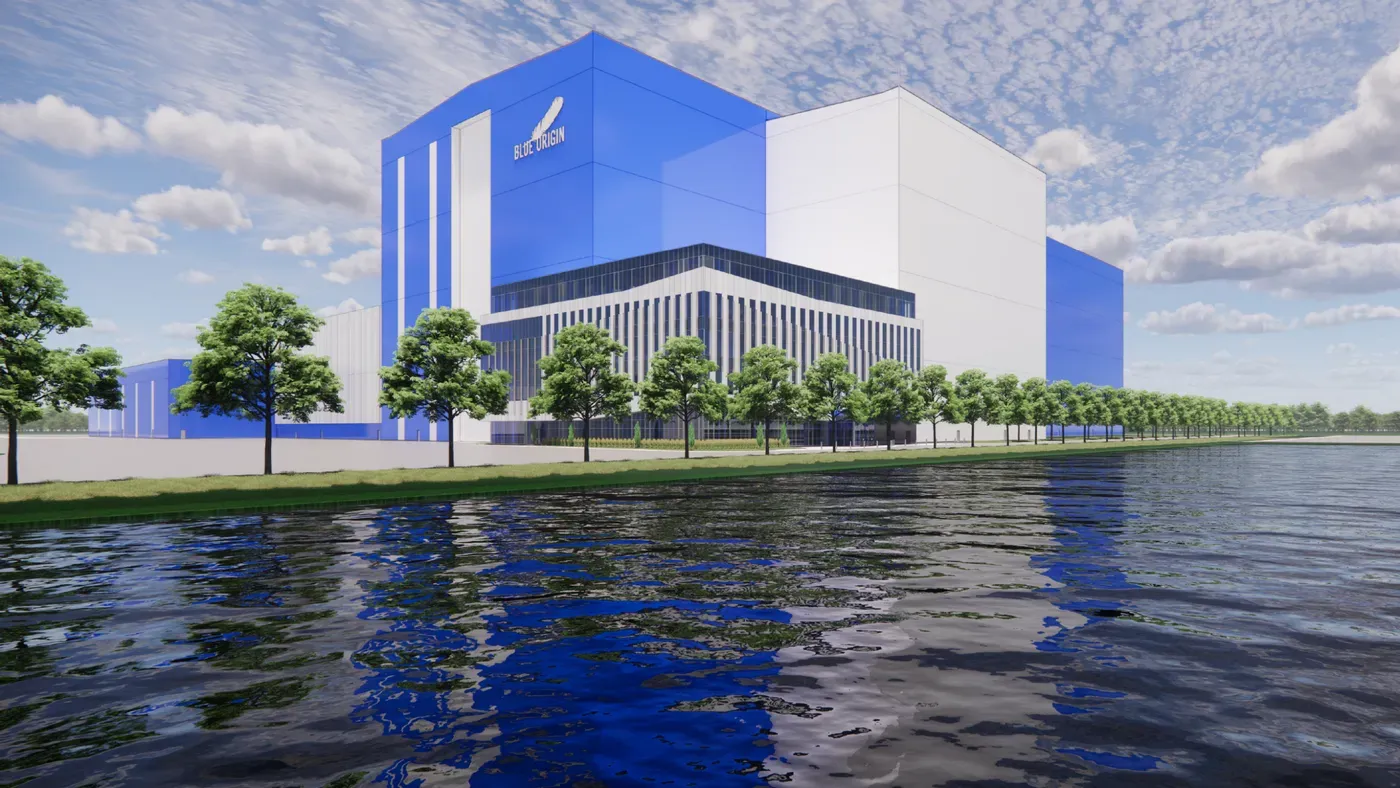
Blue Origin has made a significant announcement regarding its expansion plans for launch facilities in Florida. The company aims to increase its rocket flight capacity to over 100 missions annually from its existing sites at Cape Canaveral.
The expansion will include the construction of two additional launch pads specifically designed for the New Glenn rocket, which is currently under development. This brings the total number of New Glenn launch pads being built in Florida to four. The new facilities are expected to support a significant increase in launch frequency.
In addition to the new launch pads, Blue Origin is investing heavily in infrastructure that will enable the mass production of upper stages for the larger variant of the New Glenn rocket. A new manufacturing facility has been planned to meet this demand, with a capacity to produce up to 150 upper stages per year.
The company's expansion plans also include the procurement of two additional landing ships, which will be used to recover and refurbish the first stage of the New Glenn rocket after each launch. This is in addition to its existing vessel, Jacklyn.
Blue Origin has stated that these investments are focused on increasing the efficiency and reliability of its mission operations, with a goal of supporting multiple flights per week by the end of the decade. The company's senior vice president of operations, Ian Richardson, emphasized this objective in an update on Blue Origin's website.
Blue Origin's investment in Florida infrastructure continues to grow, with approximately $3 billion allocated for facilities and equipment supporting the development of its heavy-lift New Glenn rocket. This significant commitment has enabled the company to establish a substantial presence in the state, employing over 5,000 personnel and partnering with more than 500 local suppliers.
The expansion of Blue Origin's operations on the Space Coast is evident in the proliferation of manufacturing and launch sites across Brevard and Orange Counties. According to Ian Richardson, the company now operates at more than 20 locations within these counties, a marked increase from just a couple of years ago. This growth underscores Blue Origin's commitment to establishing itself as a major player in the space industry.
Notably, Blue Origin is poised to surpass SpaceX as the largest employer on the Space Coast, where the California-based company has long been a dominant force. With hundreds of successful launches under its belt, SpaceX has established itself as a stalwart of commercial launch services. However, the company appears to be scaling back its involvement in this market with its Falcon 9 and Falcon Heavy vehicles.
As the commercial satellite industry grapples with a growing launch crisis, Blue Origin is well-positioned to capitalize on the demand for launch services. With its expanding infrastructure and workforce, the company is poised to play an increasingly significant role in the space industry, particularly as SpaceX's presence begins to wane from the commercial launch market.
The setback for Blue Origin's New Glenn program has created an opportunity for the company to fill a gap in the market for medium- and heavy-lift vehicles. If successful, the New Glenn rocket could become a key player in this segment of the space industry.
However, the program hit a major roadblock in late May when a problem with one of the BE-4 engines led to the loss of the vehicle and its launch site at Cape Canaveral's Launch Complex 36A. The incident was a significant setback for Blue Origin's plans to establish itself as a major player in the commercial launch market.
Despite this challenge, Blue Origin is pushing ahead with rebuilding the site at 36A and completing nearby Launch Complex 36B, which will support a larger version of the New Glenn rocket. This 9x4 variant features nine first-stage engines compared to the smaller 7x2 model with seven engines.
The new launch pads announced by Blue Origin are likely designed to support the larger 9x4 variant of the New Glenn rocket. As Richardson noted, these pads will be built using a rapid construction approach similar to that being used for LC-36B.
The 9x4 rocket is expected to carry significant payloads, including 70 metric tons to low-Earth orbit and over 20 tons to trans-lunar injection. Blue Origin's plans to launch a human lander to the Moon as part of NASA's Artemis Program may also require the 9x4 variant, which could debut in 2028 if development proceeds smoothly.
Facts based on reporting originally published by Ars Technica.
You may republish this story, in full or in part, if you credit Noti Group and link to it (licence CC BY 4.0). Photos are not included.