






Trump Orders Department of Transportation to Make Japan's Kei Cars Legal in US
The move aims to make a wider range of smaller cars available to Americans, with potential implications for vehicle manufacturers and consumers.
A surprise move from President Trump has sent shockwaves through the automotive industry, with the Department of Transportation tasked with making Japan's tiny "Kei cars legal in the US.
The idea that Americans should have access to a wider range of smaller cars has garnered unexpected support, including from those who typically advocate for larger vehicles. The notion that government policies contribute to the dominance of massive SUVs in the US market is also gaining traction.
In contrast to the vast size and power of American vehicles, Japan's Kei cars are subject to strict regulations that limit their dimensions, engine capacity, and output. These restrictions aim to promote fuel efficiency and compact design.
A key aspect of the Kei car standard is its strict dimensional requirements: vehicles must be no longer than 11.2 feet (3.4 m), no wider than 4.9 feet (1.5 m), and no taller than 6.6 feet (2 m). Engine displacement is also capped at 0.66 L, with an output of 63 hp (47 kW) or less.
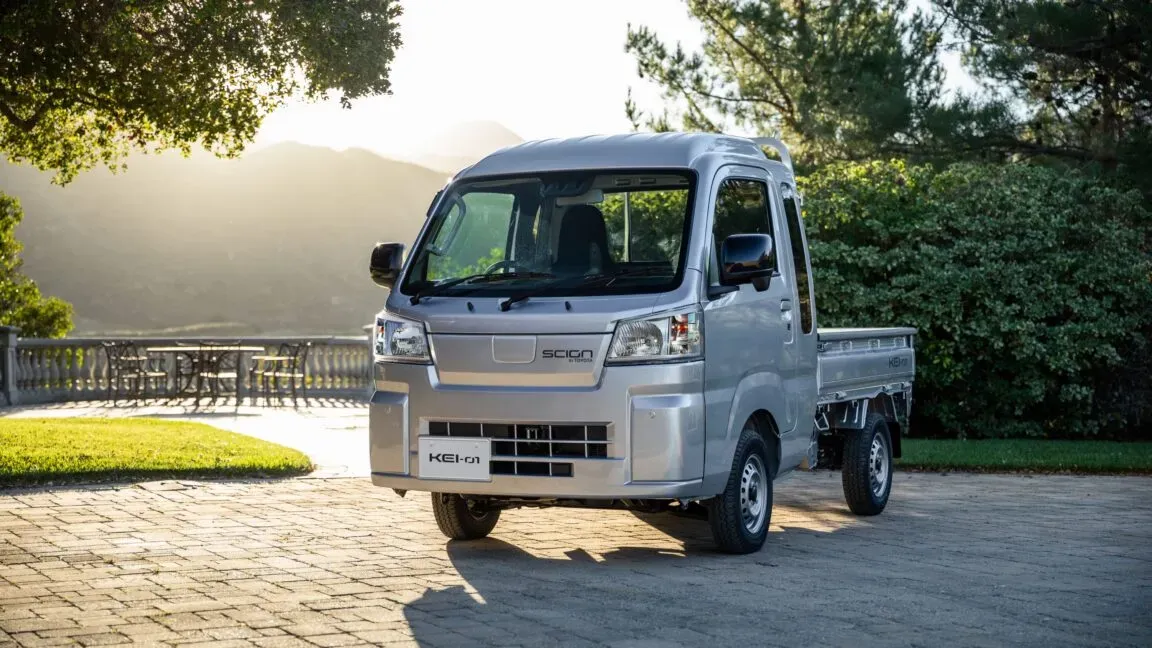
The introduction of Kei cars to the US market could have significant implications for vehicle manufacturers and consumers alike. Toyota's recent announcement that it will revive its Scion brand with a new KEI-01 model has sparked interest in this niche segment.
While details about the potential influx of Kei cars remain scarce, industry insiders are closely watching developments as they seek to capitalize on shifting consumer preferences and government policies.
Toyota's Scion sub-brand was discontinued over a decade ago, but it's now being revived as Scion by Toyota." This move is seen as an opportunity for the automaker to experiment with unconventional ideas and approaches.
The revival of Scion is part of Toyota's efforts to challenge traditional thinking in the automotive industry. According to Simon Humphries, Toyota's chief branding officer and head of design, mobility will not be defined by a single vehicle or technology. Instead, it will be shaped by diverse perspectives and innovative solutions.
As part of this initiative, Toyota has unveiled three new concept vehicles: KEI-01, SxS, and BKE. These vehicles represent different possibilities for future mobility and showcase the company's willingness to explore unconventional ideas. The Scion brand is providing a platform for Toyota to challenge conventional thinking and create new possibilities.
However, it's essential to note that the KEI-01 will be classified as a low-speed vehicle, limiting its speed to 25 mph (40 km/h). This classification means that drivers will not be able to use these vehicles on highways or high-speed roads.
The KEI-01 is one of three concept vehicles unveiled by Toyota under the Scion brand. The other two concepts are SxS and BKE, which represent different possibilities for future mobility. These vehicles demonstrate Toyota's commitment to innovation and its willingness to experiment with new ideas.
Toyota will not initially sell the KEI-01 as a retail vehicle, but it may be available to fleet buyers. This decision suggests that the company is prioritizing commercial or business applications over personal use.
The KEI-01's design is a far cry from what enthusiasts were hoping for when they heard about Toyota's plans to bring kei cars to the US market. The tiny truck will be dwarfed by other vehicles on the road and will have a top speed of just 25 mph, limiting its practicality.
One of the most striking features of the KEI-01 is its right-hand drive configuration, which may seem unusual for an American market vehicle. However, this design choice makes sense given that Japan drives on the left side of the road, and it's unlikely that the truck will be converted to accommodate US traffic patterns.
The KEI-01 is not just a novelty for personal use; Toyota sees it as a utility vehicle suited to specific needs. According to the company, its target customers include small business owners in urban environments, farmers and ranchers, organizations with campuses requiring fleets of facility vehicles, delivery drivers, and outdoor enthusiasts.
Toyota's plans to bring the KEI-01 to the US market will involve shipping knock-down kits to its assembly plant in Indiana, where they will be assembled. This move is expected to add 50 jobs to the plant by mid-2027, providing a boost to local employment.
The low-speed electric vehicle (EV) market in the US has been growing steadily, with many cities and communities adopting these vehicles for their convenience and environmental benefits. In Washington, DC, for instance, a company called Circuit operates an on-demand EV shuttle service that caters to local residents.
Pricing for the KEI-01, Toyota's low-speed electric vehicle, has yet to be announced, but estimates range from $10,000 to $28,000, giving consumers a wide price spectrum to consider.
Facts based on reporting originally published by Ars Technica.
You may republish this story, in full or in part, if you credit Noti Group and link to it (licence CC BY 4.0). Photos are not included.