







Sharp Sell-Off Hits Global Markets Amid Rising Inflation Concerns
Investors are growing increasingly concerned about rising inflation and potential interest rate hikes, leading to a sharp sell-off in global markets.
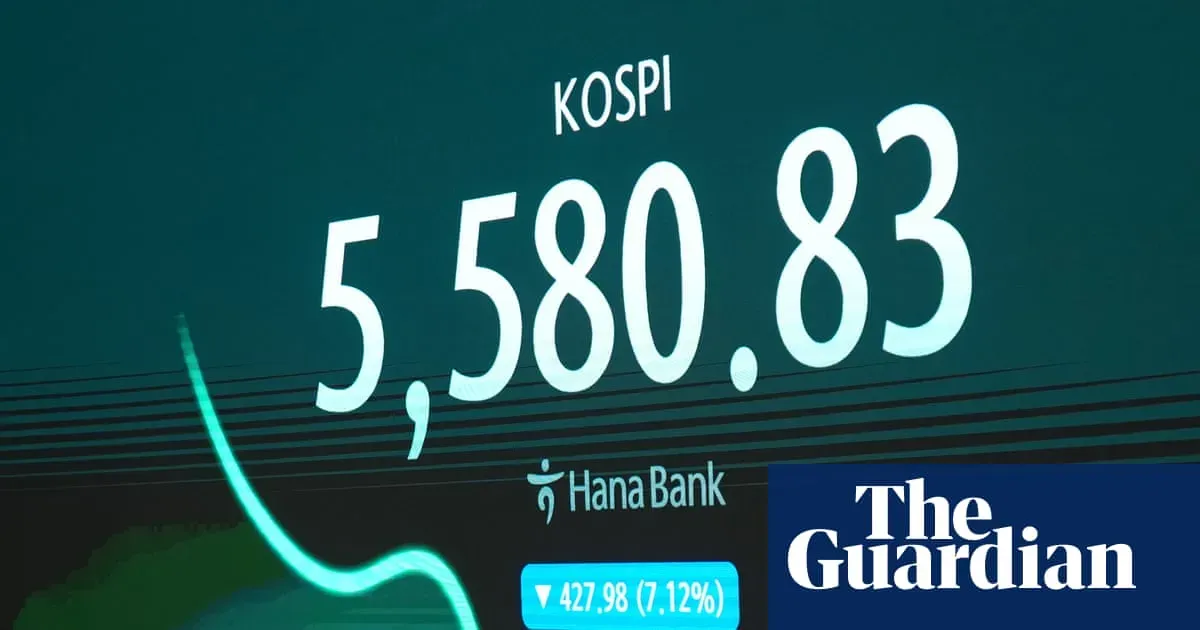
Global markets are experiencing a sharp sell-off as investors grow increasingly concerned about rising inflation and potential interest rate hikes. The tech sector is particularly vulnerable to these concerns due to its heavy debt load.
The South Korean stock market has been hit hard, with the Kospi 200 index plummeting over 8% in overnight trading. This triggered circuit breakers that temporarily halted trading at various points throughout the day. The index closed at a six-month low, down by 8.1%.
Semiconductor stocks have taken a major hit, with SK Hynix and Samsung Electronics falling nearly 11% and 9.5%, respectively. Japan's Nikkei 225 also experienced significant losses, dropping 4.9% on Thursday. Kioxia, a memory chip maker, led the decline in Tokyo, plummeting by 11%.
The sell-off follows a slide on Wall Street during the previous day's session, where the Nasdaq Composite fell by 1.9% and the S&P 500 dropped 1.1%. The losses were the worst since July for these key indices.
A sharp increase in US inflation has triggered a fresh wave of selling in the tech market, with investors bracing for further interest rate hikes by the Federal Reserve.
The consumer price index (CPI) rose to 3.7% in September, its highest level since May when it peaked at 4.2%. This unexpected surge in prices has left markets on edge, with some analysts predicting an additional interest rate increase as soon as this month.
According to Deutsche Bank analysts, the recent market turmoil can be attributed to a combination of factors, including the US CPI data and growing concerns about the impact of artificial intelligence (AI) on stock prices. Analysts led by Jim Reid noted that the price increases were not limited to energy costs, which have been affected by geopolitical tensions.
The International Monetary Fund has also weighed in on the issue, warning this week that the potential for an AI-driven share price crash poses a significant risk to global financial stability.
Global markets are bracing for a potential AI-driven correction that could have far-reaching consequences. Asian markets, in particular, are expected to be severely impacted, as they are heavily exposed to US technology stocks.
In China, the Shanghai CSI 300 plummeted by up to 2.4% on Thursday, hitting its lowest level since August 2025. Taiwan's tech giant TSMC also suffered a 2% decline despite reporting its sixth consecutive quarter of profits. The slump in these markets reflects growing concerns about the impact of an AI correction on global financial stability.
The sell-off extended to European markets, with major indices such as the Europe Stoxx 600 and Germany's DAX falling sharply by 0.4%, 0.53% respectively. In the US, stock futures pointed to further losses for tech stocks, with Nasdaq 100 futures dropping 1%.
Facts based on reporting originally published by The Guardian Business.
You may republish this story, in full or in part, if you credit Noti Group and link to it (licence CC BY 4.0). Photos are not included.