






Severe Water Shortage Grips Bedouin Community in Occupied West Bank
A severe water shortage has affected a small Bedouin community in the occupied West Bank's Jordan Valley as Israeli forces continue to build a barrier through Palestinian land.
A severe water shortage is gripping a small Bedouin community in the occupied West Bank's Jordan Valley as Israeli forces continue to build a barrier through Palestinian land.
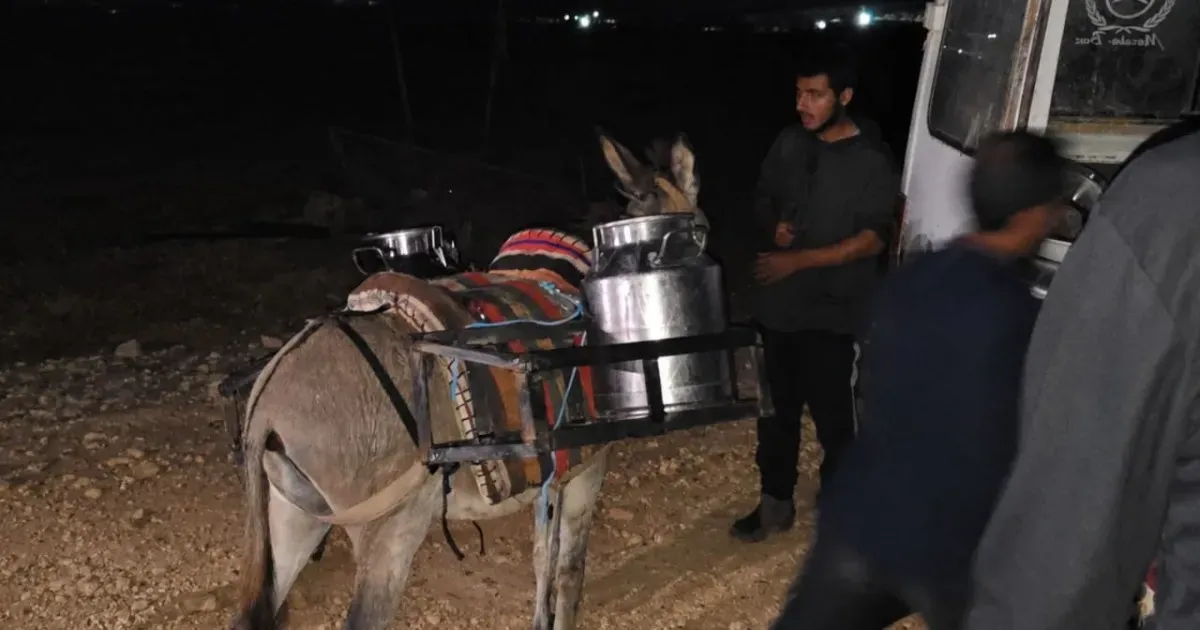
The Ras al-Ahmar community has been cut off from the outside world since mid-September, when Israel began constructing a road for military patrols, trenches and embankments that have effectively sealed off access points. Movement for Palestinians is severely restricted, forcing residents to navigate their daily lives under cover of darkness, transporting essential supplies such as water, fodder and milk via donkeys.
The situation has become increasingly dire in the past three days, with no water entering the community after Israeli forces sealed off the existing access routes that residents had been using. The community's livestock is particularly vulnerable, with 15,000 head of animals at risk of perishing due to the prolonged lack of food and water.
Community leader Saeed Ayed has spoken out about the siege, describing it as "completely besieged" and warning that the livestock will not survive without immediate action. Ayed's family has lived in Ras al-Ahmar for generations, relying on herding and animal husbandry to make a living.
The community is not alone in its struggles; Israeli settler attacks have intensified since February, with Ayed accusing settlers of attempting to force residents out of their homes to seize control of the land.
The community's resilience is being tested as they face a multitude of challenges stemming from the military barrier. In addition to attacks on their homes and livestock theft, residents are also reporting vandalism and beatings of local residents.
Access to medical care has become increasingly difficult due to the siege, posing a significant concern for elderly residents who require regular treatment. The situation is further complicated by the spread of disease among the community's livestock, particularly newborn animals that are unable to receive veterinary care.
The military barrier, which Israel claims is necessary for security purposes, runs for approximately 20km through the northern Jordan Valley. Recent construction efforts have expanded its reach, including the excavation of trenches and destruction of agricultural land that has damaged water sources and greenhouses.
According to Kerem Navot, an organization monitoring Israeli land policies in the West Bank, nearly 115 hectares were seized by the military this year, with around 85 percent of the land being privately owned Palestinian property. The construction has also had a devastating impact on local infrastructure, including wells and water networks.
The construction of Israel's separation barrier in the West Bank has led to severe restrictions on movement and access to essential services for local residents. One such example is the village of Ras al-Ahmar, where a tractor belonging to the village council was confiscated by Israeli forces last Sunday.
The driver of the tractor was detained while delivering animal fodder and water to the community, leaving hundreds of people without these basic necessities. Many of those affected are women and children who rely on these deliveries for their daily needs. The situation has sparked concern among local residents and human rights organizations.
In addition to restricting access to essential services, Israeli forces have employed other tactics to pressure Bedouin and herding communities in the Jordan Valley to abandon their properties. These include settler violence, demolition of structures, and closure of roads and access points, all aimed at making life impossible for these communities.
The United Nations Office for the Coordination of Humanitarian Affairs (OCHA) has highlighted the vulnerability of Bedouin and herding communities to displacement in the West Bank, noting that dozens of Palestinian communities have been entirely or partially displaced since 2023.
More than 2,500 Palestinians were displaced in 2026 due to settler attacks and related access restrictions, according to the United Nations Office for the Coordination of Humanitarian Affairs. This brings the total number of displaced Palestinians since 2023 to over 6,400.
As Israeli elections approach on October 27, Palestinian analysts and rights advocates argue that current measures are solidifying a new reality that may persist beyond the next government's term. They point out that these actions are having far-reaching consequences for the Palestinian population.
Hassan Mleihat, chairman of the al-Baydar Organization for Defense of Bedouin Rights, notes that settlers are rapidly increasing their efforts to displace Bedouin communities in the run-up to the elections. This is part of a broader strategy aimed at expelling Palestinians and seizing control of their land.
According to Mleihat, Israel's goal is to dominate the area's land under security pretexts, effectively isolating Palestinian communities into small geographical pockets. A road being constructed near Ras al-Ahmar is seen as a key component in this plan.
Experts believe that these Israeli measures have significant long-term implications for Palestinian communities, creating demographic, geographic, and security-related changes that may prove irreversible even if the Israeli government changes after the elections.
The normalization of Israeli settlements in the West Bank is not just about geography, but also about changing the way these settlements are perceived by the international community and the Palestinian people themselves.
According to experts, this shift is accompanied by a growing perception that the West Bank is no longer a disputed territory, but rather an area where Jews have the right to live safely. This perspective has significant implications for how Israeli and Palestinian communities in the West Bank are viewed by the state.
Israeli settlers are increasingly being presented as a population requiring protection, while Palestinians are seen primarily as a security threat. This framing is not just limited to perceptions of the two communities, but also shapes the way the land itself is treated.
For example, a tree may be viewed as a potential resource for attacks on the Jewish community, and cutting it down is seen as a necessary security measure rather than an environmental issue. This logic has far-reaching consequences for how Palestinians live their daily lives in the West Bank.
The Israeli army and police are also being redefined in this new context, with their role increasingly focused on protecting settlers from what is perceived as a Palestinian threat, rather than restraining settler aggression against Palestinians.
The long-term implications of this shift in priorities are far-reaching and will likely outlast any current government. This new reality creates a dynamic that will persist beyond the elections, regardless of who emerges victorious.
In this context, the Israeli army and police are increasingly focused on protecting settlers from perceived Palestinian threats, rather than restraining settler aggression. The separation barrier's impact on water supply to Palestinians in the West Bank underscores this trend, with severe consequences for local communities.
Facts based on reporting originally published by Al Jazeera.
You may republish this story, in full or in part, if you credit Noti Group and link to it (licence CC BY 4.0). Photos are not included.