








Polestar Collaborates with University of Oxford on Driver Experience Study
Researchers at the University of Oxford are collaborating with Polestar to explore how car performance affects the driver.
The human desire for speed has been around for thousands of years, dating back to when early humans first saw horses on the Pontic-Caspian steppe and likely imagined the thrill of riding one.
Fast forward a thousand years or so, and the invention of the wheel enabled people to move at unprecedented speeds in chariots. Today, we drive cars that are powered by engines far stronger than any animal could muster.
The usual metrics for measuring car performance include acceleration, top speed, and lap times. However, electric vehicles have entered a competitive phase, with manufacturers racing to achieve 60mph in the shortest time possible.
But quantifying a car's performance is relatively straightforward, all one needs is a stopwatch and a track. On the other hand, understanding how car performance affects the driver is a more complex question.
Researchers at the University of Oxford are collaborating with Polestar to explore this very issue. According to Christian Samson, head of product attributes at Polestar, the team aims to grasp something that cannot be captured on a specification sheet alone, the human experience behind the wheel.
The partnership with the University of Oxford enables Polestar to examine car performance from a fresh perspective, linking engineering and driver experience in a way that has not been done before.
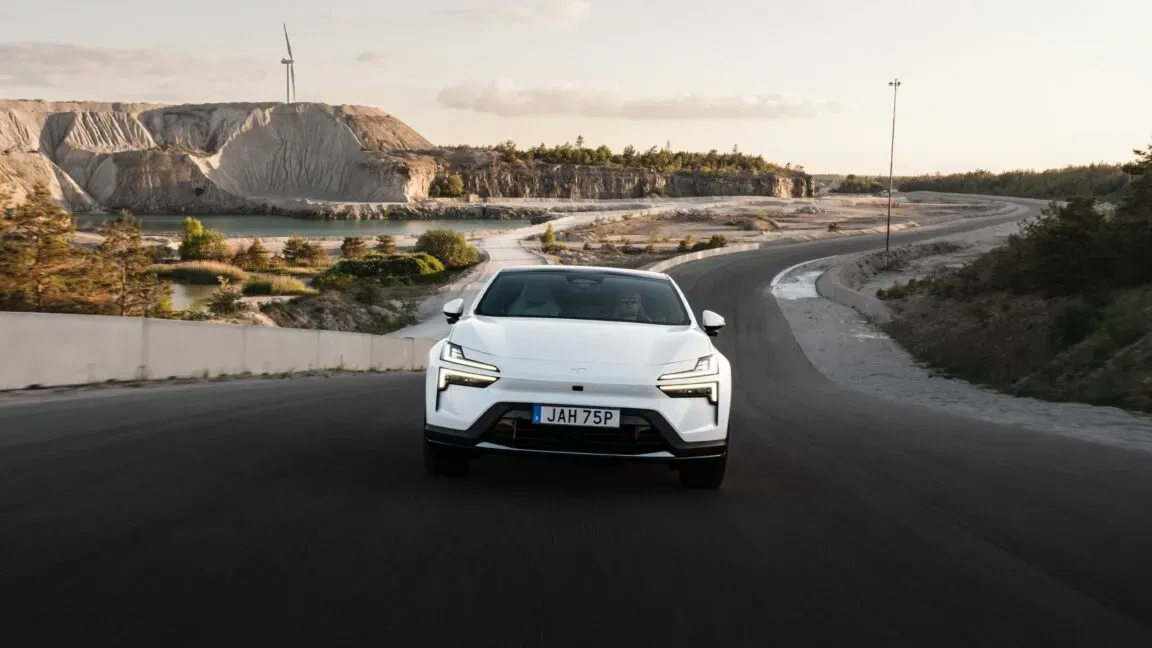
A pilot study was conducted involving 12 drivers who put both rear- and all-wheel-drive versions of the Polestar 4 through their paces at a track in Sweden.
The test drivers were equipped with heart rate monitors and skullcaps studded with electrodes to measure their physiological response, while the cars' gaze-tracking driver monitoring system recorded their visual focus. This data was combined with telemetry from the vehicles and later analyzed through subjective interviews to gain a deeper understanding of the driving experience.
As expected, the all-wheel-drive version of the Polestar 4 performed better under cornering and acceleration due to its higher power output. The car's peak acceleration was significantly greater than that of the single-motor rear-drive model.
The drivers' preferences were also clear in their subjective assessments. When asked about their experience, they rated the all-wheel-drive car much higher than the rear-drive version. One notable difference was a sense of trust and control, which was described as being particularly pronounced in the more performant vehicle.
Drivers likened the driving experience to that of a "controlled roller coaster," suggesting that the car's responsive handling had fully engaged their attention and senses.
The research conducted by Polestar suggests that a car's handling plays a significant role in creating a positive driving experience. This is not just about speed, but also about giving drivers confidence and control through predictable vehicle responses. Max Klapow, an Oxford researcher, has highlighted the importance of measuring this human experience.
Polestar acknowledges that its pilot study with 12 participants is limited, but the findings are encouraging. The results support a straightforward concept: people tend to prefer cars that handle well over those that don't, even if they may not explicitly mention handling as a priority. This preference for good handling has been echoed by industry experts.
The late Richard Parry-Jones, who held significant positions at Ford, including CTO, was known for his emphasis on vehicle handling and steering. In the foreword to a book written before his passing, he explained why this aspect of car design is crucial. According to Parry-Jones, some in the company questioned the investment in chassis and steering development, but he demonstrated that these attributes have a significant impact on customer satisfaction.
Parry-Jones' research showed that good handling is not just about performance; it also affects how drivers feel while behind the wheel. He found that bad handling can be tiring for drivers, whereas good handling is rewarding. This understanding of vehicle dynamics and linear responses has implications for car manufacturers looking to create vehicles that deliver a satisfying driving experience.
The findings from Polestar's pilot study and Parry-Jones' research underscore the importance of considering the human factor in car design. By focusing on predictable vehicle responses and good handling, car manufacturers can create vehicles that not only perform well but also provide drivers with a sense of confidence and control.
General Motors' Ken Morris emphasizes that drivers can indeed feel a difference in handling between vehicles, even if they may not be able to articulate what specifically is different.
According to Morris, this perceived difference is often linked to the structural integrity of the car, which he likens to a "vault" - a term used by drivers to describe a sense of solidity and stability on the road.
Facts based on reporting originally published by Ars Technica.
You may republish this story, in full or in part, if you credit Noti Group and link to it (licence CC BY 4.0). Photos are not included.