




New documentary-drama film "A Statement" premieres at New York Film Festival
Tom McCarthy's "A Statement" brings together an ensemble cast to portray scientists and activists gathered in 1980 discussing climate change.
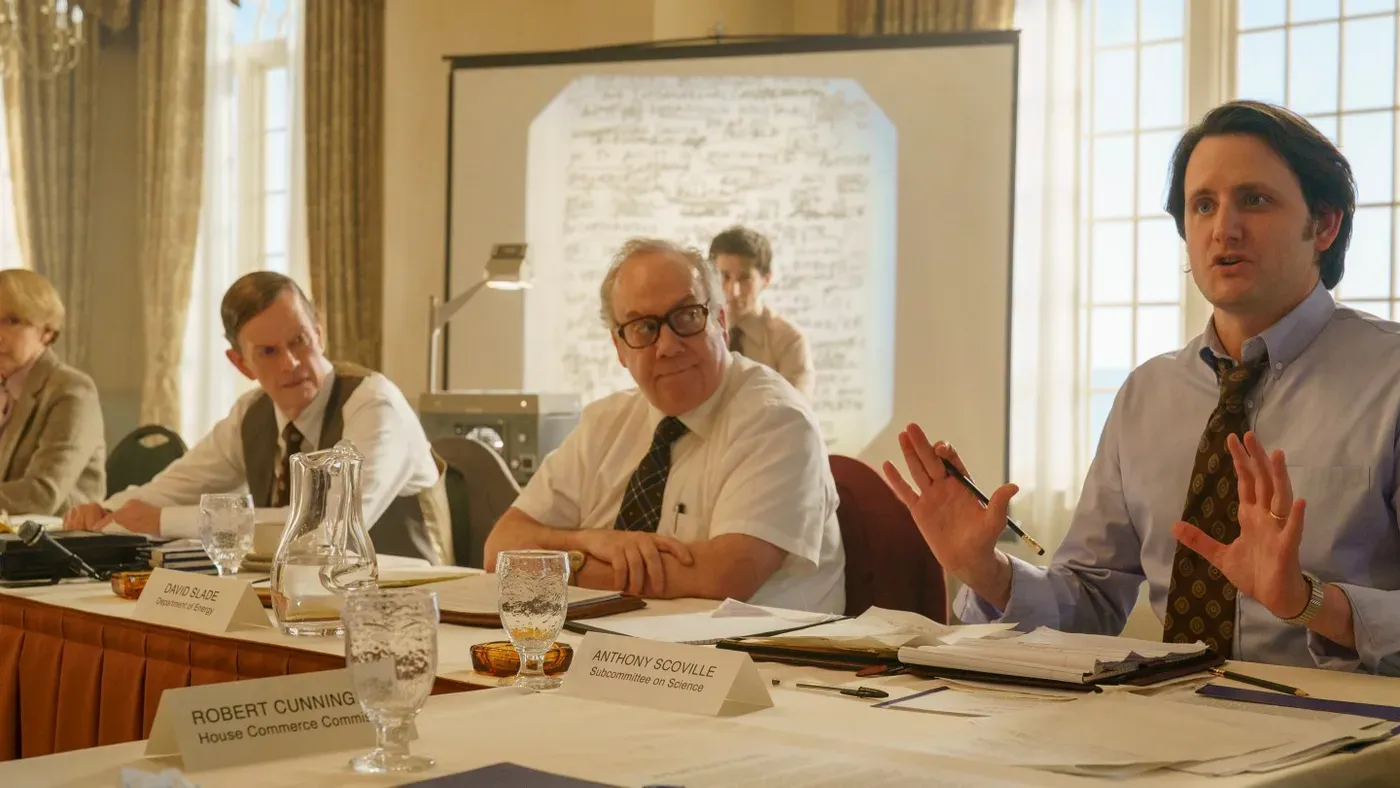
A new documentary-drama film is set to premiere at the New York Film Festival, tackling the pressing issue of climate change through a unique approach. Tom McCarthy's "A Statement brings together an ensemble cast of 20 talented actors to portray scientists, activists, bureaucrats, academics, and policymakers gathered in a Florida hotel conference room in 1980.
The film is based on Nathaniel Rich's book Losing Earth: A Recent History, which explores the early days of climate change awareness. Despite growing clean energy adoption, global CO2 emissions continue to hit record highs, highlighting the ongoing stalemate on this critical issue.
As a verbatim drama, McCarthy sticks closely to real events and conversations, mirroring his earlier work in investigative journalism with Spotlight. The film's attention to detail is evident in its depiction of long stretches of debate and discussion, which might seem dry at first glance but are actually made engaging through the director's skillful approach.
The cast of A Statement boasts an impressive array of actors, including Paul Rudd, Amy Ryan, John Turturro, Evan Peters, and Tatiana Maslany. Each actor is given meaningful screen time to bring their characters to life, resulting in sharp and nuanced portrayals that add depth to the film.
McCarthy's directing style has been praised for its ability to balance wonkish process with dramatic tension, making the talkathon feel dynamic and visually engaging. The ensemble cast is undoubtedly a key factor in this success, with each actor delivering standout performances.
The 1 hour 51 minute runtime may seem lengthy, but it allows McCarthy to fully explore the complexities of the issue at hand, providing an incisively acted and thought-provoking viewing experience.
The film's dry tone is a deliberate choice by McCarthy, who drew from Nathaniel Rich's 2019 climate science book Losing Earth: A Recent History in crafting his narrative.
To infuse some much-needed vitality into this docu-drama, McCarthy has assembled an impressive ensemble cast, featuring Paul Rudd, Amy Ryan and John Turturro among others.
The Don CeSar Hotel, a grand pink palace situated on the beach in St. Petersburg, serves as the setting for the conference room debates that make up much of the film's content.
McCarthy efficiently sets up the premise through onscreen text, explaining how Congress brought together a group of experts to draft a statement addressing the climate crisis caused by fossil fuel emissions.
The assembled panel is tasked with crafting a unified message, but their discussions quickly reveal deep divisions and conflicting opinions on whether the issue even warrants attention.
As the day-and-a-half long conference wears on, the participants begin to make progress in finding common ground, or at least acknowledging the need for action.
As the conference continues, participants like David Slade, director of the Energy Department's Office of Carbon Dioxide Effects, express skepticism about the need for urgent action on climate change. They point to uncertainties in research and argue that America's carbon emissions are relatively small compared to those of other continents.
This perspective is not unique to Slade, as others at the conference share similar views. However, they also acknowledge the historical context of climate change as a nonpartisan issue, citing the pre-Reagan era when science was considered a universal language that transcended partisan politics.
The presence of representatives from various industries, including Exxon, highlights the significant influence these groups have on climate control policies. Eli Bildner's character represents the oil and gas industry, underscoring its substantial impact on decision-making processes.
Paul Rudd shines as conference moderator Tom Jorling, struggling to keep the conversation productive and ensure that all voices are heard. His efforts aim to steer the room toward a consensus statement, but it remains to be seen whether this goal will be achieved.
Evan Peters brings a sense of urgency and anger to his portrayal of Rafe Pomerance, director of Friends of the Earth. His character's frustration with the lack of action on climate change is palpable, making for a compelling contrast to other participants who are more hesitant or dismissive.
John Turturro injects humor into his role as Dr. David Rose, an MIT nuclear engineer who draws upon historical examples to make his point. Jason Clarke also adds levity with his portrayal of John Perry, a meteorologist turned government science authority, whose flippant attitude belies the gravity of the issue at hand.
The scenes outside the conference room where key decisions are being made are just as well-crafted as the non-transcript dialogue within it. McCarthy's writing shines in these moments, showcasing his ability to balance tone and atmosphere.
Edith Brown Weiss, a legal scholar played by Tatiana Maslany, is one of the few voices of reason amidst the sea of experts. She expresses her frustration with the lack of urgency and prioritization during a break, stating that it feels like the blind leading the annoying." Her comment highlights the sense of disillusionment among some attendees.
The dynamics between the men and women in the room are striking. Edith and public health official Annemarie Crocetti are often made to feel out of their depth among the predominantly male-dominated group. However, both women speak up forcefully as the discussion wears on, bringing a much-needed perspective to the table.
Amy Ryan's portrayal of Annemarie is electrifying when she cuts in just as time is running out on day two. She urges everyone to consider global warming as a human problem that requires immediate attention and action. Her words are a stark contrast to the complacent attitude displayed by some of her colleagues.
Stenographer Bernadette, played by Nina Arianda, is another notable character in this ensemble cast. During breaks, she forms a connection with Robert Cunningham, a young expert played by Noah Robbins, who shares his nervy energy and passion for the subject matter. When he asks her how she manages to remain detached while witnessing such intense discussions, Bernadette attributes it to professional necessity.
However, as the arguments continue to unfold, Bernadette's detachment starts to waver. She becomes increasingly invested in the outcome, much like a spectator who can't help but be drawn into the drama unfolding before them. This subtle shift is expertly captured by Arianda, adding depth to an already complex character.
The documentary-drama A Statement captures the early days of climate science discussions, where debates were just beginning to take shape. When the conversation turns to renewable energy sources, disagreements arise over what options should be included. Dr. Rose's frustration grows as he argues for the inclusion of nuclear energy, only to have someone bring up the devastating Three Mile Island power plant accident.
The film's portrayal of this pivotal moment is a microcosm for the ongoing global warming conversation, where differing opinions and setbacks hinder progress. Despite the collective failure to formulate a statement, A Statement effectively conveys the sobering reality of climate crisis. The cinematography by Stuart Dryburgh adds a nimble touch, while Bryce Dessner's score provides a fittingly pensive tone.
The film's thought-provoking value lies not in its resolution but in its reflection on the complexities and challenges of addressing global warming. A Statement ultimately leaves viewers with more to consider than it does answers, making it a valuable contribution to the ongoing climate crisis conversation.
Facts based on reporting originally published by The Hollywood Reporter.
You may republish this story, in full or in part, if you credit Noti Group and link to it (licence CC BY 4.0). Photos are not included.