






Google Releases Gemini 4 Hydrogen Model for Improved Search Understanding
The new model is designed to provide clearer answers to complex queries and handle multi-part questions with greater efficiency.
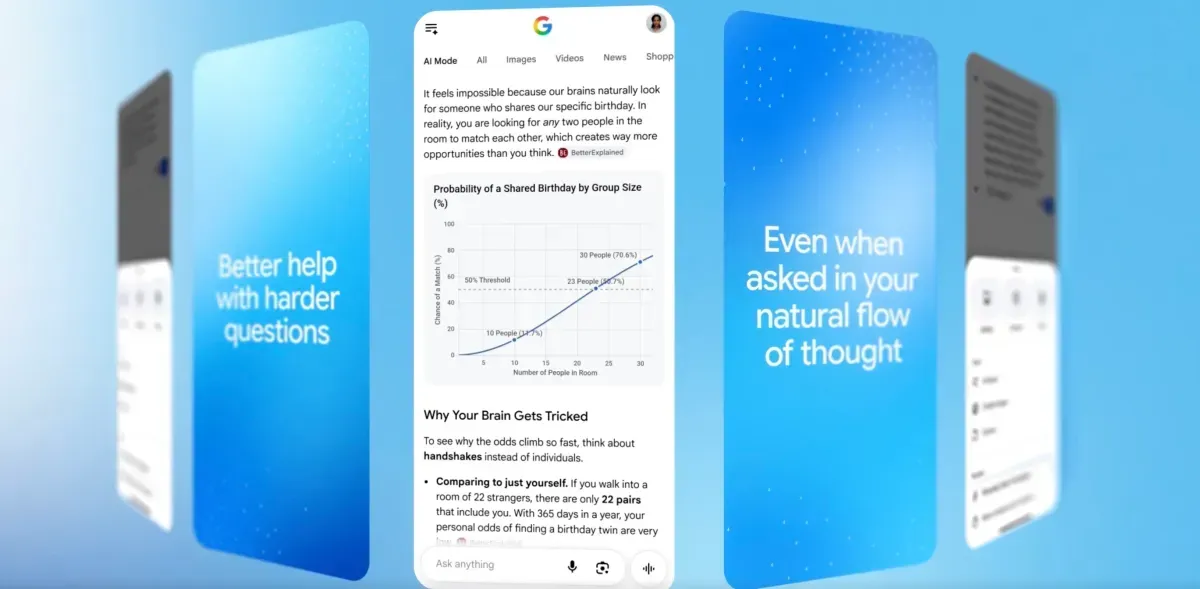
Google's latest Search upgrade aims to provide clearer answers to complex queries by leveraging its newly released Gemini 4 Hydrogen model. This significant improvement in understanding is expected to be more effective when handling multi-part questions or those with highly specific requests.
The new model is designed for fast execution across various tasks, making it an ideal choice for agentic workflows where AI performs multiple steps on its own. In contrast, Google's other models like Gemini 4 Carbon and Gemini 4 Argon excel at deep reasoning but are less efficient in this regard.
Google has emphasized the importance of selecting the right model for a particular task, suggesting that using the most powerful one isn't always necessary. According to the company, Hydrogen is significantly faster than its previous fast model, Gemini 3.8 Flash, with completion rates improved by 2.5 times.
The release of Gemini 4 Hydrogen marks an important step in Google's ongoing efforts to refine its search capabilities. This new model boasts several key improvements, including enhanced understanding of user intent and the ability to offer more relevant links and visual responses.
Google claims that Hydrogen is better equipped to navigate complex queries with multiple parts or highly specific requests. Additionally, it has improved its handling of typos, allowing users to ask their questions in a more natural manner without worrying about minor errors.
In terms of performance, Hydrogen surpasses Gemini 4 Argon on one key benchmark at its default high thinking level. This achievement underscores the model's capabilities and highlights its potential as a valuable tool for search-related tasks.
The new Search upgrade from Google boasts advanced reasoning capabilities that enhance its fan-out technique. This improvement enables the search engine to break down complex user prompts into multiple subqueries, allowing users to discover related websites they might have otherwise overlooked.
As a result of this enhancement, visual responses will become even more prevalent in AI Mode. The addition of Hydrogen to Search means that users can expect to see more images, structured responses, comparison tables, and custom tools presented as part of the search results.
Google's new model, Hydrogen, is designed to work seamlessly with other models like Carbon and Argon. This allows for a wide range of workflows and applications, from everyday tasks such as writing code or running tests to more complex activities that combine multiple models.
Hydrogen offers users four different thinking levels: low, medium, high (default), and an extra-high tier ("xhigh"). Each level is designed to complete tasks faster with fewer output tokens, providing a flexible range of options for users to choose from.
The upgrade aims to provide more accurate and comprehensive responses to complex queries by leveraging Anthropic's Claude model.
This is achieved through a hierarchical approach, where each level of processing is designed to optimize task completion with minimal output tokens, resulting in a flexible range of options for users to choose from.
Ultimately, the goal is to empower users with more precise information, facilitating better decision-making and problem-solving capabilities.
Facts based on reporting originally published by TechCrunch.
You may republish this story, in full or in part, if you credit Noti Group and link to it (licence CC BY 4.0). Photos are not included.