



Fitbit Releases Modernized Fitness Tracker with Refined Design
The Fitbit Edge is a modernized version of previous fitness bands from 2014 to 2020.
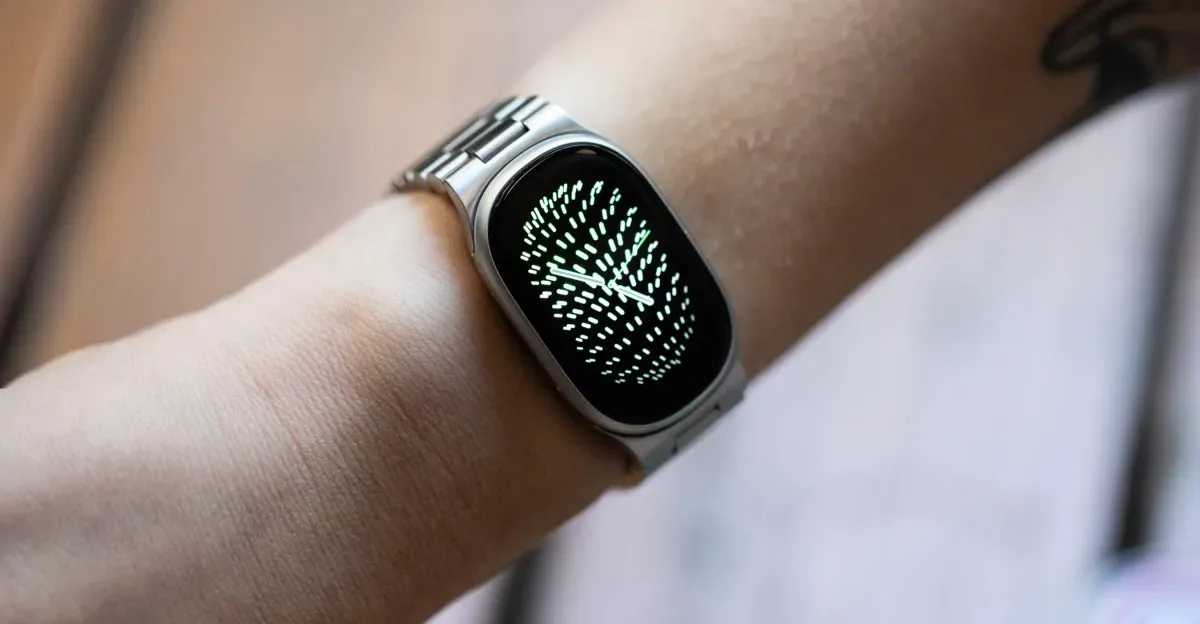
A fitness tracker that brings back memories of a bygone era has arrived on the market. The Fitbit Edge is a modernized version of the fitness bands from 2014 to 2020, including the popular Charge and Inspire series.
The Edge's design may seem familiar to those who have owned one of these older models, but it feels more refined on the wrist. Unlike its predecessors, which had boxy displays, the Edge has a fully rounded display that gives it a softer appearance.
One of the key features of the Edge is its lightweight design and basic functionality. It's a device that doesn't try to be much more than what it is, a fitness tracker that provides essential health and fitness metrics on a small screen.
The Edge's battery life is relatively standard for a fitness tracker, lasting around a week on a single charge. However, this drops to about a day and a half if the always-on display feature is enabled.
The new Fitbit Edge offers a range of interchangeable straps, including a $60 magnetic strap made from silicone that mimics the look of leather.
The watch's interface is heavily influenced by Google's Material 3 Expressive redesign, as seen on the Pixel Watch.
This means that the Fitbit OS, which is distinct from Wear OS, has adopted some of the same design elements to create a cohesive look.
Some of the new watchfaces are stylish and understated, while others draw attention to the Edge's prominent black bezels.
In terms of functionality, the Fitbit Edge offers a range of features that make it a solid choice for fitness enthusiasts.
The watch includes built-in GPS, allowing users to track their walks and runs without needing their phone nearby.
It also supports basic functions like setting alarms, viewing notifications, and controlling music playback.
However, one notable omission is the lack of microphones or speakers, which means users cannot take calls directly from the wrist.
The Fitbit Edge has made significant improvements to its automatic activity tracking feature.
During testing, it successfully identified runs without explicitly starting an activity, even when compared to other devices such as the Apple Watch Ultra 4 and a Runna app on an iPhone.
This proved to be particularly accurate in identifying transition periods between walking and running, with one test run correctly logging the exact moments of warmup and cooldown.
However, speed tracking was not as precise, consistently underestimating actual pace by around a minute per mile.
Despite this limitation, the automatic activity tracking still offers a convenient way for users to earn credit for their workouts even if they forget to manually log them.
The new Fitbit Edge has a unique way of handling certain user interactions, particularly when it comes to sharing health information with its coach feature.
One such issue arises when users share their medical history, specifically any past injuries or conditions. In my case, I regret mentioning that I used to have shin splints, as the device now remains convinced that my shins are at risk of deteriorating even though they're perfectly fine.
The Health Guardian features on the Fitbit Edge also hold promise, allowing users to track noninvasive insulin resistance and blood pressure trends. However, due to scheduling constraints, I won't be able to access these results until November 1st.
Despite its limitations, I found the Fitbit Edge to be a suitable option for those seeking a low-key tracking experience without the need for a smartwatch's advanced features.
The device's price point of $99 may seem steep compared to other options available in the market. Brands like Xiaomi and Amazfit offer cheaper trackers with displays that, although not as sleek, still provide a similar functionality.
The weariness towards smartwatches that demand increasing amounts of data is growing among users, who are seeking simpler alternatives. This trend is evident in the renewed interest in basic trackers without screens. The Fitbit Edge seems to be catering to this desire for a more straightforward fitness experience.
One major drawback of using devices with advanced features and AI-powered health coaches is the need to constantly agree to lengthy terms and conditions before use. These agreements are often lengthy and complex, making it difficult for users to comprehend their implications. As a result, many people end up hitting "agree" without thoroughly reading the fine print.
Using the Fitbit Edge requires pairing it with either an iPhone or Android smartphone. This means that in addition to agreeing to the device's terms of service, users must also accept the phone's own Terms of Service and privacy policy. Furthermore, granting various permissions is also necessary for seamless integration.
The sheer number of agreements one needs to sign off on when using a device can be overwhelming. As we review devices, it has become apparent that these contracts often go unread and unanalyzed by users who are simply looking for a functional product. The Fitbit Edge's minimalist approach may appeal to those seeking a more straightforward experience.
To pair the Google Fitbit Edge with a smartphone, users must navigate through multiple agreements, including the device's own terms of service, the phone's Terms of Service, and any additional permissions required for integration. This process can be time-consuming and daunting, particularly for those who value simplicity in their devices.
When setting up the Fitbit Edge, users are required to agree to multiple terms of service, including those from CLEAR for identity verification when uploading medical records.
This process involves reviewing and accepting the privacy policies of various third-party services, which can be complex and time-consuming. Users must also grant optional permissions for features such as location tracking, Bluetooth connectivity, and camera access.
Upon completion of the setup process, users' health data is stored separately from Google's targeted ad business, in accordance with the terms and conditions of Google's acquisition of Fitbit.
Facts based on reporting originally published by The Verge.
You may republish this story, in full or in part, if you credit Noti Group and link to it (licence CC BY 4.0). Photos are not included.