







Elephants in Sri Lanka Show Limits to Social Resilience
A new study has found that wild Asian elephants in Sri Lanka's Udawalawe National Park can become fragmented when population losses outpace additions.
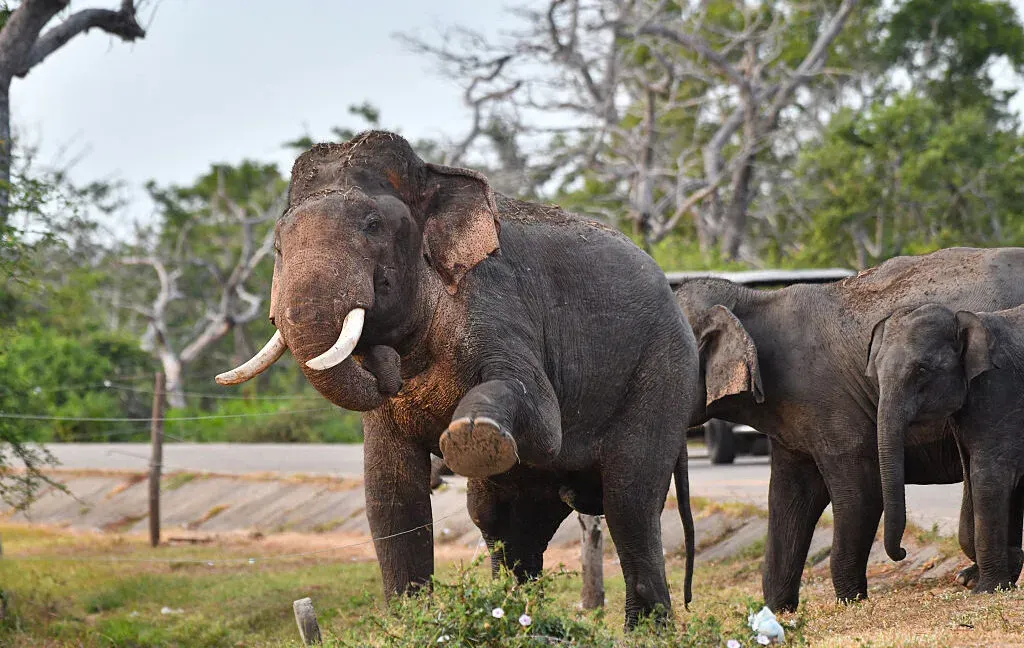
Elephants living in complex societies are known to be resilient in the face of individual losses and changes within their communities. However, a new study suggests that this resilience has its limits when steady declines in population numbers occur over time.
Researchers at the University of California, San Diego have been studying wild Asian elephants in Sri Lanka for 12 years. Led by behavioral ecologist Anastasia Madsen, the team analyzed data on these elephants and discovered that their societies can become fragmented when losses outpace new additions to the group.
The Udawalawe National Park in southern Sri Lanka is home to a large population of Asian elephants. The park was created in the 1970s around a reservoir that brought farming and settlers into the area, leading to the displacement of some residents who lived within what later became the park.
According to Shermin de Silva, an ecologist at UC San Diego and senior author of the study, Before we started the Udawalawe Elephant Research Project in 2006, it was basically a tropical deciduous forest. The reservoir had a significant impact on the area's ecosystem, leading to changes that created grasslands with more abundant food sources than the original forest.
The creation of the park and its subsequent transformation have made it famous for its large elephant herds. However, the researchers' findings suggest that this stability may be short-lived if losses within the population continue unchecked.
As the elephants in Udawalawe National Park face increasing pressures from habitat loss and poaching, their social structures are beginning to show signs of strain. The study's results raise important questions about the long-term sustainability of these complex societies.
The forest's resurgence came at a cost - invasive plants like lantana began to take over, creating dense thickets that even elephants found unappealing due to the lack of food within them.
This shift had significant consequences for the park, as it reduced its attractiveness to elephant populations from outside while also limiting the availability of sustenance for the resident elephants. As a result, fewer calves reached adulthood.
Researchers observed this transformation firsthand by driving random routes along the park's roads about three days a week. They relied on a distinctive feature - the formation of holes and cuts over time in an elephant's floppy ears - to identify individuals.
Between 2007 and 2018, the team identified 443 adult and subadult female elephants that roamed the park. By focusing on females, they were able to study a social structure known as fission-fusion societies.
In these societies, females live independently but maintain connections with other members of their network, which is somewhat similar to human social dynamics where individuals have different groups for work, family, and personal relationships.
The team's analysis of the Asian elephant population revealed a surprising trend. Despite their large size, the elephants' social networks were surprisingly fragile and prone to collapse. When members left or died, they weren't replaced by new individuals with strong ties to the existing community.
This imbalance had significant consequences for the communities themselves. As more females disappeared than arrived, the network's resilience began to wane. By 2018, nearly seven out of ten elephants seen at the start of the study were gone, despite their potential lifespan of over six decades.
The researchers noticed that once the balance tipped, the remaining communities became smaller and more isolated from one another. This fragmentation was not simply a result of the population's reduction, but rather a sign of deeper changes within the network itself.
To confirm this observation, the team looked at a subset of 59 elephants that remained present throughout the study period. These residents were expected to maintain consistent relationships with each other, given their long-term presence in the community. However, the analysis revealed that even among these core individuals, relationships were changing and fracturing over time.
This shift was not a gradual process but rather occurred within one to three years after the decline began, indicating a rapid breakdown of social bonds within the community.
The loss of key individuals in elephant communities may have triggered a rapid breakdown of social bonds within these groups. These individuals likely played a crucial role in maintaining relationships between subgroups, much like how certain people often attend city hall meetings and serve as the glue that holds their community together.
Researchers suggest that weak ties, such as casual acquaintances, were among the first to be lost. These relationships are thought to represent tolerance rather than close friendships, allowing individuals to coexist without intense conflict. This type of connection is particularly important in large animal societies where conflicts can have severe consequences.
The disappearance of grasslands has contributed to a decline in social interactions within elephant communities. As competition for resources increases, elephants may prioritize quality over quantity in their relationships, leading to a reduction in the number of acquaintances and friends they maintain. This shift is likely a response to the changing environment rather than a deliberate choice.
In complex systems, small changes can be indicative of larger issues on the horizon. Network statistics suggest that some elephant communities experienced fluctuations from year to year before eventually breaking apart. These fluctuations, known as flickering, may serve as an early warning sign for park managers and conservationists if detected in time.
Early detection of these signals could potentially allow for intervention before a population collapse occurs. By monitoring the health of these complex systems, researchers hope to identify signs of trouble and take proactive steps to prevent further decline.
Monitoring elephant populations over a long period is essential for detecting early signs of decline, but researchers often lack access to such data for many communities.
The absence of comprehensive records makes it challenging to identify potential problems before they escalate into more severe issues, which can be devastating and irreversible.
As Madsen explained, the situation is akin to a ship taking on water without proper maintenance, the consequences are catastrophic if left unchecked. A point of no return is reached when structural damage occurs, but this may not become apparent until much later.
The study's data cutoff in 2018 has proven to be a concerning benchmark, with de Silva's team predicting a decline in the elephant population that appears to be unfolding faster than anticipated.
The elephant population's decline has been particularly concerning in recent years, with a significant portion of Asian elephants living in poor-quality habitats.
These subpar environments have likely contributed to the species' loss of nearly two-thirds of its historic range, underscoring the need for holistic management approaches that consider entire landscapes. This includes addressing issues such as roads and infrastructure development, which can harm elephant populations, rather than solely focusing on wildlife conservation efforts.
Facts based on reporting originally published by Ars Technica.
You may republish this story, in full or in part, if you credit Noti Group and link to it (licence CC BY 4.0). Photos are not included.