







Dark Matter Signal Detected by LUX-ZEPLIN Detector
A potentially significant result has been reported at a conference in Japan by scientists working on the LUX-ZEPLIN detector in South Dakota.
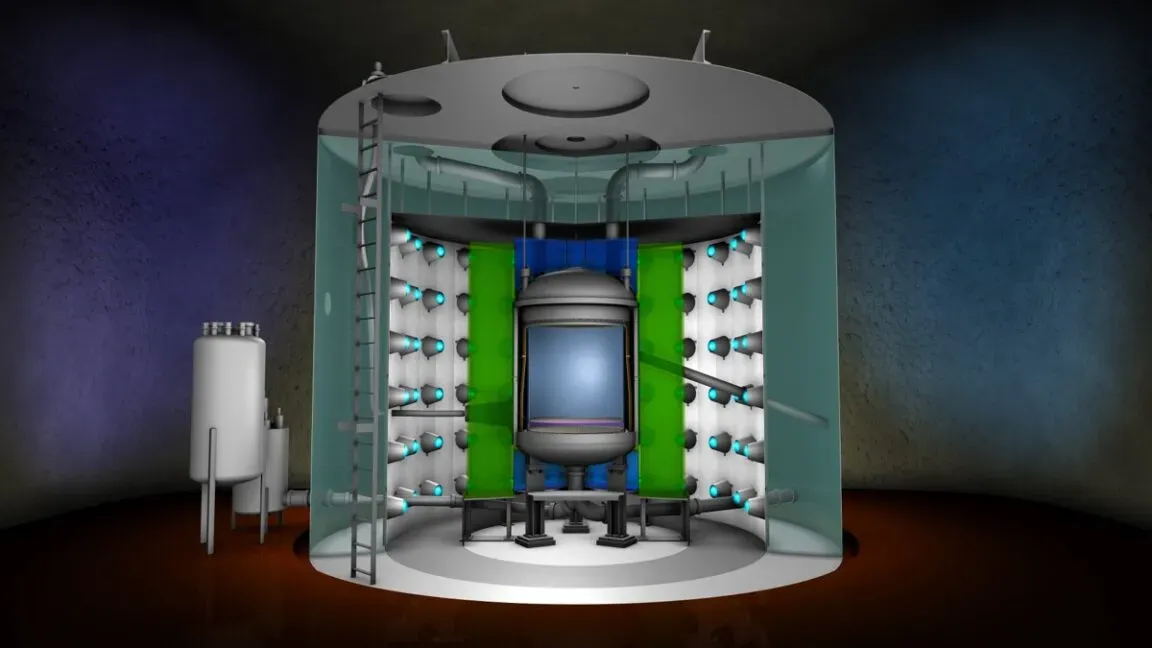
Physicists have been searching for a way to directly detect dark matter particles for decades, but so far, they've come up empty-handed. This elusive substance is thought to make up about 85% of the universe's mass, and researchers believe that weakly interacting massive particles (WIMPs) could be responsible.
A team of scientists working with the LUX-ZEPLIN detector in South Dakota has reported a potentially exciting result at the 2026 TeV Particle Astrophysics conference in Japan. Although the signal is still below the threshold needed to confirm discovery, it's being taken seriously due to its persistence and the fact that the researchers were unable to account for it.
The LUX-ZEPLIN detector uses liquid xenon to detect interactions with dark matter particles, which would cause a nucleus to recoil. However, in this case, the event had a higher nuclear recoil energy than expected, meaning that several lower-energy WIMPs should have been detected as well; they were not.
This anomaly has sparked debate among theorists about possible alternative models for WIMP behavior. One possibility is that the interaction rate increases with collision energy. Another idea is that WIMPs could have an internal structure similar to an atom and only interact if hit hard enough.
The LUX-ZEPLIN team is continuing to collect data, as are researchers at other facilities such as XENONnT in Italy and PandaX in China. These efforts will help determine whether the reported signal is a statistical fluke or a genuine indication of dark matter particles.
A preprint of the research has been made available on the arXiv server, although it's yet to be formally published. The team hopes that by sharing their findings, they can spark further discussion and potentially lead to breakthroughs in our understanding of dark matter.
The researchers are also aware of the risks associated with reporting a potential anomaly too early. Previous tantalizing hints have been discredited as statistical flukes or instrumental errors when more data became available.
While the LUX-ZEPLIN team is cautious about their findings, they feel compelled to share them with the broader scientific community in the hope that it might lead to new insights into the nature of dark matter.
Quantum entanglement continues to fascinate scientists, who are still trying to fully understand its implications and potential applications. This phenomenon, where disturbances in one part of the universe can instantly affect distant parts, has been described as "the closest thing we have to magic" by physicist N. David Mermin.
Entanglement is a fundamental aspect of quantum mechanics, which underlies many cutting-edge technologies such as quantum computing and next-generation sensors. However, maintaining entanglement is often a delicate process, as any interference can cause the entangled particles to decohere quickly.
Recently, physicists at CERN's Large Hadron Collider made headlines with their discovery of entanglement between pairs of top quarks produced in the ATLAS experiment. This breakthrough raised the possibility that large colliders could be used as investigative tools to study spooky action at a distance.
Building on this momentum, researchers have now observed entanglement in pairs of Z bosons using data from the ATLAS detector. The physicists analyzed the decay patterns of these short-lived particles, which are produced when Higgs bosons decay into electrons and muons.
The team used sophisticated algorithms to reconstruct the angles at which these particles were emitted, allowing them to infer the spins of the original Z bosons that preceded them. This achievement represents the highest-energy example of entanglement observed to date.
Entanglement research has significant implications for our understanding of quantum mechanics and its applications in various fields. Further studies may reveal new insights into the nature of this phenomenon and potentially lead to breakthroughs in technologies such as quantum computing.
The discovery of entanglement in Z bosons also highlights the importance of continued investment in high-energy particle physics research, which has led to numerous groundbreaking discoveries in recent years.
Researchers have been experimenting with innovative ways to construct buildings on Mars using locally sourced materials.
The team's mixture of sand and glue, derived from gelatin and a special yeast, has shown promising results in simulated Martian conditions.
This unique blend is inspired by the process of freeze-drying, which involves removing moisture from substances at extremely low temperatures and pressures.
In this context, the Martian environment's harsh conditions are similar to those found in freeze-drying processes, making it an ideal setting for testing the team's concoction.
The mixture is 3D-printed into small domes, about the size of wine corks, and when exposed to the simulated Martian atmosphere, it undergoes a process akin to freeze-drying, resulting in a light, porous foam.
The compressive strength of this foam has been measured at around 10 to 12 megapascals, which is sufficient to support structures on Earth despite its lower gravity.
Archaeologists at Griffith University have made a surprising discovery about human behavior in the distant past. They found evidence that people may have been consuming mind-altering substances by chewing on betel nuts as far back as 25,000 years ago.
The researchers discovered two ancient skeletons from the Indonesian island of Sulawesi, which dated to around 16,000 and 6,300 years ago. These remains showed distinctive grooves in their teeth that were likely caused by constantly sucking on whole betel nuts. The team concluded that chewing on these nuts would have released psychoactive compounds into the bloodstream.
The effects of consuming betel nut are well-documented, causing mild euphoria and heightened alertness. However, it's also known for its potential to cause dental problems due to its abrasive nature. It seems that people from this era may have turned to chewing on betel nuts as a way to alleviate tooth pain, despite the risks.
Co-author Adam Brumm suggested that while chewing on betel nuts might have provided temporary relief from toothache, it ultimately led to more severe dental health issues over time. This created a vicious cycle of continued habit formation and worsening oral health.
The practice of consuming betel nut is still seen in some parts of the world today, often mixed with other ingredients and slaked lime to release its psychoactive compounds. However, the exact mechanisms by which ancient humans ingested these substances remain unclear.
Further study is needed to fully understand the significance of this discovery and how it might have impacted human behavior in the distant past.
The implications of this finding are significant, shedding new light on the complex relationships between humans and their environment throughout history.
A 17th century manuscript has shed new light on the work of Galileo, one of history's most renowned astronomers. The discovery was made by a historian at the University of Limerick in Ireland who came across an analysis of a four-lens telescope attributed to Galileo in a 1666 treatise written by Spanish Dominican friar Ignacio Muñoz.
The manuscript, titled De Tellescopiis Stellarum, contains detailed diagrams and drawings of the instrument. It was specifically requested by the viceroy of New Spain as a test of Muñoz's scientific expertise. The historian, Jose Maria Moreno Madrid, made the discovery while perusing the treatise.
Muñoz noted in his manuscript that the telescope belonged to King Philip IV and was made by Galileo. This information suggests that Galileo may have presented the king with one large and two smaller telescopes as a gift. These gifts were likely intended to curry favor with the monarch while working on the problem of longitude.
Galileo's four-lens telescopes appeared around 1643, but if Madrid's analysis is correct, the innovation could have occurred much earlier - in 1630 at the latest. This would be a significant discovery, as it would attribute the innovation to Galileo himself. Muñoz's description would then be "the most detailed technical analysis of a telescope provenly made" by the Renaissance astronomer.
The implications of this finding are far-reaching and could rewrite the history books on astronomy. It also raises questions about how and when the four-lens telescope was developed, and whether Galileo was indeed the first to perfect it.
A separate discovery has been made in the field of entertainment history. Peep shows, a form of immersive entertainment that originated in 17th century Europe, have been found to have evolved into cosmoramas by the 19th century. These peep shows were essentially wooden cabinets containing pictures or objects viewed through a small hole or magnifying glass.
The peep shows created an illusion of depth perception and often featured special lighting effects such as candles. By the 19th century, they had become known as cosmoramas and were collected in galleries housed in urban bazaars across Britain and Ireland.
These cosmoramas served not only as entertainment but also as a marketing tool for real estate. They allowed people to view and explore different locations without having to physically visit them. This discovery highlights the innovative ways in which technology was used to enhance everyday life in the past.
The use of peep shows and cosmoramas as a form of immersive entertainment has left a lasting impact on modern-day media and storytelling. The evolution of these forms of entertainment is a testament to human ingenuity and creativity.
Historian John Plunkett's research into visual technology in the UK and Ireland uncovered an unexpected application of cosmoramas in the 1830s. While examining newspaper archives from the 1820s onwards to track the global emergence of these immersive displays, he discovered that a London-based auctioneer and surveyor, Brooks and Hedger, used cosmoramas to showcase estate properties for sale.
The firm's offices were conveniently located on Old Bond Street, near the Cosmorama Rooms in Regent Street, allowing them to capitalize on the current trend. Plunkett notes that producing cosmoramas would have been a significant investment for Brooks and Hedger, requiring substantial resources to create these elaborate visual displays.
This unusual use of cosmoramas highlights the versatility of this technology and its potential applications beyond entertainment. The evolution of such forms of entertainment is a testament to human ingenuity and creativity, with innovations like cosmoramas continuing to inspire new uses and adaptations.
Facts based on reporting originally published by Ars Technica.
You may republish this story, in full or in part, if you credit Noti Group and link to it (licence CC BY 4.0). Photos are not included.