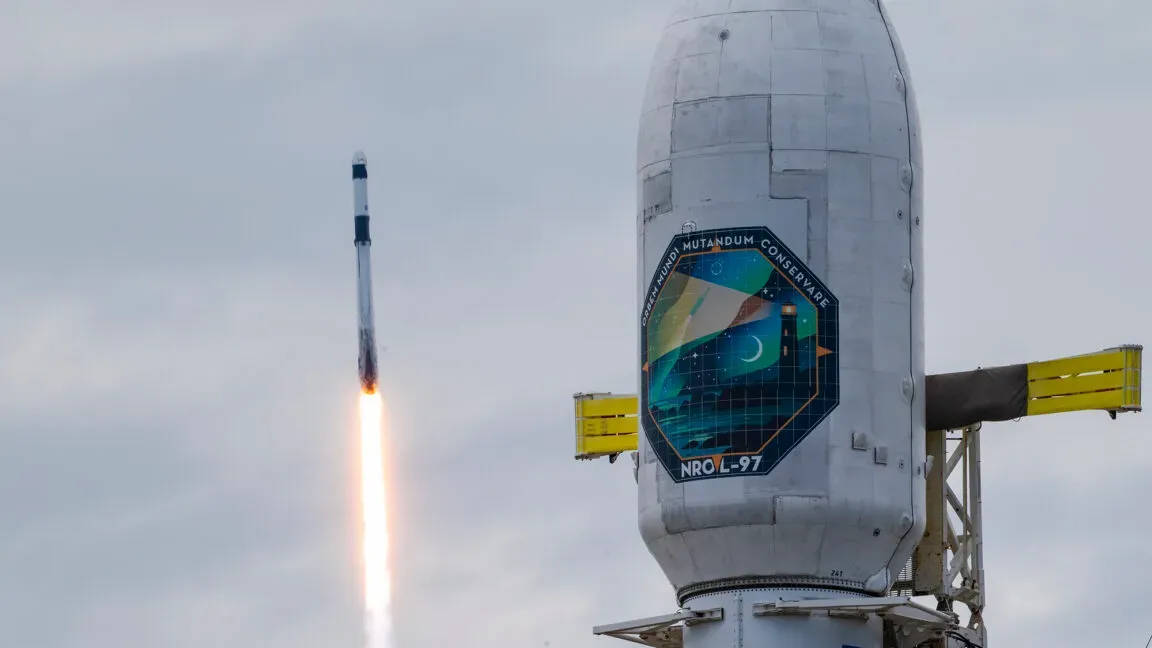








US Military's Defense Support Program Satellites Decommissioned
The US military has decommissioned its Defense Support Program (DSP) satellites, which were used to detect nuclear missile launches during the Cold War era.

A long-running program used by the US military to detect nuclear missile launches has come to an end. The Defense Support Program (DSP) satellites played a crucial role in monitoring for the launch of nuclear warheads during the Cold War era.
Launched from Space Launch Complex 40 at Cape Canaveral Air Force Station, the DSP satellites were equipped with highly sensitive infrared detectors designed to pick up on the heat generated by rocket launches. These early satellites weighed approximately one metric ton and carried around 2,000 such detectors each.
The program's initial block of satellites was launched between 1970 and 1973. At that time, these satellites were considered among the most important flown by the US due to their ability to provide real-time detection of nuclear launches. This capability would have given the US military valuable insight into potential threats from enemy nations.
As part of the Cold War arsenal, the DSP program was a significant component of American military space power. By detecting the launch of a nuclear warhead, these satellites provided early warning systems that could be used to inform decision-making and potentially prevent attacks.
The end of this program marks the final step in the decommissioning of US military assets from the Cold War era. With the threat landscape having changed significantly since then, new technologies and strategies have been developed to address emerging threats.
The US military's Defense Support Program satellites have been a cornerstone of its nuclear missile launch detection capabilities for over five decades.
Initially designed to identify Soviet ICBMs, these infrared-observing satellites proved essential for nuclear deterrence and later also played a crucial role in conventional warfare by detecting launches such as those from Iraqi Scud missiles.
Over the years, the military expanded the constellation, enhancing its reliability and expanding its capabilities. Each satellite featured over 6,000 infrared detectors and weighed approximately 2.5 tons, with some satellites flying until 2007.
One notable example of these satellites' longevity is DSP-16, which was launched on a space shuttle called Atlantis in 1991. Despite their age, the Defense Support Program satellites continued to play a vital role in detecting missile launches until recently.
In early September, the US Space Force announced that the final two surviving Defense Support Program satellites participated in an on-orbit maneuvering exercise. Independent orbital tracking revealed that these satellites subsequently raised their orbits by hundreds of kilometers, typically a step towards disposing of them into graveyard orbits above geostationary space.
The US Space Force confirmed this marked the official retirement of the program, bringing to an end over 55 years of service from at least one satellite in continuous operation.
The Defense Support Program has had an impressive lifespan, spanning over five decades of operation. Launched during the early days of satellite technology when bespoke spacecraft were the norm, its orbiting platforms have been deployed on a variety of rockets, including Titan and Delta IV Heavy vehicles.
In anticipation of the program's eventual retirement, the US military initiated the development of more advanced infrared satellites in 2011. The Space Based Infrared System offers improved sensors that can detect fainter signals and provide longer warning times for potential nuclear threats.
The transition to newer technology is continuing with the Next-Generation Overhead Persistent Infrared satellite project, set to launch within a year on a Vulcan rocket.
Facts based on reporting originally published by Ars Technica.
You may republish this story, in full or in part, if you credit Noti Group and link to it (licence CC BY 4.0). Photos are not included.