







Canadian Government Awards Funding for Three Space Companies
The Canadian government has announced funding for three companies as part of its Launch the North initiative to support the development of rockets with light lift capability.
Canada's space industry has been gaining momentum in recent years, but it was largely flying under the radar until now. The country had several launch companies working on small rockets, but their efforts were not particularly notable outside of a niche community.
The escalating tensions between Canada and the US have brought attention to the Canadian space program. The Trump Administration's trade policies and rhetoric have left Canadians feeling frustrated and concerned about relying on American goods and services. This sentiment has sparked a reevaluation of various sectors, including space access.
As part of this reassessment, the Canadian government announced funding for three companies: NordSpace, Reaction Dynamics, and Canada Rocket Company. The initiative, known as Launch the North, aims to support the development of rockets with "light lift capability, which is a crucial step in establishing a sovereign launch industry.
The initial awards were $8.33 million CAD, but the government has signaled that larger funding opportunities are on the horizon. This news has prompted one of the companies, Canada Rocket Company from Toronto, to take a more ambitious approach and skip the small-rocket phase altogether.
The advice from industry experts has been clear: building a smaller rocket is not an effective way to de-risk a rocket development program. This consensus was reached after speaking with over 150 engineers, including those at high-ranking positions within companies like Starship engineering.
Industry insiders have pointed out that developing a smaller rocket would essentially mean starting from scratch, with about 90 percent of the work being redundant and having little value in the long run. This realization has led many to question whether pursuing a small-rocket approach is worthwhile, especially if commercialization is not the ultimate goal.
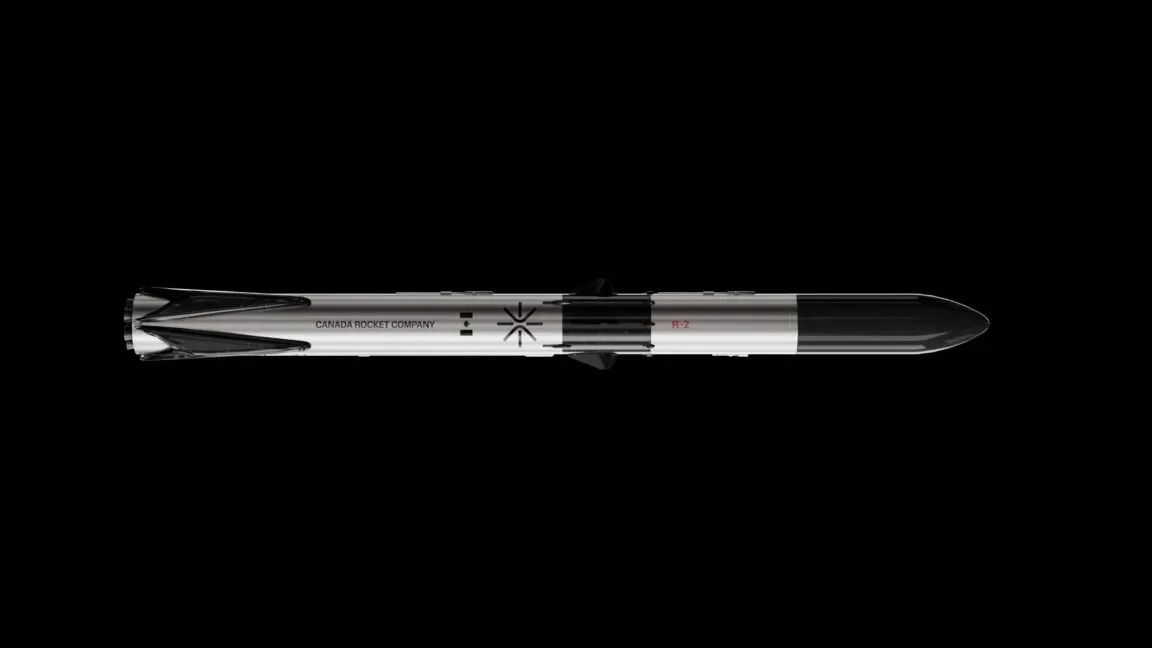
In response to this advice, Canada Rocket Company decided to take a more ambitious route by developing a medium-lift vehicle, dubbed the R-2 rocket. This new design bears some resemblance to SpaceX's Falcon 9 rocket and features nine methane-fueled engines, a gas-generator engine cycle, and retractable landing legs.
The R-2 rocket is designed to carry payloads of up to 12.5 metric tons to low-Earth orbit, with the company aiming for a launch readiness date of 2032. This ambitious timeline suggests that Canada Rocket Company is committed to making significant strides in its development efforts.
The mood in Canada is shifting towards self-sufficiency, particularly when it comes to its aerospace industry.
For decades, Canada has relied heavily on the United States for defense and space-related needs, but this trend seems to be changing with the unveiling of a Defense Industrial Strategy earlier this year. Space launch was identified as a priority capability within this strategy, which aims to establish a strong industrial and technological base to support defense readiness. This marks a significant departure from Canada's past reliance on American rockets for launching its satellites.
The country's aerospace industry has largely stagnated since the cancellation of the Avro Arrow interceptor aircraft in 1959, but the current mood is one of determination to revive it. The strategy highlights space as one of the key areas where Canada needs to focus on developing its own capabilities. This shift towards self-sufficiency is likely driven by a growing awareness of the importance of owning and controlling one's own defense and military infrastructure.
This renewed focus on sovereignty is also reflected in Kolias' comments, who sees the current geopolitical climate as an opportunity for Canadian industries to finally build real ambitious industries." The sentiment suggests that Canada is ready to take control of its own destiny, at least when it comes to space launch capabilities.
The Canadian government is considering a significant investment in its own launch industry, potentially putting as much as half a billion dollars on the table for a sovereign capability. This move would also come with guarantees of launch contracts to support the development of domestic industries.
Canada Rocket Company is at the forefront of this effort, having raised $22.5 million to date and gearing up for a Series A fundraise. The company's workforce is expected to grow as it expands its operations, currently comprising around 30 people including Canadian rocket scientists who have returned from working abroad.
The Jeremy Hansen Test Facility, named after the Canadian astronaut who became a national hero after participating in Artemis II, will serve as a hub for testing and development of the E-1 engine. The facility is being built on a 50-acre site leased from the Greater London International Airport Authority and will feature an engine test area with multiple vertical and horizontal test stands.
The new facility will be capable of testing engines producing over 1MN in thrust, or around 225,000 pounds of thrust. According to Kolias, testing is expected to begin at the Jeremy Hansen Test Facility within about two years, marking a significant milestone for Canada Rocket Company's ambitious plans.
Canada's space program has gained significant prestige after Jeremy Hansen's successful flight on Artemis II. This achievement is particularly noteworthy as it was made possible by America's space program. The fact that Canada's success came at a time of strained relations between the two nations raises questions about how to perceive this development.
The geopolitical implications of Canada's growing space capabilities are multifaceted, but one potential outcome is that improved relations with the US could be facilitated in the future. With its own launch industry taking shape, Canada can now rely less on American support and more on its own resources, allowing it to maintain a sense of independence while still cooperating with its neighbor.
Facts based on reporting originally published by Ars Technica.
You may republish this story, in full or in part, if you credit Noti Group and link to it (licence CC BY 4.0). Photos are not included.