





Young Star Beta Pictoris Hosts Water and Carbon Dioxide Ice
Astronomers have used the James Webb Space Telescope to study a young star called Beta Pictoris and found water and carbon dioxide ice in its disk.
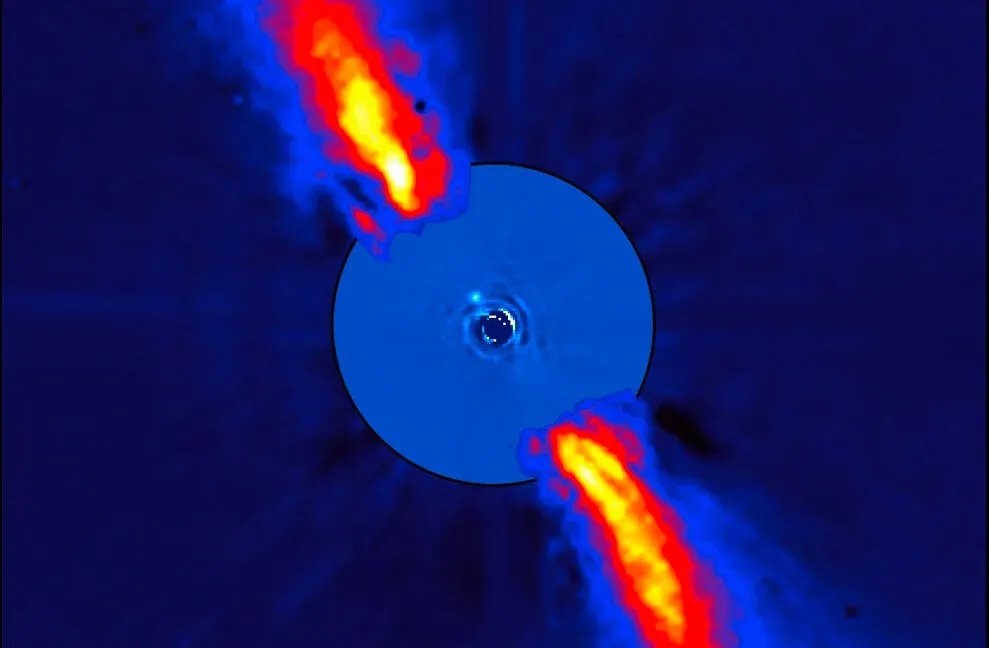
Astronomers have made an intriguing discovery using the James Webb Space Telescope to study a young star called Beta Pictoris. Located about 64 light-years from Earth, this star is approximately 20 million years old and has a vast disk of dust and debris surrounding it.
The researchers, led by Sarah Betti at the Space Telescope Science Institute in Baltimore, used the telescope to search for ice within the disk. They found both water and carbon dioxide ice, with the water ice being glassy rather than crystalline. The presence of these ices is significant because they are mixed together in similar proportions to what is seen in comets within our own Solar System.
Beta Pictoris has been extensively studied by astronomers, who have imaged its disk since as far back as 1984. Its unique orientation allows researchers to observe the disk almost exactly edge-on, making it an ideal subject for studying planetary system development. This debris disk is constantly replenished with dust from collisions between comets and planetesimals.
The presence of water ice in Beta Pictoris' disk suggests that the raw materials needed to form planets with significant water content may be widespread around young stars. This finding could have implications for our understanding of how planetary systems are formed and what conditions might lead to the creation of life-supporting worlds.
Astronomers will likely continue to study Beta Pictoris and its surrounding disk in an effort to gain a deeper understanding of the processes involved in planetary system development. Further research using the James Webb Space Telescope could reveal additional insights into this complex process.
The conditions around Beta Pictoris b are ripe for ice formation. The outer reaches of the planet's disk are far enough from its host star that water and other volatile molecules should freeze into solid ice. However, a large reservoir of carbon monoxide gas in the disk suggests that some mechanism is replenishing it.
This gas would normally be destroyed by ultraviolet light from the star within 50 to 300 years. But for it to still exist, something must be releasing new carbon monoxide into the system. The most likely explanation is that volatile-rich comets are colliding with the planet's disk and releasing their contents.
The properties of Beta Pictoris b itself also hint at its icy origins. According to theoretical models, grains of pure ice would be destroyed by ultraviolet radiation from the star before they could be replenished through collisions. However, mixed ices that contain other molecules should survive longer.
Researchers have been searching for signs of ice in the system but so far have come up empty-handed. Previous searches for water vapor and the characteristic dip in starlight at a wavelength of 3 micrometers have yielded nothing.
Betti and her team used Webb's Near Infrared Spectrograph to observe Beta Pictoris on December 7, 2023. They recorded a full spectrum of light from 0.6 to 5.2 micrometers for every point in the image, then subtracted the overwhelming glare of the star to look for signs of ice.
The team's analysis revealed a striking uniformity in the distribution of water ice features across the disk.
Water and carbon dioxide ices were detected at two spots on opposite sides of the star, each roughly 100 astronomical units out, with both spectra showing signs of these ices.
However, it was not just their presence that was significant but also the shape of the features they produced. The team found that the carbon dioxide features were shifted toward shorter wavelengths and were much broader than those of pure carbon dioxide ice measured in the lab.
This shift and broadening of the features suggest that the carbon dioxide molecules are trapped inside water ice, not sitting as separate grains. This mixing of ices is consistent with models suggesting that such "dirty" ice can survive the star's intense ultraviolet radiation.
The team calculated that there is slightly more than one carbon dioxide molecule for every 10 water molecules in the ice, making up about 11 percent of its composition.
This ratio falls within a range similar to what has been measured in Solar System comets and other newborn stars, suggesting that the ices of Beta Pictoris may have formed through processes similar to those that built up on dust grains in our own Solar System.
The absence of a sharp peak just above 3 micrometers in the spectrum suggests that the water ice at Beta Pictoris is not crystalline but rather amorphous. This type of disordered solid forms when water molecules freeze rapidly and stay that way, sticking to their surroundings without arranging themselves into a regular crystal lattice.
Crystalline ice would have produced a distinct peak in the spectrum, but it was nowhere to be found at Beta Pictoris. The team's analysis revealed that less than 7 percent of the water ice is crystalline, which raises questions about how this unexpected composition came to be.
The prevailing theory had been that debris disks like Beta Pictoris should contain mostly crystalline ice, but it appears that amorphous ice dominates in this system. For amorphous ice to remain stable, it must stay below a certain temperature threshold, around 100 Kelvin or minus 173° Celsius, and avoid interactions with high-energy radiation.
The researchers believe that the icy grains were likely formed in the interstellar medium before they made their way into the Beta Pictoris system.
The discovery of ice in the Beta Pictoris system has significant implications for our understanding of how planets form and evolve. The researchers propose that frequent collisions among planetesimals are necessary to explain the uniform distribution of icy grains throughout the disk.
These collisions would release fresh dust, including previously buried ice, replenishing what is destroyed by starlight. Evidence of such collisions already exists in the form of a curved streak of dust in the southwestern arm of the disk. This debris trail is thought to be the result of a violent collision that occurred relatively close to the star.
The findings support the idea that carbon monoxide gas in the disk originates from colliding icy bodies, and provide an explanation for how ice can persist despite being exposed to ultraviolet light. However, the team was unable to determine the exact amount of crystalline ice present or rule out other molecules that may be hiding within the mixture.
The discovery raises the possibility that primordial interstellar ice is a common ingredient in planetary systems, including our own. If so, this could mean that the raw materials for water-rich planets are more abundant than previously thought, with significant implications for the search for life beyond Earth.
The discovery of water-rich planets could be more feasible than previously thought due to the abundance of raw materials necessary for their formation.
This new understanding would have significant implications for astrobiologists searching for life beyond Earth. The search for extraterrestrial life may need to focus on a broader range of planetary environments, rather than just those with conditions similar to our own.
Facts based on reporting originally published by Ars Technica.
You may republish this story, in full or in part, if you credit Noti Group and link to it (licence CC BY 4.0). Photos are not included.