







Wildfires pose significant threats globally due to human activity
Reduced human activity during 2020 lockdowns led to decreased average fire activity worldwide.
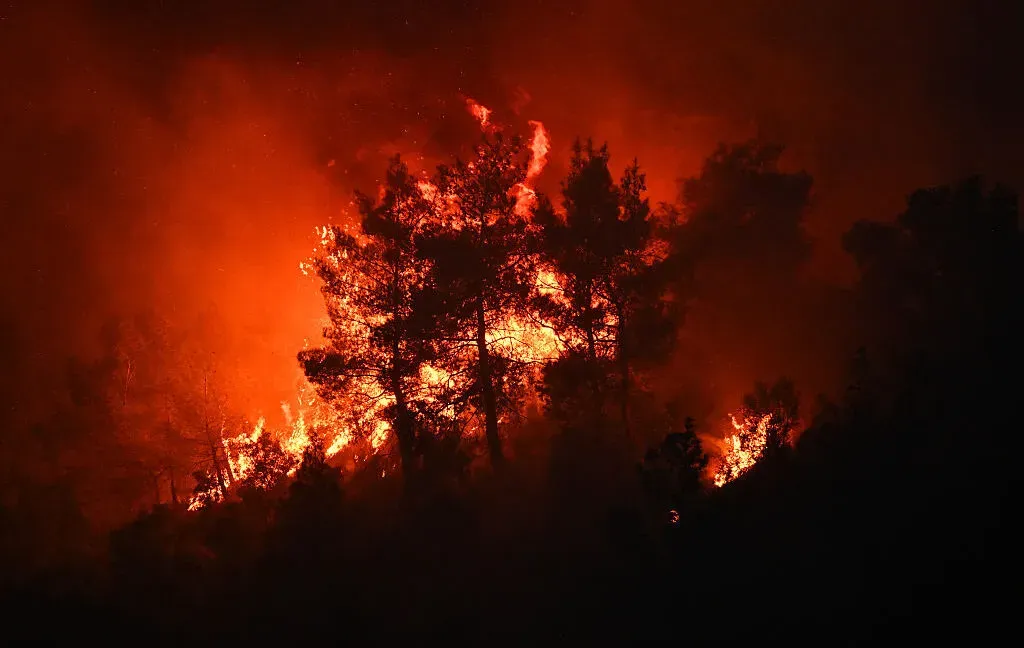
Wildfires have become a global concern, posing significant threats to human life and property. In recent years, Australia's southeastern region was ravaged by massive bushfires that destroyed thousands of homes between 2019 and 2020.
The impact of human activity on wildfires is multifaceted and challenging to quantify due to the interplay of natural and human factors. A study published in Cell Reports Sustainability sheds light on this complex issue by comparing wildfire patterns during the COVID-19 era with other years.
Data from the 2020 lockdowns suggest that reduced human activity led to a decrease in average fire activity worldwide. This observation is particularly striking given the significant disruptions caused by the pandemic, which resulted in widespread shutdowns and changes in daily life.
Wildfires do not occur randomly across the globe; their frequency and severity are influenced by various factors, including geography and climate. Researchers have identified distinct fire regimes that describe when, how often, and with what intensity fires occur in different regions.
Weather conditions play a crucial role in shaping fire regimes. Adequate rainfall can foster the growth of vegetation that serves as fuel for wildfires. However, the moisture content within plants is also a critical factor; dry conditions make them more susceptible to burning, while droughts can render vegetation increasingly flammable.
Weather conditions play a significant role in causing fires, but human activity is also a key contributor.
Human presence outdoors can lead to accidental fires, particularly during dry and sunny periods when vegetation is more prone to burning.
The complexities of human involvement in fire are multifaceted; not only do people unintentionally start blazes, but they also actively work to contain them through firefighting efforts.
Preventative measures, such as clearing flammable materials from an area, can be taken by humans to mitigate the risk of wildfires spreading. However, some methods used for this purpose blur the line between prevention and ignition.
A unique opportunity arose during the COVID-19 pandemic, when lockdowns led to a significant reduction in human mobility across various countries; this provided researchers with a natural experiment to study the impact of human activity on wildfires.
The researchers used a combination of regional lockdown orders and mobile phone location data to define the period of restricted mobility during the pandemic.
Data from NASA's Suomi NPP satellite, which is operated by the National Oceanic and Atmospheric Administration, helped track fires across various regions. The VIIRS sensor on board the satellite detects heat signatures from fires with a spatial resolution of 375 meters, but each large fire can appear as multiple hot spots due to its detection method.
The study compared fire detections during the 2020 lockdown periods with those from the same weeks in 2013-2019. To ensure that weather conditions didn't skew the results, researchers accounted for variations in past years.
Fires decreased by around 12.3 percent in areas under lockdown during the first half of 2020 compared to the recent-past average. The drop in fire detections varied depending on vegetation type, with forests experiencing a decline of about 27.7 percent and grasslands seeing an 8.4 percent decrease.
Weather factors were controlled for in the study to accurately measure human impact on fires. Without adjustments, the estimated decline was only 5.8 percent, which wasn't statistically significant. However, after accounting for weather conditions, the researchers found that humans are a major cause of fires in forests and grasslands.
The decrease in fire detections during lockdowns doesn't necessarily mean humans were responsible for all of it. The researchers found that restricting human activity reduced both the number of fires started and the number put out by people. This opposing dynamic is what led to a net 12.3 percent decrease.
According to Wang, The 12.3 percent figure represents the overall effect, not the direct contribution of humans. He emphasized that the opposing effects of fewer ignition sources and reduced suppression capacity need to be considered when interpreting this number.
In some areas, lockdowns actually led to an increase in fires. This was particularly true for regions with high human mobility during normal times, such as South America, southern Africa, and northeast Asia. Colombia saw a notable 31.4 percent rise in fire activity, followed by India at 25.4 percent and Honduras at 70.7 percent.
The researchers were unable to gather direct evidence explaining why this happened. Instead, they inferred that diminished suppression capacity was likely responsible for the increase in fires. Wang acknowledged that this inference is not a definitive observation, but rather an educated guess based on earlier studies.
One way the researchers analyzed the data was by looking at how fire activity changed as mobility decreased in different countries. In areas with low initial fire counts, the decline followed a linear pattern as mobility fell. However, countries with higher fire counts showed a more gradual increase that plateaued around 27 percent on average.
The varying responses to reduced mobility suggest that different mechanisms were at play, according to the researchers. They believe that fewer ignition sources led to a steady decline in fires, while weakened suppression capacity caused a slower rise. But Wang cautioned that other factors may also be contributing, such as changes in land use patterns.
Human activities were not the sole cause of changes in fire patterns worldwide, as researchers found that areas subjected to prescribed burning saw a significant decline in fires when excluded from analysis.
The study examined 12 countries and discovered that areas where prescribed burning occurred experienced a decrease in fires by about half compared to the average between 2013 and 2019. However, this analysis was complicated by the fact that locations and sizes of prescribed burns shift annually due to fire return intervals and land-management cycles.
When excluding areas subjected to prescribed burning, the decline in fires decreased from 45.3 percent to 27.8 percent in those same countries. This suggests that human activities played a role in the observed changes in fire patterns.
The research's methodology has limitations, particularly its reliance on mobile phone data to track human movement. This may not accurately capture human activity in rural areas where coverage is limited, and the analysis only focused on the first half of each year.
As a result, the study's findings might not fully account for regions where fires occur more frequently during the second half of the year, such as the western United States. The researchers emphasized that this quasi-experimental design provides strong associational evidence but falls short of being a controlled experiment.
The analysis suggests that there is no single ideal policy response to changing fire patterns, and instead highlights the importance of adapting policies to specific regional needs. In areas where fires decreased, reducing accidental ignitions through education and maintaining prescribed burning can be crucial, while in regions where fires increased, addressing reduced monitoring and suppression efforts may be necessary.
The complexity of managing wildfires demands a nuanced approach that takes into account local circumstances. Wang emphasizes that implementing a single, uniform policy is unlikely to be effective.
Fire-risk projections can be improved by considering human behavior, allowing for more accurate predictions even as weather and societal conditions change. This tailored approach can help mitigate the impact of fires in areas where they are increasing.
Facts based on reporting originally published by Ars Technica.
You may republish this story, in full or in part, if you credit Noti Group and link to it (licence CC BY 4.0). Photos are not included.