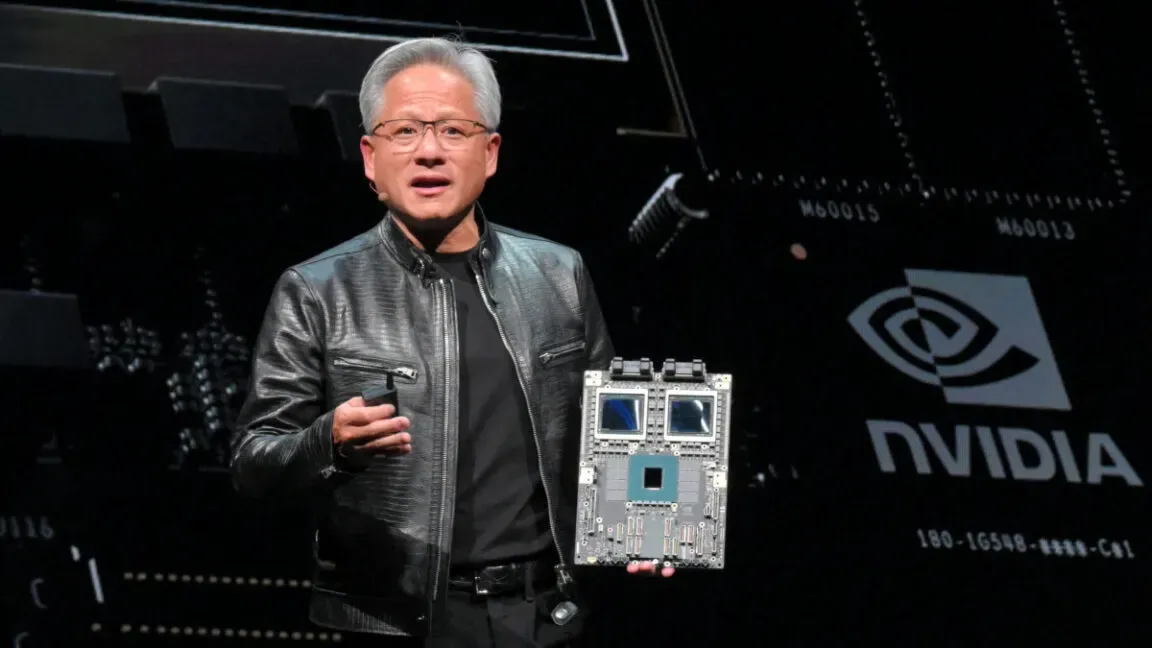








Nvidia's Chief Security Officer Steps Down Amid Controversy Surrounding CEO
The departure of Nvidia's chief security officer David Reber has raised questions about the company's handling of sensitive information, particularly in relation to its dealings with Megaspeed and CEO Jensen Huang's personal life.

Nvidia's chief security officer stepped down in August due to health reasons, or so it seemed at first glance. David Reber, who had been with the company for seven years and served as CSO for four of them, made his departure public on LinkedIn.
His post disclosed that he had been diagnosed with young-onset Parkinson's disease over two years ago, a personal struggle that apparently took priority over his professional role. This was what Reber said in his own words: "This wasn’t a pivot I had planned. But I know what needs to come first: family and health."
The timing of Reber's departure is notable, given the subsequent controversy surrounding Nvidia CEO Jensen Huang's personal life. Just two months after Reber left, Huang himself stepped down amid allegations of extramarital relationships with company employees.
These revelations started with an executive at Megaspeed, a Singapore-based data center company under investigation by U.S. authorities for allegedly funneling Nvidia chips to China. The scope of the scandal widened as reports emerged of two separate affairs involving Nvidia staff.
Nvidia's security team is now in the spotlight, prompting questions about their knowledge and potential concerns regarding the government's scrutiny of Megaspeed and Huang's personal life.
The scrutiny surrounding Nvidia's Megaspeed dealings has raised questions about how the company's security team operates, particularly in relation to its CEO's personal life.
Typically, relationships between executives and employees are handled by HR, legal, and the board of directors, not security personnel. However, security experts warn that even consensual office affairs can be exploited by foreign intelligence services for leverage over an executive who wants to keep it quiet.
The difficulty in identifying potential risks lies in how intelligence services gather information, often through everyday conversations rather than hacking. Retired senior intelligence officer Nicholas Eftimiades has trained over 1,000 corporate security professionals and emphasizes that this method makes it challenging for security teams to spot the signs of espionage.
Some Nvidia employees were aware of the CEO's relationships with colleagues, even if they didn't explicitly break company rules. The New York Times reported earlier in the week that Nvidia's top lawyer was engaged with the government's Megaspeed inquiry more than a year ago, and multiple sources have confirmed that colleagues knew about these personal connections.
The extent to which this information reached Nvidia's security team remains unclear, leaving many questions about how they could have been unaware of the CEO's relationships.
Nvidia's security team may have been constrained by limited resources, despite the company's significant scale and global business partners.
This is a common issue in many organizations, where security teams often struggle to get sufficient funding because their efforts don't directly generate revenue.
Security experts warn that companies frequently define security too narrowly, focusing mainly on protecting facilities and preventing cyberattacks, rather than addressing broader threats.
In reality, security should encompass a wide range of risks, including insider threats, such as foreign intelligence services cultivating executives or employees through suspicious business relationships or attempts to obtain sensitive information.
This narrow focus can leave companies vulnerable to exploitation by those who seek to gather valuable information through trusted personal contacts.
The playbook for intelligence gathering has been around for a while, but what's notable is that China often employs tactics that are more about policy insight than technological espionage. This means understanding who's pushing to change export rules and identifying key players who can facilitate or block these changes.
According to Eftimiades, this approach is particularly relevant when dealing with China, where executives often report being approached by rival intelligence services. He also highlights the phenomenon of diplomats being targeted in hotel rooms, a tactic that has been around since the Soviet era but has evolved over time.
The relationships cultivated between intelligence services and their targets can last for years, rather than weeks or months, making it a more subtle and insidious form of espionage. Eftimiades notes that technology can augment this human intelligence, using devices like IMSI catchers to gather information from mobile phones.
IMSI catchers mimic cell towers, allowing nearby phones to connect to them, and their cost has decreased significantly in recent years. Basic versions can be purchased for around $1,000 and fit into a suitcase, while government-grade models are much more expensive. There have been instances where these devices were used in Chinese espionage operations.
The use of IMSI catchers raises questions about whether they were involved in the alleged hacking of Huang's phone. Given that his device was presumably hardened to detect compromises, it remains unclear whether such technology could have been effective or whether Nvidia's security team had any knowledge of potential threats.
The Nvidia security team's handling of a potential compromise on one of its employees' devices has raised questions about the company's preparedness for cyber threats.
Eftimiades hopes that this incident will serve as a wake-up call for the US industry, which he believes is largely unaware of China's tactics. He estimates that the country has lost trillions of dollars in intellectual property due to these tactics. This lack of understanding and preparedness is evident in the company's response to potential threats.
The security team's actions or lack thereof have sparked debate about their effectiveness in detecting and preventing cyber attacks. It remains unclear whether they were aware of any potential vulnerabilities or if they had taken measures to prevent them. The incident highlights the need for companies to be vigilant and proactive in protecting themselves against cyber threats.
Ultimately, this incident underscores the importance of robust cybersecurity measures and a thorough understanding of potential threats.
Facts based on reporting originally published by TechCrunch.
You may republish this story, in full or in part, if you credit Noti Group and link to it (licence CC BY 4.0). Photos are not included.