







Unexplained Child Deaths in Madhya Pradesh State
At least 32 children have died since May in a cluster of remote villages in India's Madhya Pradesh state, with some as young as three months old.
A series of unexplained child deaths has shaken a cluster of remote villages in India's Madhya Pradesh state. At least 32 children have died since May, with some as young as three months old. The victims were mostly from the Baiga tribe, one of India's most vulnerable communities.
The cause of death is attributed to measles and malaria, possibly exacerbated by malnutrition and delayed treatment. However, officials are still investigating the exact circumstances surrounding each case. Several children suffered from multiple infections, making it harder to pinpoint a single cause.
Sanjay Uikey, who has represented the area since 2013, described the outbreak as unprecedented in his experience. As a former two-term lawmaker and current representative of the region, he has seen his fair share of health crises but nothing on this scale. The sheer number of child deaths in such a short period is particularly alarming.
The villages affected are scattered across remote forested areas of Balaghat district. These regions were once plagued by Maoist insurgency, making it difficult for people to access basic amenities like healthcare. Even today, reaching a health centre can be a significant challenge due to the rugged terrain and lack of infrastructure.
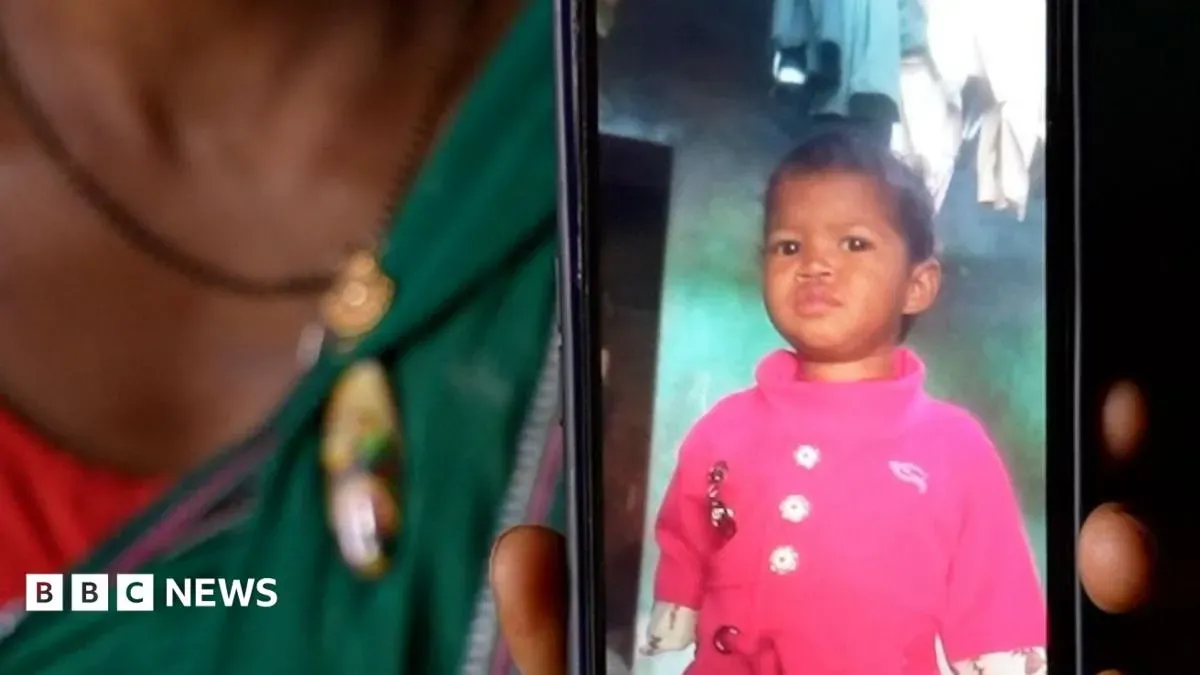
Bamita Markam was just three years old when she died in May. She had been suffering from a high fever and painful sores on her body before succumbing to convulsions. Her mother, Koushila, had taken her to see several doctors and faith healers but none seemed to have any effect.
The symptoms of Bamita's illness were alarming, she vomited blood and was in severe pain. Despite the family's efforts to save her, she passed away before midday. The community is still reeling from the shock of so many young lives lost.
Health officials are scrambling to understand the full extent of the crisis and provide support to affected families. While some progress has been made in controlling outbreaks like measles and malaria, there is clearly more work to be done in these remote areas.
The terrain in these forest villages can be treacherous during the monsoon season, making it difficult for people to travel. The landscape is characterized by narrow dirt tracks that wind through paddy fields and mud homes, often becoming slippery and impassable when heavy rain hits.
Most Baiga houses have low mud walls, rough timber and bamboo structures, and tiled or thatched roofs patched with plastic to protect against the rain. While the countryside is lush and green, the homes are sparse and scattered throughout the forested hills.
Some of these homes can only be accessed by navigating through the muddy tracks, which has been a challenge for doctors investigating the recent child deaths in the area. On a recent visit, our team walked nearly 2km uphill to reach some of the more remote homes, passing by graves of children who had succumbed to illness.
The nearest state hospital is located about 70km away from these villages, and for families without vehicles, reaching it can be a daunting task. They often have to rely on makeshift bamboo stretchers or motorcycles, which can mean losing a day's wages due to the difficulty of navigating through the muddy tracks.
When Bamita fell ill, her family did not take her to hospital because of the heavy rain and difficult terrain. Her mother believes that if they could have taken her to the hospital, she might have survived. The family is now left to cope with the loss of their child.
In some Baiga families, certain illnesses are believed to be caused by a disease goddess who must be appeased through rituals rather than treated medically. For example, when a child falls ill with chicken pox, families may perform a seven to nine-day ritual involving bathing and offering cool water and neem leaves to the local disease goddess. Many believe that treating the patient before completing the ritual could lead to death.
The scale of child deaths in India's forest villages finally began to emerge on 21 July, when village council chief Parshuram Dhurwey received reports of two children dying in the same household in Bondari village.
Dhurwey was shocked by what he heard and decided to investigate further. He called local officials and visited the area, where he found that every other child was sick with fever, rashes, and signs of malnutrition.
Government medical officer Nimish Gautam arrived on the scene and found severely dehydrated children in need of urgent care. The first case he saw was a teenage girl who had been suffering from fever and rash for several days, with alarmingly low blood sugar levels.
Despite Gautam's efforts to persuade her family to take her to a health centre, they refused, fearing that treatment would be fatal. Instead, the health team kept her under observation, and she eventually recovered.
In one village, Dhurwey reported that officials were forced to enter homes and take five seriously ill children to hospital against their families' wishes. Miraculously, all of these children survived.
By this time, it was clear that many children had been dying for weeks, with 10 confirmed fatalities across the four villages in Dhurwey's council - Adori, Kundekasa, Bondari, and Usri.
The symptoms exhibited by the affected children were eerily similar: fever, rashes, weakness, dehydration, and seizures, often accompanied by other conditions like scabies, fungal infections, or bacterial skin infections. In a region where malaria is endemic, it was difficult to pinpoint a single cause of the outbreak.
In Matla village, a six-year-old girl and her four-year-old brother died within two days of each other. Their mother, Mahasingh Parte, had been following the instructions of a faith healer, who told her not to take them to hospital.
The family's circumstances are typical of many in these forest villages. Parte is a landless farm labourer who earns barely enough money to make ends meet - about 200 rupees on a good day. Work is scarce during the monsoon season, and although there is a small primary health centre nearby, Parte has never had reason to visit it.
Poverty and remoteness have created an environment where children are more vulnerable to illness. The family's home is far from the nearest healthcare facility, making it difficult for them to access medical care when needed.
As the number of child deaths increased, investigators struggled to pinpoint a single cause. They collected samples from affected villages on 7 August and sent them for testing.
The results revealed that six out of ten samples tested positive for measles. Measles is a highly contagious infection that causes high fever, cough, runny nose, and red eyes, followed by a rash. In most cases, children recover, but malnutrition can make the disease much more severe, increasing the risk of complications such as pneumonia and dehydration.
The presence of measles in these villages raises concerns about the vulnerability of local children to other infections. Measles weakens the immune system, making it easier for children to contract other diseases. In areas where malaria is common, this can be particularly problematic.
Doctors have cautioned that malaria may not necessarily follow measles, and not every fever or rash is a result of measles infection. Instead, it appears that multiple factors are contributing to the high number of child deaths in these villages.
Malnutrition is a pervasive issue in these forest villages, where children often receive inadequate nutrition. This can be seen in the case of a five-year-old who recently succumbed to measles, weighing a mere 5kg.
Early marriage and motherhood are significant contributors to malnutrition among young girls, many of whom become mothers at an age when their bodies are still developing. This sets off a chain reaction of closely spaced pregnancies, premature births, and low birth weight, making it even more challenging for these young mothers to care for their children.
The nutritional deficiencies in these villages are further exacerbated by the limited variety of food available, with many families relying heavily on rice and lentil soup that lacks essential protein. Studies have consistently shown that Baiga households suffer from widespread nutritional deficiencies due to poor access to public services.
Despite the existence of public health services in theory, the gap between what is promised and what is delivered on the ground is stark. The state response to the crisis was slow, with health teams struggling to reach and persuade families to accept help.
Health workers were eventually deployed door-to-door in affected villages, conducting screenings and treating patients on a massive scale. Mobile medical units equipped with essential equipment like oxygen, nebulisers, and malaria tests visited more than 20 villages.
These mobile units saw an average of over 50 patients per day, about half of whom were children. The teams conducted numerous malaria tests daily, often finding multiple positive cases in the process. This highlights the scale of the crisis that these health workers faced.
In addition to treating patients, vaccination efforts became a key component of the emergency response. Despite official records suggesting high coverage rates, health workers found that many children lacked documentation and families were reluctant to vaccinate their children.
Despite the vaccination efforts, concerns remain about the overall health and well-being of children in these forest villages.
A recent audit by India's Comptroller and Auditor General revealed serious irregularities in the distribution of take-home rations, which are meant to supplement the diets of vulnerable groups such as children under three years old, pregnant women, and lactating mothers. The audit highlighted issues with beneficiary identification, production, transport, and distribution of these essential food supplies.
The villages continue to recover from the outbreak that claimed 32 child lives. Officials report that no new cases have been reported in over two weeks, and medical teams are still visiting villages to provide support and care to affected families. In one village, a medical camp that was once seeing up to 120 children daily is now attending to fewer than ten.
The loss of a child has left many mothers struggling to cope with the emotional toll of their grief. Bamita's mother, who lost her daughter in the outbreak, speaks about the pain of losing a child and the burden of caring for her surviving sibling. She expresses her desire to have more children, but also acknowledges the loneliness that she and her remaining child now face.
Facts based on reporting originally published by BBC News Health.
You may republish this story, in full or in part, if you credit Noti Group and link to it (licence CC BY 4.0). Photos are not included.