




Strait of Hormuz remains a perilous passage for ships due to missile and drone attacks
Captains must weigh up risks and secure war risk insurance before navigating through the strait, according to Steve Cameron.
Traversing the Strait of Hormuz remains one of the most perilous voyages for ships due to the ongoing threat from attacks by missiles and drones.
Despite receiving assistance from the US Navy, vessels are still being targeted during this passage, leaving captains with a daunting decision to make about whether to proceed. According to Steve Cameron, a former merchant navy officer and maritime consultant, captains must weigh up the risks and secure war risk insurance before making a final call on navigating through the strait.
Underwater mines pose another significant threat, which can detonate when detecting an acoustic or magnetic signal from passing vessels, causing a pressure wave that can damage the ship's hull. Mines can also be designed to rise through shallow waters or float towards their targets, further increasing the danger for ships in this region.
Ian McFarlane, a naval architect with French defence group Thales and expert on mine warfare, notes that mines are an inexpensive way of waging war at sea, as demonstrated by the Royal Navy's awareness of this threat.
The shift towards using technology to detect sea mines is becoming increasingly prominent, as the dangers posed by these underwater devices become more evident.
In recent years, autonomous systems have been developed and deployed to monitor the seabed for signs of mine placement, reducing the need for human crews to put themselves at risk. These robotic vessels can operate independently, with minimal personnel required on land to oversee their activities.
The concept of using unmanned vehicles to detect sea mines has been in development for over two decades, with early examples including the Remus 100, a torpedo-shaped robot used by the US Navy during the Iraq war in 2003. Equipped with sonar technology, these robots can scan large areas and operate at depths of up to 100ft without human intervention.
The latest developments in mine-hunting technology are being put to the test in the ongoing conflict in the Gulf, where advanced autonomous systems have been deployed by various forces, including the US military.
The development of autonomous technology in mine-hunting is being driven by the need to reduce the risk of sailors being taken prisoner or injured during operations. According to William Lupton, a naval analyst with Shephard Group, the use of uncrewed vessels has been a significant improvement over traditional methods.
In the event that an uncrewed vessel is captured, Nato navies have measures in place to prevent sensitive information from being compromised. This includes the ability to remotely wipe or destroy computer drives and other sensitive equipment. It is reported that this may have already occurred with the XLUUV seized by Iran.
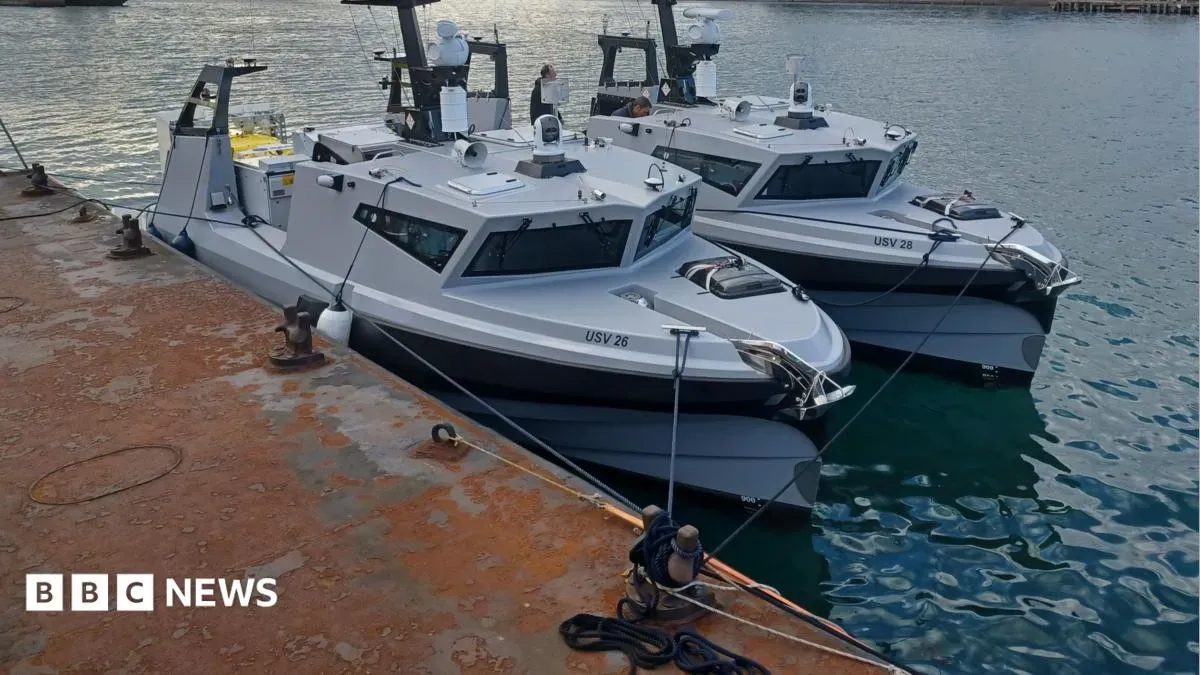
The use of autonomous technology is gaining traction globally, with various countries and organizations investing in its development. A notable example is the partnership between Thales, the Royal Navy, and France's Marine Nationale, which has resulted in the creation of a robot motor launch.
This vessel, known as the Thales Uncrewed Surface Vehicle (USV), features advanced sensors capable of detecting mines via sonar technology originally developed for the oil and gas industries. It is equipped with a 5m long rectangular box that uses high-resolution imaging to create detailed 3D pictures of the seabed, refined by artificial intelligence software.
Steve Prest, associate fellow at the RUSI defence think tank, has been instrumental in introducing uncrewed mine hunting into the Royal Navy's operations.
According to Prest, one of the key advantages of using robot vessels for mine hunting is that it can significantly reduce the risk associated with this type of operation. While it may not be possible to prove definitively that a particular area is free from mines, the use of robots can help identify potential threats and minimize the need for human intervention.
The US has also been investing in uncrewed minehunters, which are capable of either detonating or marking the location of detected mines. This approach highlights the importance of developing autonomous systems that can operate in a range of scenarios and respond accordingly.
Prest believes that the full potential of uncrewed vessels will only be realized when they are integrated into a larger system that allows for seamless sharing of data and coordination between different assets.
The psychological impact of navigating through a potentially mine-laden area is undeniable, according to Neil Roberts, who represents insurers at Lloyd's of London on marine matters.
He points out that even if the US has successfully cleared the Omani route, there remains uncertainty about the extent and location of any remaining mines. This uncertainty contributes to the fear factor, as maritime operators struggle to assess the risk and plan their routes accordingly.
The deployment of robot vessels to detect and neutralize sea mines addresses this problem by providing a more controlled and predictable approach to mine clearance.
Facts based on reporting originally published by BBC News Technology.
You may republish this story, in full or in part, if you credit Noti Group and link to it (licence CC BY 4.0). Photos are not included.