



Mural depicting Tutankhamun and Nefertiti with dark skin removed from Tahrir Square
A 66-metre-long mural in Cairo's Tahrir Square has been painted over amid allegations it revived Afrocentric claims about the Pharaohs' origins.
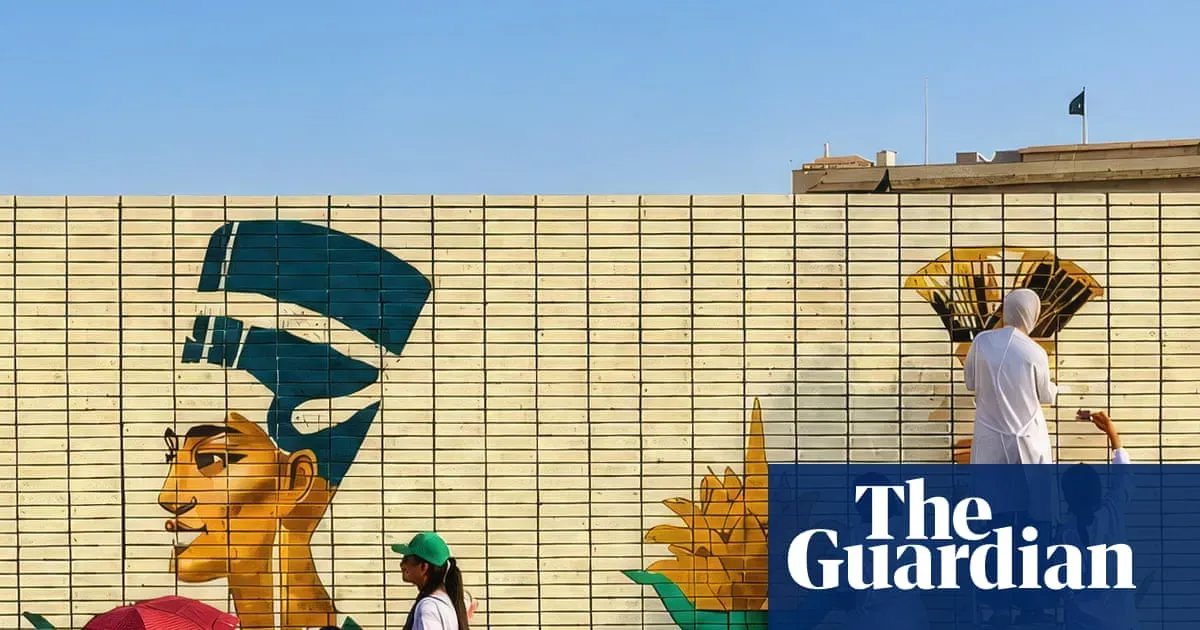
A 66-metre-long mural in Tahrir Square depicting Pharaoh Tutankhamun and Queen Nefertiti has been painted over amid allegations it revived Afrocentric claims about the Pharaohs' origins.
The artwork was one of 40 murals commissioned to beautify Cairo for Chinese president Xi Jinping's state visit last month. The murals were created by volunteer youth group Rasmet Basma, who worked tirelessly to complete the project in just five days in late August.
The mural's depiction of Tutankhamun and Nefertiti with dark skin has sparked a furious reaction among some Egyptians, who see it as an attempt to revive Afrocentric claims about the Pharaohs' origins. This controversy was brewing on social media even before Chinese president Xi Jinping landed in Cairo.
The team behind the mural used AI programme ChatGPT to generate the designs, which were then painted onto the wall by volunteers. The project's founder, Ahmed Moussa, has revealed that the Cairo governorate had asked them to paint over the work just hours before Xi arrived.
Ahmed Moussa, 22-year-old founder of Rasmet Basma, admitted that the team was approached by the Cairo governorate and instructed to cover up the mural. The deputy governor and district head had even visited the site during the project's execution, initially expressing admiration for the murals.
The controversy surrounding the murals on Tahrir Square has taken an unexpected turn as the artist behind them explained their creative choices. According to Moussa, a golden-bronze tone was used to create shadows that made the subjects appear dark-skinned at night.
This revelation has sparked further debate about the accuracy and sensitivity of the artwork. Some critics have accused the artists of not consulting with experts in archaeology or art before creating the murals.
The issue is also being linked to the Afrocentric movement, which asserts that ancient Egyptian civilization was black African in origin and population. This perspective has been a topic of discussion among historians and researchers for years.
Egypt's former antiquities minister, Zahi Hawass, weighed in on the controversy, stating that the volunteers should not have painted a significant site like Tahrir Square without expert oversight. He also dismissed claims linking ancient Egyptian civilization to sub-Saharan Africa as "nonsense.
Several users have expressed skepticism about the accuracy of the murals, with some questioning whether anyone involved had actually studied the depictions of Nefertiti and Tutankhamun in history books or museum exhibits.
Egyptian society has been ethnically diverse throughout history, encompassing various populations from Nubians in the south to Mediterranean communities in the north. According to Monica Hanna, an Egyptologist at the American University in Cairo, this diversity is often overlooked in discussions about ancient Egyptian culture.
The debate surrounding the Afrocentric claims made about Tutankhamun and Nefertiti's depictions has sparked controversy among experts. Hanna dismissed these claims as pseudoscience", emphasizing that Egyptians never had a single skin color. She pointed out that the country is home to diverse populations, from Nubians with darker skin tones to Mediterranean individuals with lighter complexions.
Critics argue that AI tools like ChatGPT can perpetuate misinformation and shape audiences' perceptions of themselves. Walid Mahmoud, an AI researcher and expert in African anthropology, noted that these tools are built by companies outside Egypt and reflect the information most widely shared online, rather than factually accurate representations. He warned against accepting AI-generated content at face value, especially when it comes to cultural identity and heritage.
Art critics also weigh in on the use of AI in creative processes, with Mostafa Eissa advocating for technology to remain a tool, not a decision-maker. By allowing AI to substitute an artist's skill, he fears that originality will be lost, leaving works empty of human touch.
Facts based on reporting originally published by The Guardian World.
You may republish this story, in full or in part, if you credit Noti Group and link to it (licence CC BY 4.0). Photos are not included.