



Jose Mourinho's Early Career as Interpreter Not a One-Dimensional Story
The Portuguese manager's past experience working under Sir Bobby Robson has been overlooked by some fans who mock his early career as an interpreter.
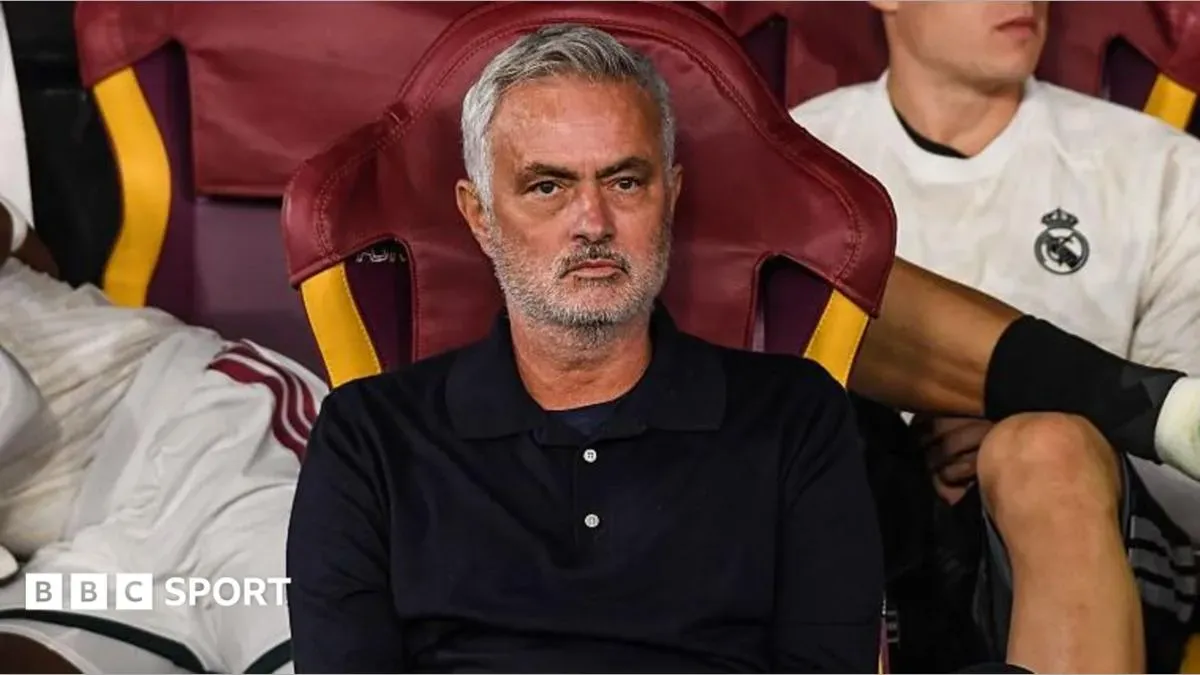
Jose Mourinho's reputation as a master tactician has been on full display in recent weeks, but it seems some fans still can't help but mock his humble beginnings. For Barcelona supporters, the Portuguese manager is often referred to as "traductor" - Spanish for translator - a jab at his early career as an interpreter.
However, Mourinho's past is anything but one-dimensional. He learned his trade while working under Sir Bobby Robson, helping the legendary coach navigate languages and cultures during their time together at Sporting Lisbon and Porto. This experience would eventually lead him to become a manager in his own right, starting with spells at Benfica and later achieving Champions League glory twice.
Mourinho's success is not limited to Europe; he has also won titles in England, Italy, and Spain, showcasing his ability to adapt and thrive in different environments. His tactical acumen has been on display in recent weeks, particularly during Real Madrid's 2-1 win over Barcelona last weekend. This victory showcased Mourinho's willingness to experiment with formations and personnel.
Real Madrid's 4-4-2 shape was a notable departure from their usual approach, with winger Vinicius Jr suspended and Federico Valverde playing at right-back. The absence of the suspended player led to some creative lineup choices, including Bernardo Silva partnering Aurelien Tchouameni in midfield.
The tactical decisions made by Mourinho during this match have sparked praise from observers around the world, but they also raise questions about his reputation as a manager. Is he simply a master of tactics, or is there more to him than meets the eye?
The Real Madrid boss has a reputation for outsmarting his opponents, but is it just clever tactics or something more?
Mourinho's plan to neutralize Pedri involved instructing one of his most hardworking players to mark the Barcelona midfielder closely. This strategy minimized Pedri's impact on the game.
Real Madrid's 4-4-2 formation was designed to counter Barcelona's high-intensity press, with players deliberately drawing opponents towards them in wide areas. This created opportunities for quick switches and impressive dribbling runs.
The tactic paid off when Marc Cucurella found space behind Lamine Yamal on the left flank, allowing Real Madrid to exploit the gap.
Real Madrid's approach to the match against Barcelona was a masterclass in adapting to the opponent's tactics. By running into space behind Barcelona's high line, the team managed to exploit a key weakness in their defense.
Barcelona's tendency to converge around the ball often leaves them vulnerable to counter-attacks. In this instance, Real Madrid's players were able to capitalize on this by creating space and opportunities for scoring.
Mourinho's approach is not one of rigid tactics or fixed positional references, but rather a dynamic system that adapts to the strengths and weaknesses of his team. This more fluid style can make it difficult for opposing teams to prepare effectively.
The idea of tactical periodisation, pioneered by Vitor Frade, underpins Mourinho's approach to football. By considering the interplay between technical, tactical, physical, and psychological aspects of the game, he is able to create a holistic system that gets the best out of his players.
This nuanced understanding of football as a complex system is reflected in Mourinho's ability to adapt his tactics to suit different teams and opponents.
Mourinho's approach to training sessions at Real Madrid has seen a shift towards shorter but more intense exercises that focus on ball control.
Players are also being conditioned to be match fit through ball-related drills, indicating a deliberate emphasis on developing their skills in this area.
This tactical approach is part of a broader trend in football coaching, where some experts advocate for minimizing the impact of chaos during matches while others accept and adapt to its presence.
In contrast to coaches who prioritize maintaining control over the game's flow, Mourinho's background suggests an ability to thrive in situations where teams are forced to respond to unpredictable circumstances.
Mourinho has a proven track record of success at top-tier clubs, having won numerous titles with Porto, Chelsea, Inter, and Real Madrid early in his career.
In recent seasons, a shift has been observed in defensive strategies, with teams increasingly adopting zonal defense, where players block specific areas of the pitch to prevent opponents from gaining an advantage.
This approach allows attacking teams to plan and exploit these blocked zones by moving their players into positions that create numerical overloads on the pitch. However, the rise of man-to-man pressing has disrupted this dynamic, forcing attackers to make quicker decisions under pressure.
As a result, games have become more chaotic, with teams struggling to maintain control and find clear-cut attacking opportunities. This unpredictability may actually suit Mourinho's style of play, which often thrives in high-pressure situations.
The training methods employed by Frade, a team that has worked closely with Mourinho, focus on developing players who can think critically and adapt quickly to changing circumstances. By preparing players to solve problems independently, Mourinho aims to create teams that can perform well even when the game doesn't unfold as planned.
Mourinho's managerial career has been marked by a pattern of returning to previous clubs, often after a significant period of time. He began his tenure at Benfica in September 2025, marking a return to the club that started his managerial journey 25 years prior.
This trend is also evident in his stints at Chelsea and Real Madrid, where he won multiple league titles before leaving and eventually returning to claim more victories. The changing football landscape may be presenting Mourinho with an opportunity for another tactical evolution, one that could potentially mark a departure from traditional possession-based play.
Facts based on reporting originally published by BBC Sport.
You may republish this story, in full or in part, if you credit Noti Group and link to it (licence CC BY 4.0). Photos are not included.