

Colin Kaepernick Speaks Out on Price of Protesting Racial Injustice in Sports
Colin Kaepernick has spoken out about the price he paid for protesting racial injustice and police brutality in sports, ten years after his iconic gesture during a 2016 match.
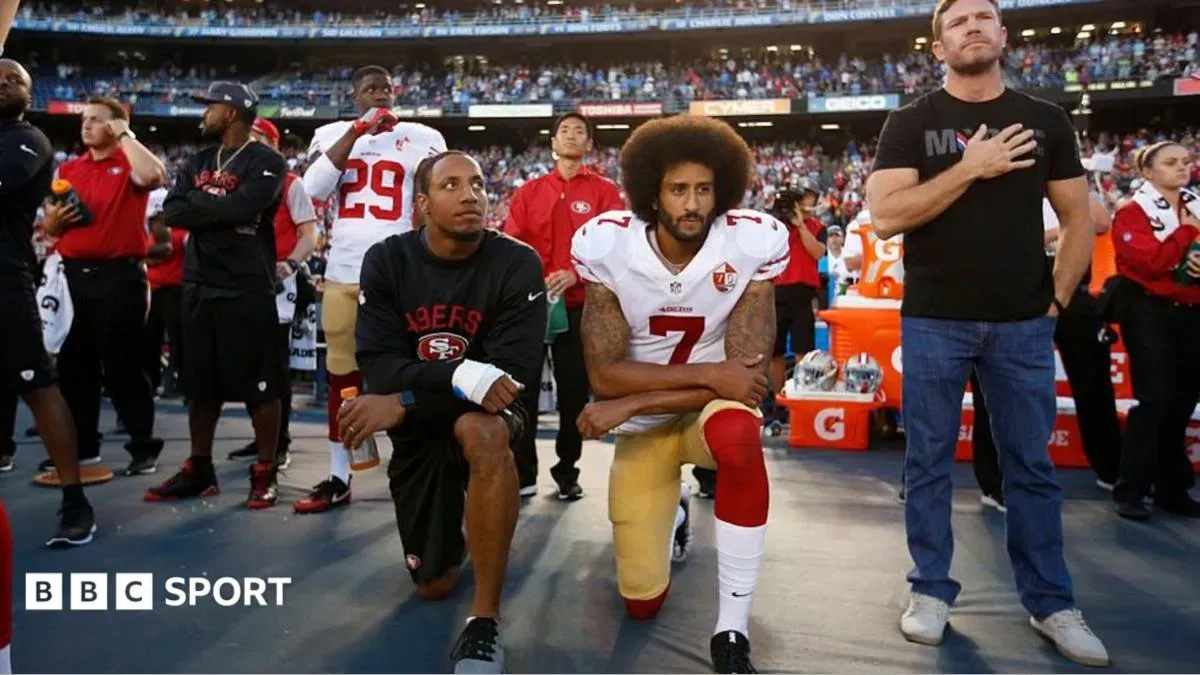
Colin Kaepernick has spoken out about the price he paid for protesting racial injustice and police brutality in sports, ten years after his iconic gesture during a 2016 match.
Kaepernick's decision to kneel during the US national anthem before a pre-season game sparked both admiration and outrage, highlighting the deep divisions within society. The former NFL quarterback has consistently maintained that his protest was peaceful and aimed at raising awareness about systemic issues in the United States.
In an interview with BBC Sport, Kaepernick reflected on the journey he embarked upon, noting that he had anticipated potential repercussions for his career. He acknowledged that history shows athletes who speak out often face serious consequences, citing examples of civil rights leaders like Malcolm X and Martin Luther King Jr., who were assassinated in their fight against racial inequality.
Kaepernick's protest began with sitting during the national anthem before a pre-season game, but he later opted to kneel instead. This move was seen as a bold statement, highlighting his conviction that his stance was not just about football, but about addressing systemic issues that perpetuate racial injustice.
The former quarterback has been vocal about his reasons for protesting, stating that he could not show pride in the US flag when it represented a country that oppressed black people and people of colour. His actions sparked a wave of solidarity among some NFL players, while others condemned him for disrespecting the military.
Kaepernick's decision to kneel during the anthem has had far-reaching consequences, inspiring other athletes to speak out against racial inequality. However, his career in the NFL was ultimately cut short, as he became a polarizing figure who faced intense backlash from fans and team owners.
The impact of Kaepernick's protest extends beyond sports, with many seeing it as a catalyst for increased athlete activism. His stance has been widely debated, with some viewing him as a hero who dared to challenge systemic injustices, while others see him as a troublemaker who disrespected the nation's symbols.
The backlash against Colin Kaepernick's protest was swift and severe. Then-presidential candidate Donald Trump was among those who condemned the quarterback's actions, describing them as "a terrible thing that showed a lack of patriotism. He even went so far as to suggest that players who refused to stand for the national anthem should be fired.
The National Football League (NFL) also took steps to quash the protest, announcing that it would fine teams whose players did not stand for the anthem. This move was seen by some as an attempt to stifle dissent and maintain a sense of unity among the league's fans and players.
Despite the pressure, Kaepernick continued to speak out against systemic injustices. He opted out of his contract with the 49ers in March 2017, citing concerns about the team's management and the NFL's handling of player protests. The move was seen by some as a strategic decision, but others believed that he would have been released regardless.
Kaepernick's decision to sit out the rest of the season was a bold one, given his impressive track record on the field. He had led the 49ers to the Super Bowl in 2013 and thrown 16 touchdowns in his final season with the team. Yet despite his talent, he struggled to find a new team after leaving San Francisco.
Looking back on the experience, Kaepernick says that he anticipated some of the backlash against him, but not the level of support he received from others. What I couldn't have predicted was the people who would show up for me in significant ways," he reflects, "and also the people who worked against me and against the movement."
Kaepernick's decision to file a grievance against NFL team owners was seen by some as a last resort. He believed that they had conspired not to hire him because of his protests, and he sought financial compensation for what he saw as a form of retaliation. In 2019, he reached a settlement with the league.
The controversy surrounding Kaepernick's protest eventually led the NFL to acknowledge its mistakes. The league admitted that it was "wrong for not listening to players earlier" and encouraged all players to speak out against injustice. However, by then, hopes of a comeback for Kaepernick had long since faded.
The gesture of taking a knee during matches has become a familiar sight in football stadiums across the UK. However, it's not just the players who have been protesting against racism - national teams from around the world, including England's men's and women's teams, have also followed suit.
For Colin Kaepernick, this widespread adoption of his protest is a welcome development. He notes that seeing other countries' national teams take part in similar actions was a humbling experience for him. The fact that players are now actively calling out racism and taking steps to address it is something he is excited about.
Despite the progress made, there's still much work to be done in tackling racism not just in the UK but globally. Kaepernick acknowledges this reality, stating that it's a collective challenge that requires ongoing effort from individuals and organizations alike. The fact that players are willing to take action towards addressing this issue is a positive step forward.
Kaepernick has maintained a relatively low profile over the past decade, but his influence on the civil rights movement remains significant. However, recent surveys suggest that athlete activism may have lost some momentum in recent years. This is reflected in the declining number of players who choose to take a stand against racism.
The No Room for Racism campaign, which took place last October, saw several Premier League players remain standing when their teammates took the knee. While this gesture still has value in raising awareness about structural inequalities, some may view it as a sign that the pace of change is too slow. Reports of discrimination received by anti-discrimination charity Kick It Out have more than doubled over the past five years.
Kaepernick believes that now more than ever, protests are necessary to bring attention to social injustices. He attributes the decrease in activism to concerted efforts from organizations and corporate entities to undermine these movements. This includes actions taken by the NFL and the Trump administration, which he feels have contributed to the decline of athlete activism.
The fight against racism is far from over, and Kaepernick's comments serve as a reminder that ongoing effort is required to address this issue. His message emphasizes the need for continued action and awareness-raising efforts in order to create meaningful change.
Kaepernick's stance on taking a political stand in sport has been met with fierce opposition over the years.
Critics have accused him of using his platform to promote the Black Lives Matter movement, rather than simply advocating for racial equality and justice within the sports world.
This criticism reached a boiling point in 2018 when Nike featured Kaepernick as the face of an advertising campaign, which sparked widespread backlash and calls to boycott the brand.
Some opponents even went so far as to encourage people to destroy their Nike merchandise in protest.
The use of Kaepernick's image by Nike was seen as a powerful statement that blurred the lines between sport and politics.
Kaepernick has made appearances at several high-profile sporting events in recent years, including golf's Ryder Cup and the finals of football's Club World Cup and World Cup. He was also booed by crowds when attending the NBA Finals in New York in June.
His presence at these events often sparks controversy, with some viewing it as a calculated move to gain favour and popularity. According to Kaepernick, this raises important questions about the role of politics in sports.
Fifa's decision to award its inaugural 'Peace Prize' to US President Donald Trump last year was widely criticized, including by Kaepernick. He described the move as "regrettable" and highlighted the need for athletes to speak out against injustice.
When attending sporting events, Kaepernick is often met with boos from the crowd. This, he believes, reflects the strong feelings of opposition towards him in some quarters. It also underscores the complex and often fraught relationship between sports and politics.
Kaepernick has spoken about the personal journey that led up to his decision to kneel during the national anthem. In his memoir, The Perilous Fight, he recounts growing up as a black man adopted by a white family and encountering racism from an early age.
The book provides a detailed account of Kaepernick's childhood, education, and evolution into the athlete and activist he is today. He hopes that by sharing his story, others will gain valuable insights and be inspired to take action.
Kaepernick remains committed to using his platform to promote social justice and support community organizations through his Know Your Rights campaign.
Kaepernick's impact on modern history cannot be overstated, as his use of the platform to promote change has left an indelible mark.
His actions have been likened to those of Muhammad Ali, who famously spoke out against the Vietnam War, and Tommie Smith and John Carlos, who gave the Black Power Salute at the 1968 Olympics. This comparison is a testament to the significance of Kaepernick's protest.
The simplicity of his principle - building a society that works for everyone - has been lost in the complexities of modern issues. In the US, there is still much work to be done to address people's needs and create an equitable society.
Ultimately, it will take collective effort from individuals and institutions to move forward as a society and address the inequalities faced by many.
Facts based on reporting originally published by BBC Sport.
You may republish this story, in full or in part, if you credit Noti Group and link to it (licence CC BY 4.0). Photos are not included.