







Investigation into Ownership of Traditional Textile Designs in India Launched
A young man's discovery in India has sparked an investigation into the ownership of traditional textile designs after he noticed a lack of originality among scarves on sale.
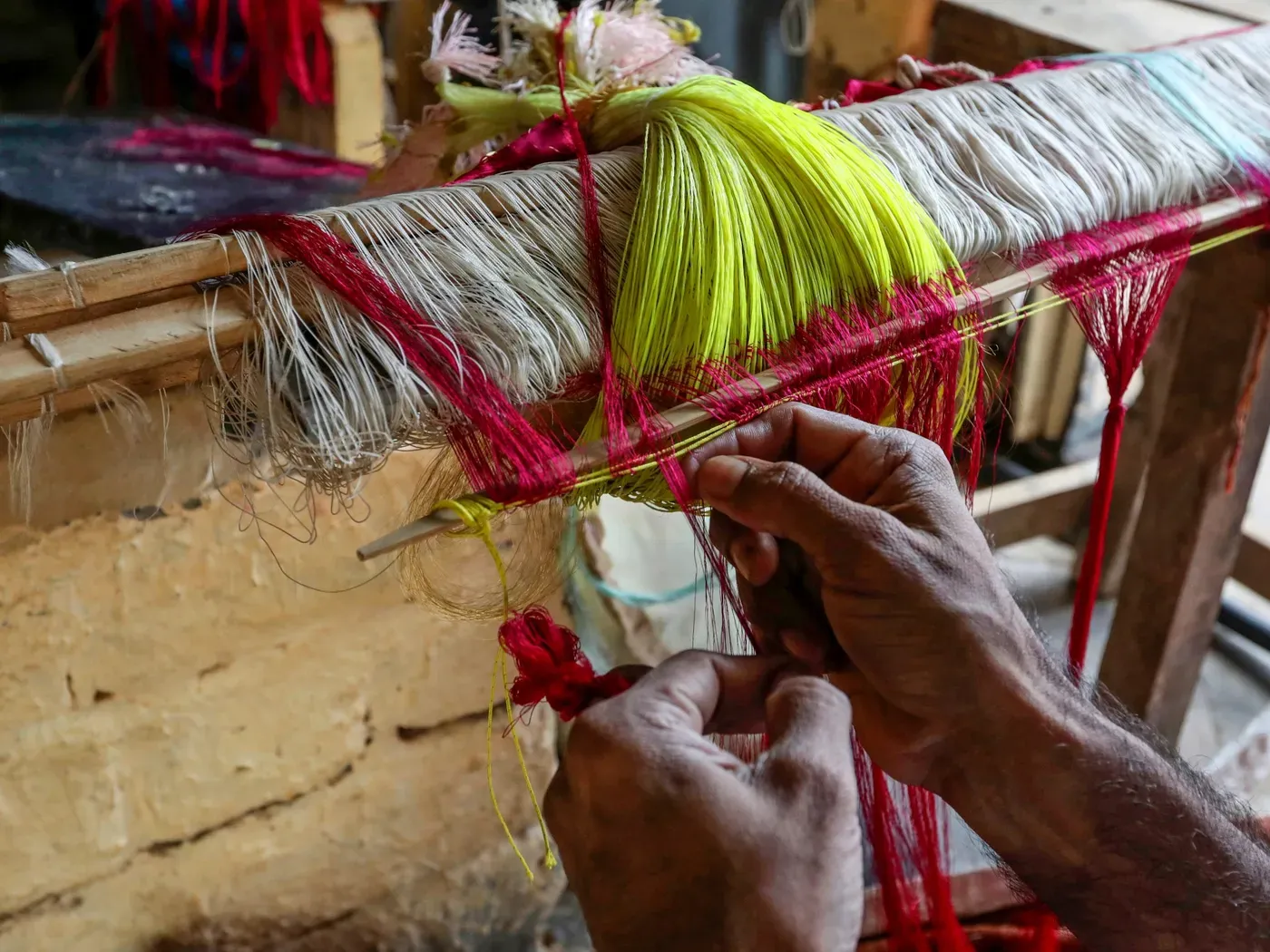
A young man's discovery in India has sparked an investigation into the ownership of traditional textile designs in the country.
Bitupan Deka was out shopping for a "gamusa" (traditional scarf) in Meghalaya when he noticed something unusual about the patterns on display. Every shop selling the scarf had the same limited number of designs repeated over and over, raising questions about the role of traditional weavers in creating these iconic motifs.
Deka's investigation revealed that weavers in Sualkuchi, a district in neighboring Assam state, are paid a one-time fee for each design they develop. This fee is roughly 2,000 rupees ($21), and weavers are not entitled to royalties on their work. Manufacturers have been cutting down the number of designs produced by weavers as a cost-saving measure.
This discovery prompted Deka, an assistant professor of computer technology at MIT University in Shillong, to create a system that can generate infinite new designs for fabrics. The system is intended to be a tool for traditional designers, allowing them to create new and modern motifs more easily.
Deka's goal is not to replace traditional designers, but rather to provide them with a means of creating variety for consumers. He hopes that his system will become a valuable resource for the textile industry.
Traditional textile designs in India carry significant cultural and historical significance. Patterns and motifs are often inspired by local mythology and history, and weavers inherit these designs through generations of tradition.
The process of creating traditional textiles is labor-intensive, involving the use of locally available colors and materials to paint intricate patterns onto fabrics. Weavers do not simply reproduce existing designs; they imbue them with their own unique perspective and understanding of their cultural heritage.
Deka's system has the potential to democratize access to traditional textile design, allowing weavers and manufacturers to collaborate in new ways and create innovative products that honor India's rich cultural traditions.
The use of AI in textile design has reached new heights with Deka's system, which can replicate traditional patterns with ease.
However, this has raised concerns about the ownership and authenticity of India's rich cultural heritage. The Rekh Sanganeri Dataset is another example of a digital platform that aims to preserve hand-block printed Sanganeri textiles from Rajasthan.
This dataset includes high-resolution images of printed patterns, annotated down to intricate details such as ink bleed and slight misalignment. These imperfections are what give handmade work its unique character.
But there's a catch: while these tools were designed to preserve traditional crafts, they're also making it easier for others to reproduce these designs digitally without involving the artisans themselves.
Dinesh Chhipa, a Bagru designer and textile businessman from one of India's oldest artisan families, has mixed feelings about this development. He acknowledges that digital technology can fill the gap in production speed, but warns against borrowing regional names like Bagru and Jaipuri for commercial gain.
India has been digitizing its textile memory for years, with initiatives such as the Botanical Survey of India's historical collections and the national portal Bharatiya Vastra Shilpa Kosh.
India's textile traditions are at risk of disappearing without proper documentation, but digitization offers a solution that could also be used by AI systems to reproduce these crafts on a large scale.
At the India AI Impact Summit in New Delhi earlier this year, Tata Consultancy Services showcased Bridgital Loom, an AI system that converts textile designs into instructions for a loom. The system uses LED lights to guide weavers through intricate patterns named after their origins in cities like Banarasi and Kanchipuram.
TCS claims that the technology allows weavers to execute complex designs faster and with fewer errors, serving as a bridge between artisans and technology. A pilot project is currently underway at Kanchipuram, a town in southern Tamil Nadu state, where the system is being tested.
The head of AI strategy at Bridgital Loom, Muthulakshmi Nellaiappan, noted that it takes more than 15 years for a weaver to master their craft. However, she believes that technology can speed up this process significantly, enabling younger weavers to become masters much sooner.
With the help of AI, the traditional master-apprentice hierarchy in textile knowledge systems is being disrupted. Weavers no longer need to conceptualize or remember patterns and codes; instead, they follow machine instructions, ceding creativity and memory to artificial intelligence.
TCS has ensured that its system can work with both electronic and non-electronic looms, including handlooms, in order to scale up the technology. However, this raises questions about who owns culture when it is reduced to plain data.
For centuries, India's rich textile heritage has been an integral part of the country's cultural identity, with intricate designs and patterns that have been passed down through generations of artisans. This knowledge was never formally documented or patented, existing instead as a collective memory within communities.
As a result, Indian textiles like Kanchipuram sarees and Banarasi fabrics have become synonymous with traditional craftsmanship, but their origins are often shrouded in mystery. The names of these textiles evoke the places they originated from, rather than being mere products of mass production.
However, this knowledge is now being fed into artificial intelligence (AI) systems that can generate designs at an unprecedented scale and speed. For designers and manufacturers, the possibilities offered by AI are tantalizing: motifs can be combined with ease, colors changed instantly, and thousands of designs created in a matter of seconds.
The machine's ability to churn out designs has sparked concerns about the future of traditional artisans like Ananthalakshmi Vadivel, who runs a family business in Kanchipuram. She notes that her venture is already facing stiff competition from cheaper electronic loom-produced sarees.
While AI may be able to replicate traditional designs with remarkable accuracy, it raises questions about ownership and authorship. Who gets paid when an AI system creates a textile design that draws on centuries-old traditions? The answer lies in the complex web of intellectual property laws, which are struggling to keep pace with the rapid advancements in technology.
In December 2025, the Indian government introduced a blanket licence for AI developers to train their models on copyrighted material without seeking permission from each rights holder. However, this system assumes that every work has a single author or originator, which is not always the case with traditional motifs and designs.
The communal nature of these designs poses a significant challenge for intellectual property laws, which are based on the idea of individual ownership and authorship. As AI continues to play an increasingly prominent role in the textile industry, it remains to be seen who will benefit from its creations, the artisans who have passed down their knowledge through generations or the companies that own the AI systems.
The rights to traditional textile designs in India remain unclear as AI-enabled mass production gains momentum. With multiple parties involved in creating digital datasets and tools, it's uncertain who should receive royalties or copyright credits. The artisan behind a design may not be acknowledged on product labels, leaving them without recognition.
In an effort to modernize the handloom sector, the government is setting up an AI-handloom research department at the Indian Institute of Technology (IIT) in New Delhi. This $1.4m facility will combine traditional weaving techniques with contemporary technology to boost India's handloom industry.
Thousands of weavers are set to be registered and equipped with sensors that convert weave patterns into digital data. QR-coded tags will also be issued to track the origin of each piece, making it harder for artisans to be overlooked in the production process.
This initiative aims to bring more transparency to the textile industry by tracing the origins of each item. By doing so, artisans may gain greater recognition and their work could be valued as an archive.
In recent years, traditional textiles have been rebranded as contemporary art pieces in galleries around the world. The value of these items has increased accordingly, with some artists now showcasing their textile-based work internationally.
Artists like Gurjeet Singh from Chandigarh city are using discarded fabrics to create sculptures that explore complex social issues such as gender and identity. This new perspective on traditional textiles is gaining traction in art circles worldwide.
In London, artist Sayan Chanda uses cut and rewoven vintage quilts to challenge fixed notions of cultural belonging. Meanwhile, artist Sumakshi Singh from Gurugram is reconstructing the remnants of vanished homes and gardens through delicate embroidery and suspended thread structures.
In an effort to preserve India's rich textile heritage, a recent art show in New Delhi showcased the work of 20 artisans and craft-led collectives who are keeping traditional crafts alive through their innovative interpretations.
The curator of the exhibition, Aparupa Ray Ganguly, aimed to present these traditional crafts as living practices that continue to evolve with each new generation of artisans. This approach is evident in the case of Kanmai Payun, an Assamese weaver who is the last practitioner of Fulor Saneki, a unique flower pattern used by her community.
However, the increasing value of textiles in art galleries has not necessarily led to greater recognition or control for their makers. In fact, artisans are often missing from exhibitions and events that feature their work, highlighting the issue of traditional textiles being aestheticized without acknowledging the people who created them.
This trend was evident at a recent exhibition titled No 'One' Maker, where artisans were absent from the show's preview, leaving only the mass-produced products to be showcased.
Facts based on reporting originally published by Al Jazeera.
You may republish this story, in full or in part, if you credit Noti Group and link to it (licence CC BY 4.0). Photos are not included.